IDC Meaning: Definition, Context, Examples, and Modern Usage (2026 Guide)
You open your phone after a long day and see a friend text, “IDC, do whatever you want.” At first, it looks simple. But is your friend relaxed, annoyed, or quietly upset? That small three-letter abbreviation can carry more emotion than its letters suggest. IDC meaning in text is usually “I don’t care,” but the real message depends heavily on context, punctuation, the relationship between the people, and the conversation that came before it.
People are searching for this abbreviation because texting has become increasingly short and informal. Acronyms such as IDC, IDK, IMO, TBH, and WYD appear in texts, comments, DMs, and online conversations every day. Younger users may recognize them instantly, while someone unfamiliar with internet slang can easily misunderstand the tone.
The good news is that IDC isn’t complicated once you know what to look for. In this guide, we’ll cover its basic definition, social meaning, examples, emotional tone, platform usage, and situations where it’s better avoided.
Quick Answer / Quick Definition of “IDC Meaning in Text”

IDC meaning in text is usually “I don’t care.” People use IDC in texting, DMs, comments, and casual online conversations to show that something doesn’t matter to them, they have no preference, or they don’t want to discuss it. Depending on context, it can sound relaxed, indifferent, dismissive, or irritated.
Detailed Meaning Breakdown
Primary Meaning
The primary meaning of IDC is “I don’t care.”
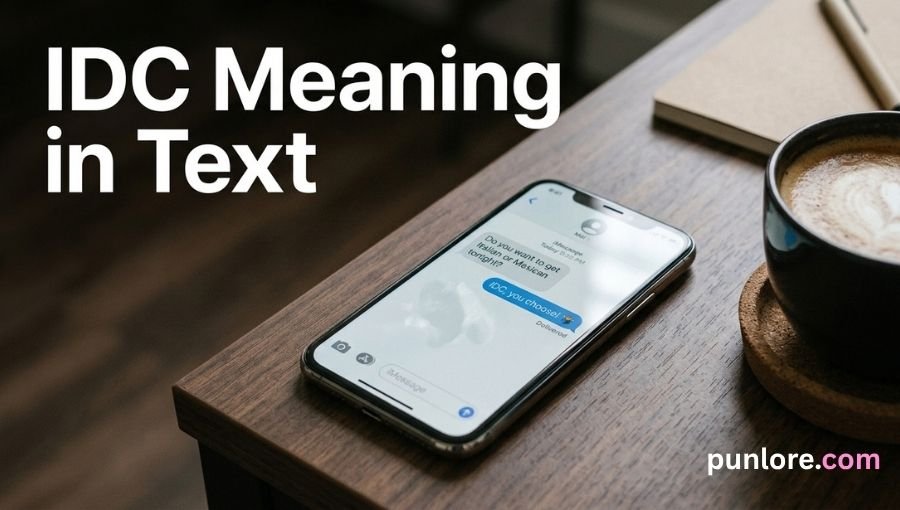
It’s a shortened form designed for fast, casual communication. Someone might write it when they genuinely have no preference:
“Pizza or burgers?”
“IDC. You choose.”
Here, IDC is fairly neutral. The person is leaving the decision to someone else.
The important detail is that “I don’t care” doesn’t always mean “I dislike this.” It can simply mean the subject isn’t important enough to have a strong opinion about.
Secondary Meanings
The phrase can also communicate indifference.
For example:
“IDC what movie we watch.”
This may mean, “Any movie is fine with me.”
It can also suggest emotional distance:
“IDC anymore.”
That version usually carries more weight. It may signal frustration, disappointment, or exhaustion rather than simple neutrality.
In my experience, the words around an abbreviation often tell you more than the abbreviation itself.
Rare or Misinterpreted Meanings
IDC is not normally a secret code with a completely different standard definition in everyday texting. However, context can change its emotional meaning.
A short “IDC” after an argument may sound cold or defensive. The same three letters in a discussion about dinner may be perfectly friendly.
That’s why translating IDC word-for-word isn’t enough. You need to interpret the surrounding conversation.
What “IDC Meaning in Text” Means in Different Contexts
In Texting and Messaging
In ordinary texting, IDC is mainly used to express a lack of concern or preference.
For example:
“Which restaurant should we go to?”
“IDC, pick one.”
The speaker isn’t necessarily annoyed. They may simply be happy for the other person to decide.
Compare that with:
“Why did you tell everyone?”
“IDC.”
That response can feel dismissive because the topic is emotionally sensitive.
When someone asks about IDC meaning in text, this difference is usually the key point: the same abbreviation can be neutral or negative depending on context.
On Social Media Platforms
IDC appears across Instagram, Snapchat, TikTok, and Threads, but its tone can vary with the format.
On Instagram, someone might comment, “IDC what anyone says—I love this outfit.” Here, IDC emphasizes confidence or personal preference.
On Snapchat, it can be much more conversational: “IDC lol, send whatever pic you want.”
On TikTok, creators may use IDC in captions to sound bold, playful, or unconcerned: “IDC, I’m posting it anyway.”
On Threads, the abbreviation may appear in short opinions or debates, sometimes giving a statement a blunt edge.
The platform matters less than the surrounding words. A laughing emoji can soften IDC, while a period can make it feel firmer.
In Dating and Relationships
In romantic conversations, IDC deserves extra attention.
If someone says:
“IDC which movie we see ❤️”
they may genuinely be flexible.
But:
“IDC about your opinion anymore.”
is much more serious. It can signal hurt, anger, or emotional withdrawal.
In relationships, people sometimes use IDC as a defense when they actually do care but don’t want to show vulnerability. Don’t automatically assume that’s happening, though. The broader conversation should guide your interpretation.
In Professional Communication
IDC is generally too informal for workplace communication.
A coworker writing “IDC which version you use” might intend to say they have no preference. Still, the message can sound careless.
A safer professional alternative is:
“Either version works for me.”
Or:
“I don’t have a preference.”
This matters especially in emails, client messages, applications, and communication with managers. Casual slang can create an unnecessarily dismissive impression.
Cultural or Regional Differences
IDC is widely understood in English-language internet communication, particularly among people familiar with texting slang.
Age can make a bigger difference than geography. Frequent social-media users are more likely to recognize it immediately, while someone who rarely uses online abbreviations may read the letters literally or ask what they mean.
The emotional interpretation can also vary by communication style. Some people consider blunt language normal; others see it as rude.
Tone, Psychology & Why People Use It
Why People Use It & What It Signals Socially
The main reason people use IDC is speed. Typing three letters is easier than typing “I don’t care.”
It can also create an informal, relaxed style. Friends often use abbreviations because they don’t need every message to sound polished.
IDC may signal:
- No preference
- Lack of interest
- Emotional distance
- Confidence
- Frustration
- A desire to end a topic
The meaning depends on the social situation.
Emotional Layer Behind It
A friendly IDC might look like:
“IDC where we eat 😂”
A neutral version might be:
“IDC which one you choose.”
A colder version could be:
“IDC. Do what you want.”
The final example feels different because the punctuation and wording add emotional weight. When interpreting IDC meaning in text, tone markers such as “lol,” emojis, punctuation, and previous messages can make a major difference.
10 Real Conversation Examples (Explained)
1. Choosing Dinner
Message: “IDC, you pick the restaurant.”
Meaning: The person has no preference.
Tone: Neutral and relaxed.
Likely interpretation: They’re giving you the choice.
2. Ending an Argument
Message: “IDC anymore.”
Meaning: The speaker feels finished with the discussion.
Tone: Frustrated or emotionally tired.
Likely interpretation: They probably don’t want to continue.
3. Making Plans
Message: “IDC what time we leave.”
Meaning: Any reasonable time works.
Tone: Casual.
Likely interpretation: You can choose the time.
4. Responding to Gossip
Message: “IDC what she said.”
Meaning: The speaker claims not to care about the person’s comments.
Tone: Potentially defensive.
Likely interpretation: They want to dismiss the gossip.
5. Social Media Confidence
Message: “IDC if they don’t like my post.”
Meaning: The poster isn’t concerned about criticism.
Tone: Confident.
Likely interpretation: They’re standing by their choice.
6. A Sensitive Question
Message: “IDC who you went with.”
Meaning: It could mean genuine lack of concern.
Tone: Potentially cold.
Likely interpretation: Context is needed, especially in a relationship.
7. Friendly Flexibility
Message: “IDC lol, both games are fun.”
Meaning: Either option is enjoyable.
Tone: Friendly.
Likely interpretation: No strong preference exists.
8. A Heated Conversation
Message: “IDC. Believe whatever you want.”
Meaning: The speaker wants to stop defending their position.
Tone: Irritated.
Likely interpretation: The conversation may be escalating.
9. Group Planning
Message: “IDC where we meet.”
Meaning: Location isn’t important to the sender.
Tone: Neutral.
Likely interpretation: Someone else can decide.
10. Emotional Withdrawal
Message: “Honestly, IDC anymore.”
Meaning: The speaker may have become emotionally detached.
Tone: Serious and possibly hurt.
Likely interpretation: There’s probably more behind the statement than simple indifference.
Where Misunderstandings Happen
Context Confusion
The biggest problem is assuming IDC always means the same thing.
“I don’t care” can mean “either option is fine” or “I’m upset and don’t want to talk.” Look at the subject, previous messages, and punctuation before deciding.
Generational Gap
Older users or people who don’t spend much time texting may find IDC abrupt. Younger users who regularly use internet slang may see it as completely ordinary.
Neither interpretation is automatically correct. Communication habits differ.
Platform Differences
A playful TikTok caption can make IDC feel confident or humorous. The same abbreviation in a serious private conversation may feel dismissive.
Always consider where the message appears and who wrote it.
Similar Words, Symbols, or Abbreviations
| Term | Meaning | How It Differs from IDC |
|---|---|---|
| IDK | I don’t know | Shows uncertainty rather than indifference |
| IMO | In my opinion | Introduces a personal view |
| TBH | To be honest | Signals straightforwardness |
| NVM | Never mind | Often withdraws or dismisses a previous point |
| Whatever | Any option is acceptable | Can sound more dismissive |
| IDGAF | I don’t give a f*** | Much stronger and more vulgar |
| I don’t mind | No strong preference | Usually softer and more polite |
| Meh | Mild lack of enthusiasm | Often suggests boredom or weak interest |
When Not to Use “IDC”
Professional Risks
Avoid IDC in formal emails, job applications, client conversations, and important workplace discussions.
Even when your intention is harmless, it may sound as if you’re uninterested in the task.
Cultural Risks
Not everyone interprets abbreviations the same way. If you’re communicating with someone unfamiliar with texting slang, spelling out your meaning is safer.
Tone Risks
IDC can become harsh when used alone.
If you mean “either option works,” say exactly that. Clear wording prevents a neutral message from sounding irritated.
Expert Tips for Using “IDC” Correctly
- Use IDC with close friends when casual language is already normal.
- Add “lol” or an emoji when appropriate to soften a playful message.
- Don’t use IDC when a person is sharing something emotionally serious.
- Consider whether “I don’t mind” better communicates your intention.
- Read the conversation before assuming someone is being rude.
- Avoid IDC in formal workplace writing.
- Don’t use it during an argument if you actually want the other person to understand your feelings.
- Remember that punctuation can change the perceived tone.
- If someone seems offended, clarify what you meant instead of doubling down.
- When in doubt, write the full phrase.
Frequently Asked Questions
What does IDC mean in text?
IDC usually means “I don’t care.” It’s a common texting abbreviation used to express indifference, lack of preference, or a desire not to focus on a particular subject. Its emotional tone isn’t fixed, though. Depending on the conversation, it can sound casual, neutral, confident, dismissive, or annoyed.
Is IDC positive or negative?
IDC can be either positive, neutral, or negative depending on context. “IDC which restaurant we choose” is usually neutral. “IDC about you anymore” is much more negative and emotionally serious. The surrounding words, punctuation, relationship, and subject matter help determine what the sender actually intends.
Can IDC be used romantically?
Yes. Romantic partners may use IDC casually when they have no preference, such as choosing a movie or restaurant. However, IDC can sound especially cold during emotional conversations. If someone sends it after discussing trust, feelings, or conflict, don’t assume it means simple indifference without considering the larger conversation.
How should I respond to IDC?
Your response should match the situation. If someone says, “IDC where we eat,” simply choose a place. If they say IDC during an argument, ask a calm question such as, “Do you mean you don’t want to talk about it right now?” That gives them an opportunity to clarify their emotional meaning.
What does IDC mean on Snapchat?
On Snapchat, IDC generally still means “I don’t care.” Because Snapchat conversations are usually informal, the abbreviation may sound playful or casual. Snaps, captions, emojis, and the sender’s relationship with you can change the tone. A message such as “IDC lol” is generally softer than a standalone “IDC.”
Does IDC mean the person is angry?
Not necessarily. A person can use IDC simply because they have no preference. Anger becomes more likely when the abbreviation appears after an argument or with phrases such as “do whatever you want.” Context matters more than the abbreviation itself.
What’s the difference between IDC and IDGAF?
Both express a lack of concern, but IDGAF is much stronger. It contains profanity and often communicates deliberate bluntness or defiance. IDC is comparatively mild and can be used casually among friends. In professional or sensitive situations, neither is ideal, but IDGAF carries considerably more risk.
What does IDC mean when a girl or guy texts it?
The abbreviation doesn’t have a special male or female meaning. Whether a girl, guy, friend, partner, or coworker uses IDC, it generally means “I don’t care.” The important clue is the conversation around it. Their relationship with you and the emotional context are more useful than their gender.
Final Summary & Smart Usage Advice
The simplest answer to IDC meaning in text is “I don’t care.” That’s the standard definition, but the emotional message can change significantly depending on context.
In casual conversations, IDC often means that someone has no preference. If a friend says, “IDC what we watch,” they’re probably happy to let you decide. On social media, the same abbreviation can express confidence or a carefree attitude.
Things become different during arguments or sensitive conversations. A short “IDC” can sound dismissive, defensive, or emotionally distant. That’s why reading the surrounding conversation matters more than translating the three letters alone.
IDC is common in texting, DMs, comments, and informal online communication. It isn’t a good choice for most professional situations, where clearer phrases such as “I don’t have a preference” are safer.
If you’re receiving IDC from someone, don’t immediately assume they’re angry. Check the subject, punctuation, previous messages, and your relationship with the sender.
If you’re using it yourself, ask what you really mean. If you mean “either option works,” say that when clarity matters.
The memorable rule is simple: IDC tells you the words; context tells you the tone.
Also Read This: SMTH Mean in Text



Pingback: White Heart Emoji Meaning: 2026 Guide & Examples