
MDNI Meaning: Definition, Context, Examples, and Modern Usage (2026 Guide)
Imagine opening a TikTok profile, Tumblr page, or social media bio and seeing four letters you don’t recognize: MDNI. You may wonder whether it’s slang, a warning, or something connected to the creator’s content. In most online communities, MDNI meaning is “Minors Do Not Interact.”
It is a boundary-setting phrase used by adults to tell people under 18 not to interact with their account or content. You’ll often see it in bios, usernames, captions, profile warnings, and community spaces where mature themes may appear.
The abbreviation has become more visible as online communities have developed clearer ways to label adult-only spaces. Fandom communities, artists, creators, role-play accounts, and users discussing mature subjects may use it as a quick notice.
The exact meaning is usually straightforward, but the way people use it can vary. Understanding the context matters, especially because not every account uses the abbreviation in precisely the same way.
Here’s what the term means, where you’ll see it, how to interpret it, and when it’s better to use clearer language.
Quick Answer / Quick Definition of “MDNI Meaning”
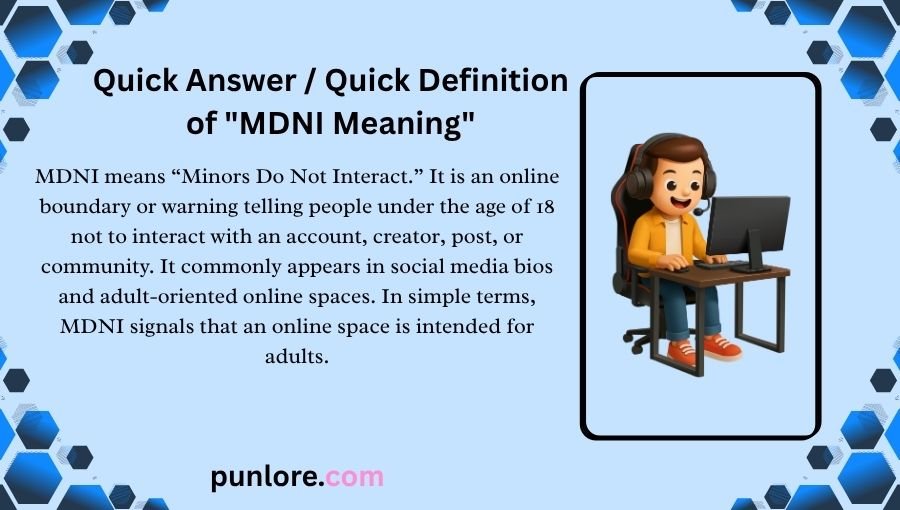
MDNI means “Minors Do Not Interact.” It is an online boundary or warning telling people under the age of 18 not to interact with an account, creator, post, or community. It commonly appears in social media bios and adult-oriented online spaces. In simple terms, MDNI signals that an online space is intended for adults.
Detailed Meaning Breakdown
Primary Meaning
The most common MDNI meaning is “Minors Do Not Interact.”
Here, “minors” generally refers to people who are under the legal age of adulthood, although the exact age can depend on the context and the person’s location. “Do not interact” means the account owner does not want minors commenting, messaging, following for interaction, participating in discussions, or otherwise engaging with the account.
For example, someone might write:
“MDNI | 18+ account | mature discussions”
The first part establishes a boundary. The second reinforces it.
You’ll usually encounter this abbreviation in online communities where conversations, artwork, fiction, role-play, humor, or other material may be intended for adults.
One useful observation is that the phrase is often less about describing the content itself and more about setting an audience boundary.
Secondary Meanings
Some people expand MDNI slightly differently, such as “Minors Don’t Interact.”
The wording changes, but the practical message is nearly identical: people who are minors should not engage with the account or space.
In casual online writing, abbreviations aren’t always standardized. A creator might use MDNI, while another person writes “minors DNI,” “18+,” or “adults only.”
The important part is the instruction, not the exact grammar of the expansion.
You’ll also sometimes see the abbreviation alongside other labels, such as:
- 18+
- Adults only
- Minors DNI
- No minors
- Adult account
- Mature content
These additional labels can make the intended boundary easier to understand.
Rare or Misinterpreted Meanings
MDNI isn’t normally a secret code or a romantic abbreviation. On social media, its established use is overwhelmingly connected to age boundaries and interaction restrictions.
A common mistake is assuming that MDNI automatically means every post contains explicit material. That’s not necessarily true.
An account may discuss adult relationships, mature themes, sensitive subjects, or other age-restricted topics without every individual post being explicit.
Another mistake is reading MDNI as “don’t view this.” The phrase specifically focuses on interaction, although an account owner may also expect minors to avoid viewing the associated content.
When the context isn’t obvious, check the rest of the profile or post description before making assumptions.
What “MDNI Meaning” Means in Different Contexts
In Texting and Messaging
In direct messages, MDNI can function as a short reminder that a conversation is intended only for adults.
For example:
“This group is MDNI. Please keep it 18+.”
The sender isn’t necessarily insulting younger users. They’re establishing an audience rule for the conversation.
A private community might use the abbreviation in its welcome message, while an individual might include it in a profile before accepting messages.
If you see MDNI in a message, don’t treat it like ordinary slang that requires a clever response. Usually, it’s a boundary or audience notice.
A simple reaction such as “Understood” is enough when a response is necessary.
On Social Media Platforms
The abbreviation appears across several social platforms, although its exact presentation varies.
On Instagram, you may find it in a bio, caption, Story, or creator profile. A user might combine it with “18+” to make the intended audience unmistakable.
On Snapchat, it can appear in a profile or private-community context where users are establishing who should participate.
On TikTok, creators may put the abbreviation in a bio or caption when discussing mature subjects. Platform rules still apply regardless of the warning.
On Threads, MDNI may appear in a profile description, post, reply, or conversation where an adult-only audience is being requested.
The tone can range from polite to firm. For example:
“MDNI, please respect the boundary.”
sounds more courteous than:
“MDNI. Do not follow or message.”
The meaning remains essentially the same.
In Dating and Relationships
In dating-related spaces, MDNI usually identifies an adult-only audience, rather than expressing romantic interest.
For example:
“18+ dating discussion. MDNI.”
This tells younger users not to participate in the conversation.
It doesn’t mean “I don’t want minors to date me” in a personal romantic sense. The phrase is broader: it’s an audience restriction.
An adult creator might also use it when discussing relationships, intimacy, sexuality, dating experiences, or other mature subjects.
That distinction matters. Seeing MDNI on a dating profile or post shouldn’t be interpreted as a flirtatious message. It’s primarily a boundary marker.
In Professional Communication
MDNI isn’t normally appropriate for ordinary workplace communication.
You wouldn’t generally put “MDNI” in a company email, résumé, business proposal, or standard customer-service message. The abbreviation belongs primarily to informal online communities.
If an organization needs to restrict access by age, clearer professional language is preferable:
“This material is intended for adults 18 and older.”
That wording is more precise and easier for a broad audience to understand.
A small but important distinction: an online abbreviation can communicate a personal preference, but it doesn’t automatically create a legally enforceable age restriction. Platforms, businesses, and communities should follow their own applicable rules.
Cultural or Regional Differences
The abbreviation is especially recognizable in English-speaking internet communities, particularly spaces influenced by fandom, social media, and online creator culture.
However, people don’t necessarily interpret age boundaries identically everywhere. Definitions of adulthood, platform norms, and expectations around age-restricted material can differ by country.
Age also matters. Younger internet users who spend significant time in fandom communities may recognize MDNI immediately, while someone who rarely uses social media may have never encountered it.
In mixed-language communities, users may prefer a clearer phrase such as “18+ only” rather than an English abbreviation.
Tone, Psychology & Why People Use It
Why People Use It & What It Signals Socially
The main reason people use MDNI is simple: they want to establish a boundary quickly.
A short abbreviation can fit neatly into a profile where there’s limited space. It also signals that the creator expects visitors to pay attention to audience restrictions before interacting.
There can be a psychological benefit, too. Stating a boundary publicly reduces the need to explain it repeatedly in private messages.
For many users, the phrase communicates:
- This is an adult-oriented space.
- Minors aren’t the intended audience.
- Please respect the account owner’s boundary.
- Check the account’s other warnings before engaging.
I’ve found that the clearest profiles often pair the abbreviation with a plain-language explanation. Four letters alone can be easy to overlook.
Emotional Layer Behind It
The emotional tone depends heavily on how the abbreviation is presented.
A friendly version might say:
“18+ only, MDNI — thanks for respecting my space.”
That sounds calm and welcoming.
A neutral version might simply say:
“MDNI | 18+”
There is no obvious emotional message beyond the boundary.
A firm version could read:
“MDNI. Do not interact.”
That sounds more protective and direct.
None of these necessarily indicates anger. The wording around MDNI determines whether the boundary feels gentle, neutral, or strict.
10 Real Conversation Examples (Explained)
1. Profile Bio
Message: “MDNI | Adult account.”
Intended meaning: The account is intended for adults and minors shouldn’t interact.
Emotional tone: Neutral and direct.
Likely interpretation: A visitor should respect the stated age boundary.
2. Group Chat
Message: “Just a reminder: this group is MDNI.”
Intended meaning: The group is restricted to adults.
Emotional tone: Calm and administrative.
Likely interpretation: The sender is reinforcing an existing community rule rather than starting an argument.
3. Social Media Caption
Message: “Posting some mature relationship commentary tonight. MDNI.”
Intended meaning: The creator doesn’t want minors participating in the discussion.
Emotional tone: Informative with a firm edge.
Likely interpretation: The audience should consider the warning before engaging.
4. Direct Message
Message: “Before we continue, just so you know, this account is MDNI.”
Intended meaning: The conversation is intended for adults.
Emotional tone: Cautious and boundary-focused.
Likely interpretation: The sender wants to establish expectations before continuing.
5. Fandom Account
Message: “18+ fandom space. MDNI.”
Intended meaning: Only adults are invited to interact with the account.
Emotional tone: Neutral.
Likely interpretation: The creator is defining the intended audience for the community.
6. Comment Section
Message: “Please read the bio. MDNI.”
Intended meaning: The account has an adult-only interaction rule.
Emotional tone: Firm.
Likely interpretation: The commenter expects the other person to review the account’s stated boundaries.
7. Friendly Reminder
Message: “Hey! This page is MDNI, so please don’t interact if you’re under 18.”
Intended meaning: The creator wants to communicate the restriction without sounding hostile.
Emotional tone: Polite but clear.
Likely interpretation: The boundary is serious, but the wording is deliberately respectful.
8. Mature Discussion
Message: “MDNI — tonight’s post discusses adult relationships.”
Intended meaning: The topic is aimed at adults.
Emotional tone: Informational.
Likely interpretation: The reader should recognize that the discussion isn’t intended for minors.
9. Someone Asks What It Means
Message: “What does MDNI stand for?”
Reply: “It means ‘Minors Do Not Interact.’ It’s basically an 18+ audience warning.”
Intended meaning: A straightforward definition.
Emotional tone: Helpful and neutral.
Likely interpretation: The person asking probably encountered the abbreviation without knowing internet slang.
10. A Boundary Is Repeated
Message: “I already mentioned that this account is MDNI. Please respect that.”
Intended meaning: The account owner believes someone has ignored a clearly stated boundary.
Emotional tone: Firm and possibly frustrated.
Likely interpretation: This is no longer merely informational; the speaker is actively enforcing the boundary.
Where Misunderstandings Happen
Context Confusion
The biggest problem is assuming every abbreviation has one universal meaning in every situation.
If someone encounters MDNI outside the social media environment where it is normally used, they may not know what it means. Even experienced internet users can misunderstand it if the surrounding profile gives no explanation.
Adding “18+” or “minors do not interact” removes much of that ambiguity.
Generational Gap
Internet abbreviations evolve quickly.
Someone who spends years in online fandom communities may recognize MDNI immediately. Another adult who mainly uses email, Facebook, or professional networking sites may have never seen it.
That’s not a knowledge problem. It’s simply a difference in online communities and vocabulary.
When communicating with a broad audience, plain English usually beats niche shorthand.
Platform Differences
Platform culture also changes how abbreviations are interpreted.
A phrase commonly understood in a fandom community may be less familiar to a general audience on another platform. The same four letters can therefore require different levels of explanation.
Creators should consider their audience rather than assuming everyone understands internet shorthand.
Similar Words, Symbols, or Abbreviations
| Term | Meaning | How It Differs from MDNI |
|---|---|---|
| 18+ | Adults aged 18 and older | Gives an age threshold but doesn’t specifically use the “do not interact” instruction. |
| Minors DNI | Minors Do Not Interact | Essentially the same boundary, but written more explicitly. |
| Adults Only | Intended only for adults | Broader and easier for general audiences to understand. |
| NSFW | Not Safe For Work | Describes potentially inappropriate or mature content, not specifically an age-based interaction rule. |
| SFW | Safe For Work | Indicates content is generally suitable for workplace viewing; it doesn’t establish an adult-only audience. |
| Mature Content | Content intended for mature audiences | Describes the material rather than directly instructing minors not to interact. |
| DNI | Do Not Interact | A broader boundary that can target anyone, not specifically minors. |
| Age-Gated | Access is restricted based on age | Describes a formal access restriction more generally. |
| Adult Account | An account operated for or intended for adults | Broader wording that may or may not explicitly prohibit minor interaction. |
When Not to Use “MDNI Meaning”
Professional Risks
Don’t rely on MDNI when communicating an important age restriction to customers, employees, students, or the general public.
A formal notice should state the requirement plainly. Abbreviations can be misunderstood, and workplace communication generally benefits from precise wording.
If a business genuinely needs to restrict access by age, it should use clear language and appropriate procedures rather than assuming everyone knows internet slang.
Cultural Risks
An abbreviation that feels obvious within one online community may be unfamiliar elsewhere.
Using MDNI without explanation can therefore create unnecessary confusion, particularly in multilingual or international communities.
If your audience is broad, consider writing “18+ / minors do not interact” the first time. After that, an abbreviation may be easier to understand.
Tone Risks
MDNI can sound blunt when presented without context.
For example:
“MDNI. Don’t message me.”
may feel considerably harsher than:
“This is an 18+ account, so please don’t interact if you’re under 18.”
The underlying boundary hasn’t changed. The presentation has.
Use the version that fits your community and the seriousness of the situation.
Expert Tips for Using “MDNI Meaning” Correctly
- Know the audience first. Use the abbreviation where internet shorthand is likely to be understood.
- Explain it when necessary. Pair MDNI with “18+” or “minors do not interact” for clarity.
- Put the boundary somewhere visible. A profile bio or community description is easier to notice than a buried comment.
- Don’t assume MDNI makes content automatically restricted. A label doesn’t replace applicable platform rules.
- Use plain language for formal communication. Businesses and organizations should avoid relying on niche slang.
- Be consistent. If an account is adult-only, communicate that boundary across relevant profile areas.
- Don’t use it as an insult. MDNI is a boundary-setting term, not a label for judging someone.
- Respect another user’s stated boundary. If an account says minors shouldn’t interact, don’t test the rule.
- Add context for younger or unfamiliar audiences. “18+” is often clearer than an unexplained abbreviation.
- Remember that context matters. The abbreviation normally signals an audience restriction, not a description of someone’s personality or relationship status.
Frequently Asked Questions
1. What does MDNI mean on social media?
MDNI usually means “Minors Do Not Interact.” On social media, it tells people under the relevant age threshold not to engage with an account, post, community, or creator. You’ll commonly see it in bios, captions, profiles, and fandom spaces. It is primarily a boundary-setting abbreviation.
2. Is MDNI the same as 18+?
They’re closely related, but they’re not exactly the same phrase. 18+ identifies an age group, while MDNI specifically tells minors not to interact. Many users put both together because the combination is clearer: one states the intended age and the other communicates the interaction boundary.
3. Is MDNI negative or rude?
Not necessarily. The phrase itself is usually neutral and boundary-focused. Its tone depends on the surrounding wording. “18+ MDNI, thanks for understanding” sounds polite, while “MDNI. Do not contact me” sounds much firmer. The abbreviation isn’t automatically hostile.
4. Can MDNI be used in a romantic context?
Yes, but it doesn’t normally mean something romantic by itself. An adult may use MDNI on a profile or discussion involving dating, relationships, intimacy, or mature themes. In that situation, it indicates the intended audience is adults rather than expressing romantic interest toward a particular person.
5. What should you do if someone says MDNI?
If you’re under the stated age restriction, the safest response is not to interact with that account or space. If you’re an adult and simply don’t understand the abbreviation, you can ask what it means when appropriate. Usually, there’s no special response required; respecting the boundary is the important part.
6. What does MDNI mean in a TikTok bio?
In a TikTok bio, MDNI generally tells minors not to interact with the creator’s account. The creator may be discussing mature subjects or simply want an adult-only community. Because abbreviations can be overlooked, some creators also write “18+” or “minors do not interact” to make the boundary more obvious.
7. Is “Minors DNI” different from MDNI?
There is essentially no meaningful difference in the intended message. “Minors DNI” spells out the subject and uses the broader abbreviation “DNI,” meaning “Do Not Interact.” MDNI compresses the same idea into four letters. Both are normally used to establish an adult-only interaction boundary.
8. Does MDNI mean the content is NSFW?
Not automatically. MDNI establishes an age or interaction boundary, whereas NSFW is a label describing content that may be inappropriate to view at work or in public settings. An account can use MDNI without every post being NSFW. Always read the surrounding warnings and profile information.
Final Summary & Smart Usage Advice
The clearest MDNI meaning is “Minors Do Not Interact.” It is an internet abbreviation used mainly by adults who want to establish an adult-only audience or prevent minors from interacting with an account, post, community, or discussion.
You’ll most often encounter it on social media, fandom accounts, creator profiles, group chats, and conversations involving mature subjects. The phrase can appear alone, but it’s often paired with 18+, “adults only,” or a more detailed content warning.
The abbreviation itself isn’t automatically rude, romantic, explicit, or negative. Its tone comes from the surrounding language. A polite explanation can make the boundary feel welcoming, while a short command can sound much firmer.
For readers, the safest approach is simple: recognize the age boundary and respect it. For creators, clarity is usually better than relying on shorthand alone. If your audience may not know the abbreviation, write out the meaning or add an age label.
You don’t need to overthink the term. In most online contexts, the message is straightforward: this is an adult-oriented space, and minors shouldn’t interact.
Memorable takeaway: MDNI is a boundary, not a mystery—it means minors should not interact.
Also Read This: TSSS Meaning in Text


Pingback: Platitudes Meaning: Definition & Examples 2026
Pingback: Boof Meaning: Definition, Context & Usage 2026
Pingback: What Does IFK Mean in Text? 2026 Meaning Guide