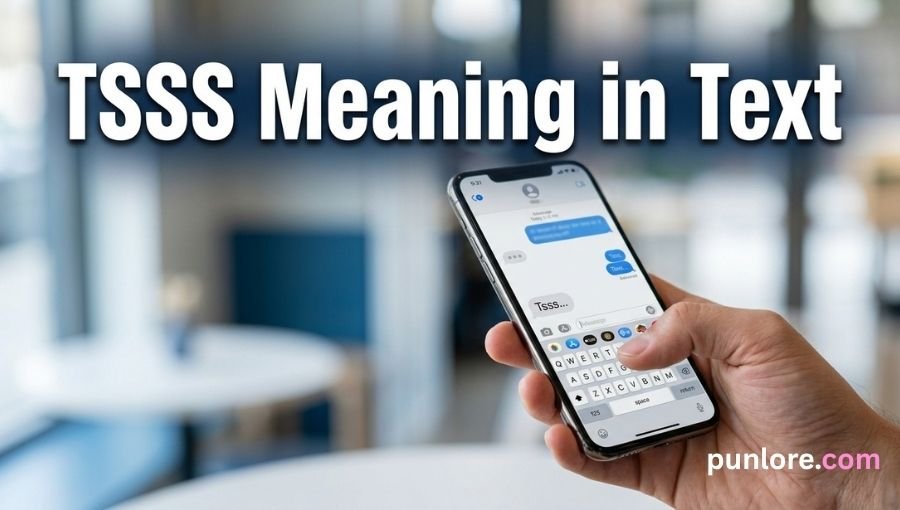
TSSS Meaning in Text: Definition, Context, Examples, and Modern Usage (2026 Guide)
You get a text that simply says “tsss…” after telling a friend some bad news. You pause. Is the person annoyed? Surprised? Making a joking sound? Or did they use an abbreviation you’ve never seen before? That confusion is exactly why people search for TSSS meaning in text.
Unlike common abbreviations such as LOL or BRB, TSSS doesn’t have one universally accepted definition. Its meaning depends heavily on context, punctuation, capitalization, relationship, and platform.
In casual online conversation, “tsss” can work like a written sound of disapproval, disbelief, frustration, or mild annoyance. In some conversations, however, people may use the letters as a personal abbreviation or typo. That’s why treating every TSSS message as having one fixed translation can lead to awkward replies.
The term is especially easy to misunderstand because short reactions carry a lot of emotion with very few characters. A message like “TSSS, seriously?” feels very different from “tsss 😂.”
Here’s a practical breakdown of what the expression can mean, how people use it, and how to respond without guessing wrong.
Quick Answer / Quick Definition of “TSSS Meaning in Text”
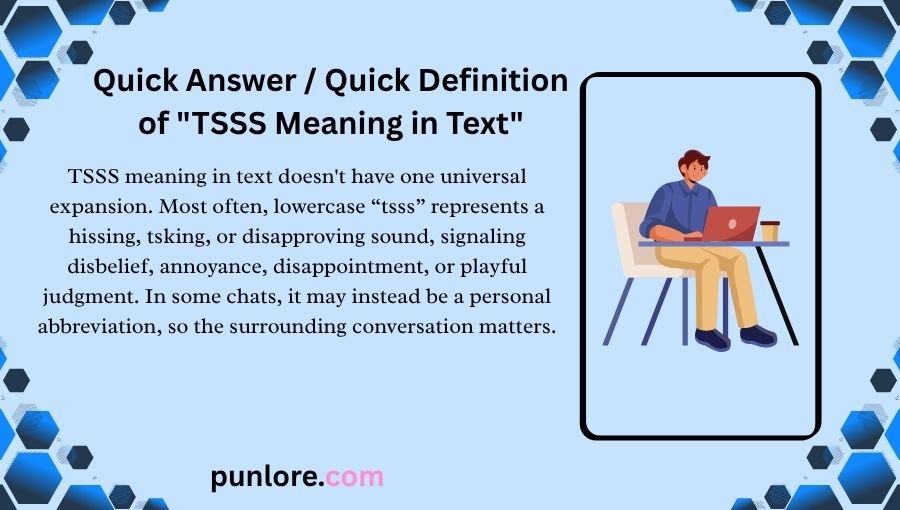
TSSS meaning in text doesn’t have one universal expansion. Most often, lowercase “tsss” represents a hissing, tsking, or disapproving sound, signaling disbelief, annoyance, disappointment, or playful judgment. In some chats, it may instead be a personal abbreviation, so the surrounding conversation matters.
Detailed Meaning Breakdown
Primary Meaning
The most useful way to understand TSSS is as a written reaction sound rather than a fixed acronym.
Think of the sound someone makes when they hear something foolish or disappointing: “Tsss…” It can resemble “tsk,” “ugh,” or a quiet hiss. The writer is expressing a reaction without spelling out a complete sentence.
For example:
“You really forgot her birthday? Tsss…”
The writer probably isn’t naming four separate words. They’re showing disapproval or disbelief.
This use is common in informal digital communication because texting removes facial expressions and vocal tone. A few letters can recreate a sound that would normally be heard in person.
Secondary Meanings
Depending on the person and conversation, TSSS may also communicate:
- Disbelief: “Tsss, you actually believed him?”
- Disappointment: “Tsss… that’s rough.”
- Annoyance: “TSSS, don’t start again.”
- Playful teasing: “Tsss 😂 you know you messed up.”
- Sympathy with attitude: “Tsss, poor thing.”
Some users may also invent their own expansion for the letters. There is no reliable universal dictionary-style expansion that applies to every message.
Rare or Misinterpreted Meanings
A common mistake is assuming every four-letter slang expression must be an acronym.
That’s not necessarily true here. TSSS can simply imitate a sound.
It can also be a typo, an exaggerated version of “tss,” or a person’s individual texting habit. If someone regularly uses unusual abbreviations, their intended meaning may be specific to their social circle.
When the context doesn’t make sense, asking “What do you mean by tsss?” is safer than assigning a meaning yourself.
What “TSSS Meaning in Text” Means in Different Contexts
In Texting and Messaging
In everyday texting, TSSS usually works as an emotional reaction. The exact feeling comes from what happened immediately before it.
For example:
“You said you’d study, but you played games all night.”
“Tsss 😭”
That response could mean playful judgment rather than serious anger.
Punctuation changes the feel, too. “Tsss…” sounds slower and more disappointed, while “TSSS!” feels sharper and more dramatic.
A lowercase version often feels casual. Capital letters can make the reaction more intense, although some people capitalize everything without intending extra emotion.
On Social Media Platforms
On Instagram, Snapchat, TikTok, and Threads, “tsss” can appear in comments, captions, DMs, or story replies.
On TikTok, for example, someone might comment:
“Tsss, bro really thought that would work.”
That’s likely playful disbelief.
Instagram users may use it in a story reply:
“Tsss… looking dangerous 🔥”
Here, the tone could be teasing or flirtatious rather than negative.
On Snapchat, the expression may feel especially conversational because messages are often brief. Threads comments can be more public, so the same reaction may come across as stronger criticism.
The platform doesn’t create a fixed definition. The surrounding content determines the emotional meaning.
In Dating and Relationships
In romantic conversations, TSSS can be playful, teasing, or mildly critical.
Imagine someone sends:
“You still haven’t asked me out?”
A reply such as:
“Tsss, impatient much? 😂”
could be flirtatious teasing.
But after an argument, the same expression might sound dismissive:
“TSSS. Whatever.”
That’s much colder.
When reading TSSS meaning in text between romantic partners, look at the relationship history and the messages surrounding it. Emojis, punctuation, and affectionate language can completely change how the reaction lands.
In Professional Communication
This expression is generally too ambiguous for formal workplace communication.
A coworker might understand “tsss” as joking, while a manager could read it as disrespectful or irritated. Even in a relaxed office chat, the intended tone isn’t guaranteed to survive the screen.
Instead of writing:
“Tsss, that’s not happening.”
a professional response could be:
“I don’t think that approach will work.”
The second version removes uncertainty.
Cultural or Regional Differences
The sound represented by “tsss” can vary across languages and cultures. Some communities use similar spellings for tsk, hissing, frustration, or disapproval.
Age matters, too. Younger users who frequently communicate through memes and short-form social content may recognize expressive spellings more quickly than someone who primarily uses traditional texting.
So, if you’re wondering about TSSS meaning in text, don’t assume every speaker uses it in exactly the same way.
Tone, Psychology & Why People Use It
Why People Use It & What It Signals Socially
The appeal is simple: it saves words while showing emotion.
Writing “I can’t believe you did that” takes a full sentence. Writing “Tsss…” creates an immediate reaction and leaves the other person to infer the feeling.
That ambiguity can actually be useful. Friends often enjoy teasing each other without directly stating, “I’m judging you.”
I find the punctuation particularly revealing. Three dots can make a tiny expression feel much more dramatic.
Emotional Layer Behind It
Tone can range from friendly to cold.
Friendly:
“Tsss 😂 you really wore that?”
Neutral or surprised:
“Tsss… that’s unexpected.”
Cold or critical:
“TSSS. Seriously?”
The difference isn’t the letters alone. It’s the relationship, situation, punctuation, emoji use, and previous messages.
10 Real Conversation Examples (Explained)
- Message: “Tsss… you actually bought it?”
Meaning: The sender is surprised or mildly judgmental. Tone: Playful. Likely interpretation: They can’t believe your decision. - Message: “TSSS 😭 that’s embarrassing.”
Meaning: A strong reaction to an awkward event. Tone: Amused. Likely interpretation: They’re laughing with you or at the situation. - Message: “Tsss, poor guy.”
Meaning: The sender feels some sympathy. Tone: Soft and sympathetic. Likely interpretation: They feel bad for someone. - Message: “TSSS! Don’t test me.”
Meaning: The person is warning someone not to push them. Tone: Sharp. Likely interpretation: Genuine irritation is possible. - Message: “Tsss 😂 you knew better.”
Meaning: The sender is teasing someone for making an obvious mistake. Tone: Friendly. Likely interpretation: Lighthearted criticism. - Message: “Tsss… that’s actually crazy.”
Meaning: Surprise rather than direct criticism. Tone: Shocked. Likely interpretation: They’re reacting strongly to unexpected news. - Message: “Tsss, look at you 👀”
Meaning: The sender noticed an attractive or impressive change. Tone: Flirty. Likely interpretation: A playful compliment. - Message: “TSSS. I’m not getting involved.”
Meaning: The sender wants distance from drama. Tone: Detached. Likely interpretation: They don’t want responsibility for the situation. - Message: “Tsss, you lost again?”
Meaning: The sender is poking fun at someone. Tone: Teasing. Likely interpretation: Friendly banter, assuming the relationship supports it. - Message: “Tsss…”
Meaning: The sender gives only a reaction, without explanation. Tone: Unclear. Likely interpretation: Ask for context if the situation matters.
Where Misunderstandings Happen
Context Confusion
The biggest problem with TSSS is that the same spelling can express several emotions.
“Tsss 😂” and “TSSS.” aren’t emotionally identical. One may be joking, while the other could signal annoyance.
Generational Gap
Someone familiar with expressive internet slang may instantly read “tsss” as a reaction sound. Another person may assume it’s an acronym and search for a specific expansion.
That difference can create unnecessary confusion.
Platform Differences
A reaction in a private Snapchat chat may feel harmless. The same expression under someone’s public Instagram post can look more judgmental because other people can see it.
Public context matters.
Similar Words, Symbols, or Abbreviations
| Term | Meaning | How It Differs from TSSS Meaning in Text |
|---|---|---|
| Tsk | Disapproval or annoyance | More established as a reaction sound |
| Ugh | Frustration or disgust | Usually clearer and more direct |
| SMH | Shaking my head | Explicit abbreviation rather than a sound |
| LOL | Laughing out loud | Usually signals amusement |
| Oof | Reaction to something painful or awkward | Often expresses sympathy or discomfort |
| Hmm | Thinking, uncertainty, or doubt | Less openly disapproving |
| Bruh | Surprise, disbelief, or frustration | Often addresses the other person directly |
| Wow | Surprise or admiration | Usually less negative |
When Not to Use “TSSS Meaning in Text”
Professional Risks
Avoid it in emails, job applications, customer service messages, formal presentations, and serious workplace conversations.
Its ambiguity can make you sound dismissive even when you intended humor.
Cultural Risks
Don’t assume everyone recognizes the expression. A slang reaction that feels normal among friends may be confusing to someone from a different linguistic or cultural background.
Tone Risks
Avoid using it during sensitive conversations unless you know the other person’s communication style well.
After someone shares serious personal news, “Tsss” could sound uncaring. A direct, supportive sentence is usually better.
Expert Tips for Using “TSSS Meaning in Text” Correctly
- Read the whole conversation before deciding what the expression means.
- Treat it as a reaction sound first, not automatically as an acronym.
- Look at punctuation such as “…” or “!” for emotional clues.
- Check whether emojis make the message softer or more playful.
- Consider your relationship with the sender.
- Don’t use it when a serious message requires clear communication.
- If the meaning is unclear, ask instead of guessing.
- Use lowercase for a softer, casual feel when appropriate.
- Be cautious with uppercase because it may look more forceful.
- Remember that TSSS meaning in text can be personal, especially in private friend groups.
Frequently Asked Questions
What does TSSS mean in text?
TSSS usually represents a written reaction sound similar to “tsk” or a hiss. It can express disbelief, annoyance, disappointment, teasing, or surprise. There isn’t one universally accepted expansion, so the surrounding conversation matters more than the letters alone.
Is TSSS positive or negative?
It can be either. A message like “Tsss 😂” may be playful, while “TSSS. Seriously?” can sound irritated. The punctuation, emoji, subject, and relationship between the people involved all influence the emotional reading.
Can TSSS be romantic?
Yes, in the right conversation. Someone might write “Tsss, look at you 👀” as a playful or flirtatious reaction. However, the expression itself isn’t inherently romantic. The surrounding message and existing relationship provide the romantic meaning.
How should I respond to TSSS?
Match the context rather than reacting to the letters alone. If a friend sends “Tsss 😂,” playful banter may work. If you’re unsure whether they’re annoyed, ask something simple such as, “What was that tsss for?”
Does TSSS have one official meaning?
No. Unlike standardized texting abbreviations with widely recognized expansions, TSSS meaning in text varies among users. It may function as a reaction sound, an exaggerated spelling of “tss,” or an individual abbreviation.
Why do people type TSSS instead of TSK?
Both can represent a reaction, but they don’t necessarily sound identical. “Tsk” is strongly associated with disapproval, while “tsss” can feel more dramatic, playful, drawn-out, or expressive depending on the writer.
Does capitalization change TSSS?
It can. “tsss” generally looks casual and conversational, whereas “TSSS!” may appear louder or more forceful. Still, capitalization isn’t a universal rule because some people use uppercase letters simply for emphasis or personal style.
Is TSSS rude?
Not automatically. Between close friends, it can be harmless teasing. In a serious conversation or professional setting, however, it may appear dismissive or judgmental. If you don’t know the recipient’s communication style, a clearer phrase is the safer choice.
Final Summary & Smart Usage Advice
Understanding TSSS meaning in text is less about memorizing a single definition and more about reading the situation.
In casual digital communication, “tsss” most commonly works as a written reaction sound. It can suggest disbelief, mild disapproval, frustration, surprise, teasing, or sympathy. The emotional direction depends on what came before it.
The safest approach is to look at the complete message. Check the punctuation. Notice emojis. Consider whether the person is a close friend, romantic partner, coworker, or stranger. A playful “Tsss 😂” can feel completely different from “TSSS.” after an argument.
It’s also worth remembering that slang isn’t universal. One person’s familiar texting habit may be another person’s mystery abbreviation. If the conversation matters, don’t build a major assumption around four letters.
Use the expression casually with people who understand your style. Avoid it when clarity, professionalism, or sensitivity matters more than personality.
Once you recognize that TSSS meaning in text is context-dependent, the expression becomes much easier to interpret.
The simple rule: read the tone around “TSSS,” not just the letters themselves.
Also Read This: SMH Meaning in Text



Pingback: MDNI Meaning: Definition, Examples & Usage 2026
Pingback: What Does DATY Mean? Definition & Examples 2026
Pingback: EOW Meaning: Definition, Examples & 2026 Guide
Pingback: Dapper Meaning: Definition, Examples & Usage 2026
Pingback: Helonium Meaning: Definition & Usage Guide 2026
Pingback: What Does MIS Mean? Definition & Examples 2026