Ick Meaning in Text: Definition, Context, Examples, and Modern Usage (2026 Guide)
If you’ve ever received a text that made you suddenly think, “Nope, that’s not attractive,” you’ve probably encountered what people mean by Ick Meaning in Text. Imagine you’re chatting with someone you like, and they casually reveal a habit that completely changes how you see them. You pause, stare at your phone, and think: “Ick.”
That tiny word can say a lot.
When people search for Ick Meaning in Text, they’re usually trying to understand what someone meant by “ick,” “the ick,” or “you gave me the ick” in a message, comment, caption, or dating conversation. The expression has become especially common in casual online communication, where one short reaction can replace an entire explanation.
The term is often associated with dating, attraction, social behavior, and sudden turn-offs, but it can also describe something unpleasant, awkward, embarrassing, or gross. Context matters more than the word itself.
You’ll see it on TikTok, Instagram, Snapchat, Threads, dating apps, and ordinary text messages. Younger users often use it casually and humorously, while people unfamiliar with current internet slang may interpret “ick” more literally.
This guide breaks down the meaning, context, tone, examples, and modern usage so you can understand exactly what someone means when they use “ick.”
Quick Answer / Quick Definition of “Ick Meaning in Text”
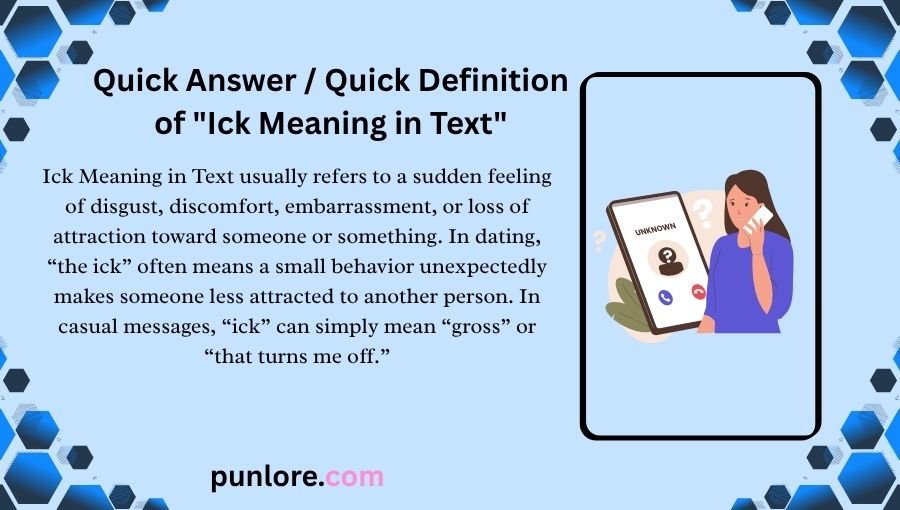
Ick Meaning in Text usually refers to a sudden feeling of disgust, discomfort, embarrassment, or loss of attraction toward someone or something. In dating, “the ick” often means a small behavior unexpectedly makes someone less attracted to another person. In casual messages, “ick” can simply mean “gross” or “that turns me off.”
Detailed Meaning Breakdown
Primary Meaning
The most common meaning of Ick Meaning in Text is a quick reaction to something that feels unpleasant, unattractive, awkward, or off-putting.
For example:
“He called his mom ‘mommy’ in front of everyone. Ick.”
The person isn’t necessarily saying the behavior is objectively terrible. They’re describing their own emotional reaction.
That distinction matters. An “ick” is usually subjective.
Something that gives one person the ick might be completely normal to someone else. One person may find excessive selfies annoying, while another thinks they’re confident and fun.
The word is especially common when attraction is involved. Someone might have been interested in a date but suddenly lose interest after noticing a particular habit.
A simple way to remember the meaning is:
Ick = an immediate feeling of “Nope, that’s not attractive or comfortable to me.”
Secondary Meanings
Outside romance, ick can describe ordinary disgust.
For example:
“There was something green floating in my drink. Ick.”
Here, the speaker isn’t discussing attraction at all. They’re simply expressing revulsion.
It can also signal embarrassment:
“I accidentally sent the screenshot to the person I was talking about. Ick.”
In that case, the word communicates an uncomfortable emotional reaction rather than physical disgust.
Online, “ick” can also be playful exaggeration. Someone may say:
“My dog looked at me while I was dancing. Ick.”
Obviously, the dog hasn’t done anything wrong. The speaker is joking about feeling embarrassed.
Rare or Misinterpreted Meanings
Some readers assume ick always means “I don’t like you anymore.” That’s too narrow.
The expression can refer to a temporary reaction, a specific behavior, a physical sensation, an awkward moment, or a broader loss of attraction.
It also doesn’t automatically mean anger.
If someone texts:
“That joke gave me the ick.”
They may still like the person overall. They simply disliked that particular moment.
Another common misunderstanding is treating “ick” as a formal insult. It usually isn’t. It’s informal internet and conversational language, so the meaning depends heavily on the relationship between the people involved.
What “Ick Meaning in Text” Means in Different Contexts
In Texting and Messaging
In everyday texting, Ick Meaning in Text is usually easy to understand from the surrounding conversation.
A person might respond with:
“You chew with your mouth open? Ick 😭”
The message expresses mild disgust, but the crying emoji may make it playful rather than hostile.
Another example:
“I just saw my ex’s new profile picture. Ick.”
Here, the speaker may be expressing embarrassment, discomfort, or renewed dislike.
Texting creates one challenge: there’s no facial expression or voice tone. A short “ick” can therefore sound harsher than intended.
Adding context can soften it:
“Lol, that’s such an ick for me.”
The phrase “for me” makes the statement clearly personal rather than universal.
On Social Media Platforms
On Instagram, someone might comment “ick” beneath a dating-related reel when they recognize a behavior they personally dislike.
On Snapchat, the word may appear in a private message after someone shares an awkward photo or story. The tone is often playful because Snapchat conversations tend to be informal.
TikTok has helped popularize “the ick” as a recognizable dating and lifestyle concept. Users frequently describe unusual habits or behaviors that suddenly make someone less attractive.
Threads can be somewhat more conversational. Someone might write:
“Nothing gives me the ick faster than people who are rude to restaurant staff.”
The statement becomes a personal opinion rather than a direct insult.
In social captions, comments, DMs, and stories, context determines whether Ick Meaning in Text sounds funny, judgmental, disgusted, or genuinely serious.
In Dating and Relationships
Dating is probably the context most closely associated with Ick Meaning in Text.
Imagine someone has gone on three dates with a person they really like. Then they see that person repeatedly being disrespectful to waiters. Their attraction suddenly drops.
They might tell a friend:
“He was so sweet until I saw how he treated the server. Instant ick.”
The dating ick doesn’t necessarily mean the person committed a serious offense. Sometimes it’s a small mannerism, phrase, fashion choice, or habit that unexpectedly changes attraction.
Examples include:
- Constantly bragging about money
- Being rude to service workers
- Speaking badly about every ex
- Trying too hard to appear cool
- Excessive jealousy
- Making inappropriate jokes
Some “icks” reveal meaningful compatibility issues. Others are simply personal preferences.
That distinction is worth remembering.
In Professional Communication
Using ick at work requires caution.
A close coworker might understand:
“That meeting was an ick.”
But a manager, client, recruiter, or executive may find the wording too casual or unclear.
Professional communication generally benefits from more precise language. Instead of saying:
“That proposal gave me the ick.”
you could say:
“The proposal raised some concerns for me.”
The informal expression can work in friendly workplace chats, especially among people who already use casual language. Still, it can sound dismissive when discussing a serious colleague, customer, or business decision.
Cultural or Regional Differences
The word is widely understood in American internet culture, especially among younger social media users. Its meaning is not limited to one city or state, though familiarity can vary by age.
Someone who spends a lot of time on TikTok or other social platforms may immediately understand “the ick.” A person who doesn’t follow online slang may interpret “ick” simply as a sound of disgust.
Age can therefore matter more than geography.
The same message can also feel different across cultures. In some settings, openly describing another person’s behavior as an “ick” may seem humorous. In more formal or indirect cultures, it could come across as unnecessarily judgmental.
Tone, Psychology & Why People Use It
Why People Use It & What It Signals Socially
The appeal of “ick” is its efficiency.
Instead of writing:
“That behavior unexpectedly made me feel uncomfortable and less attracted to this person.”
someone can simply write:
“That gave me the ick.”
One word communicates a complicated emotional reaction.
The expression also creates a sense of shared social language. When friends compare their dating “icks,” they’re often talking about preferences, boundaries, attraction, and social behavior without making the conversation sound overly serious.
Personally, one of the most interesting things about the term is how often people use it to describe a feeling that happened faster than they can explain it.
Emotional Layer Behind It
“Ick” can carry several tones.
Friendly:
“You actually put ketchup on pancakes? Ick 😂”
This is likely teasing.
Neutral:
“That behavior is an ick for me.”
This sounds like a personal preference.
Cold:
“I saw what you posted. Ick.”
This could communicate genuine rejection.
Humorous:
“He started doing motivational speeches at dinner. Immediate ick.”
The surrounding words, emojis, punctuation, and relationship between the speakers all affect the interpretation.
10 Real Conversation Examples (Explained)
1. A Dating Habit
Message: “He checks his reflection every five minutes. Major ick.”
Intended meaning: The person finds the habit unattractive.
Emotional tone: Lightly judgmental and amused.
Likely interpretation: Their attraction has probably decreased, but they’re mainly sharing an observation with a friend.
2. A Gross Situation
Message: “There was hair in my soup. Ick.”
Intended meaning: The food was disgusting.
Emotional tone: Genuine disgust.
Likely interpretation: Nothing romantic is implied. It’s simply a reaction to something unpleasant.
3. A Funny Mistake
Message: “I called my professor ‘Mom.’ Ick.”
Intended meaning: The speaker feels embarrassed.
Emotional tone: Humorous and self-conscious.
Likely interpretation: They aren’t insulting anyone. They’re laughing at their own awkward moment.
4. A Relationship Concern
Message: “He keeps making jokes about my weight. That’s an ick.”
Intended meaning: The behavior is damaging attraction and creating discomfort.
Emotional tone: Serious.
Likely interpretation: This is more than playful slang. The person may be identifying a genuine relationship problem.
5. A Social Media Reaction
Message: “That caption gave me the ick 😭.”
Intended meaning: The caption feels embarrassing or overly dramatic.
Emotional tone: Playful criticism.
Likely interpretation: The speaker probably isn’t deeply upset; they’re reacting to the style of the post.
6. A Friend’s New Crush
Message: “Wait, he says ‘yummy’ about every meal? Ick.”
Intended meaning: The friend has discovered a personal turn-off.
Emotional tone: Teasing.
Likely interpretation: The friend may still like the person, but this specific habit bothers them.
7. A Red Flag
Message: “He lied about where he was. Huge ick—and honestly a red flag.”
Intended meaning: The speaker sees dishonesty as both unattractive and concerning.
Emotional tone: Serious.
Likely interpretation: The issue goes beyond slang and points to a possible trust problem.
8. A Fashion Choice
Message: “Those shoes with that suit? Ick.”
Intended meaning: The outfit doesn’t appeal to the speaker.
Emotional tone: Opinionated but possibly playful.
Likely interpretation: It’s a personal style preference, not necessarily an attack on the person.
9. A Romantic Message
Message: “He sent me ‘good morning, beautiful’ after our first coffee. Ick.”
Intended meaning: The speaker feels the message is too intimate too soon.
Emotional tone: Uncomfortable.
Likely interpretation: The issue is probably the pace or intensity of the interaction rather than the exact words.
10. A Joke Between Friends
Message: “You said you don’t like pizza? Ick. We’re done.”
Intended meaning: The speaker is jokingly pretending to reject their friend.
Emotional tone: Playful and exaggerated.
Likely interpretation: The relationship is fine; the “rejection” is humor.
Where Misunderstandings Happen
Context Confusion
The biggest problem is that “ick” doesn’t identify the exact emotion by itself.
It could mean disgust, embarrassment, loss of attraction, awkwardness, or playful teasing.
Compare:
“That restaurant gave me the ick.”
with:
“You gave me the ick.”
The second statement is much more personal. It may suggest the speaker’s attraction or comfort level has changed.
Generational Gap
Younger internet users are more likely to recognize “the ick” as dating and attraction slang.
Someone unfamiliar with online slang might understand only the traditional sense of “ick” as an expression of disgust.
If you’re speaking to someone who may not know the expression, adding a little context prevents confusion.
Platform Differences
The same word can feel different depending on where it appears.
A TikTok comment may be exaggerated for entertainment. A private text from a romantic partner deserves more careful interpretation.
Public comments also tend to be performative. People sometimes use strong slang because it gets attention, while private messages can carry more genuine emotion.
Similar Words, Symbols, or Abbreviations
| Term | Meaning | How It Differs from Ick Meaning in Text |
|---|---|---|
| Turn-off | Something that reduces attraction | More direct and commonly used in romantic contexts |
| Gross | Disgusting or unpleasant | Usually stronger and more literal |
| Cringe | Embarrassing or awkward | Focuses more on secondhand embarrassment |
| Nope | Strong rejection or refusal | Doesn’t necessarily involve disgust |
| Red flag | Warning sign in someone’s behavior | Suggests a potentially serious concern |
| Ew | Expression of disgust | Usually more immediate and less relationship-focused |
| Awkward | Uncomfortable or socially strange | Doesn’t necessarily mean loss of attraction |
| Deal-breaker | Something unacceptable | Usually implies a firm decision rather than a passing reaction |
| Unattractive | Not appealing | More direct and potentially harsher |
| LOL | Indicates laughter or humor | Can soften a reaction but doesn’t itself describe an ick |
When Not to Use “Ick Meaning in Text”
Professional Risks
Avoid using “ick” when discussing sensitive workplace matters, performance problems, customer complaints, or serious disagreements.
A casual slang term can make a legitimate concern sound unserious.
If you’re communicating with a client, formal language is usually safer.
Cultural Risks
Not everyone interprets slang in the same way. Someone unfamiliar with the expression may wonder whether you’re calling them disgusting.
This is especially risky in cross-cultural communication, where informal expressions don’t always translate naturally.
Tone Risks
Calling someone’s behavior an “ick” can feel dismissive when they’re sharing something vulnerable.
For instance, if a friend tells you they’re nervous about dating, replying “That’s an ick” may sound judgmental rather than supportive.
The expression works best when the relationship and context already support casual language.
Expert Tips for Using “Ick Meaning in Text” Correctly
- Consider the relationship first. A joke between close friends is different from a comment to a new date.
- Use “for me” when appropriate. Saying “That’s an ick for me” clearly frames it as a personal preference.
- Don’t confuse every ick with a red flag. Some are harmless quirks; others reveal genuine incompatibility.
- Watch your tone. A period can make a short “ick” feel colder than an emoji or playful wording.
- Use context with unfamiliar audiences. Not everyone follows current internet slang.
- Don’t use the term to shame someone. A personal turn-off doesn’t make another person objectively bad.
- Be careful in professional settings. Clear, specific language is usually more effective.
- Look at the surrounding conversation. The messages before and after “ick” often reveal the intended emotion.
- Don’t assume romantic meaning automatically. People also use the word for food, situations, fashion, and embarrassment.
- If you’re confused, ask. A simple “Do you mean that bothered you?” can prevent unnecessary overthinking.
Frequently Asked Questions
1. What does “ick” mean in a text message?
“Ick” usually means that something feels unpleasant, unattractive, awkward, or off-putting. In dating conversations, it often describes a sudden loss of attraction caused by a particular behavior or habit. In other situations, it may simply mean “gross” or “that makes me uncomfortable.”
2. Is “ick” positive or negative?
The word is generally negative, but the strength varies. Someone might use it jokingly among friends, or they might use it seriously when a person’s behavior has changed their feelings. Context, punctuation, emojis, and the relationship between the speakers can make the expression softer or harsher.
3. Can “ick” be romantic?
Yes. Romantic conversations are one of the most common places you’ll encounter the ick. It usually means a particular behavior suddenly makes someone feel less attracted to a romantic interest. However, having one ick doesn’t always mean the relationship is completely over.
4. What does it mean when someone says “you give me the ick”?
This is more personal than simply saying “that’s an ick.” It suggests that something about your behavior, appearance, mannerisms, or interaction style is making the speaker feel uncomfortable or less attracted. The seriousness depends on the surrounding conversation and how the person normally communicates.
5. Is “the ick” the same as a red flag?
No. An ick is usually a personal turn-off, while a red flag suggests behavior that may indicate a deeper problem. For example, disliking someone’s laugh might be an ick. Repeated dishonesty could be a red flag. Some situations can be both, but the terms aren’t interchangeable.
6. Why do people suddenly get the ick?
The reaction can happen when a small detail changes someone’s perception of another person. A mannerism, comment, habit, or social behavior may suddenly conflict with what they find attractive. Because attraction is subjective, there isn’t one universal list of things that causes the feeling.
7. How should I respond if someone texts “ick”?
Don’t immediately assume the worst. First, consider whether they were joking, reacting to a specific situation, or criticizing you personally. If you’re unsure, ask calmly: “What part gave you the ick?” Their answer can tell you whether it’s playful teasing, a personal preference, or a genuine concern.
8. Can “ick” mean something other than dating?
Absolutely. It can describe food, smells, awkward situations, fashion choices, embarrassing moments, online posts, or anything else that produces an unpleasant reaction. The dating meaning is highly popular, but it isn’t the only definition. Context determines whether the expression refers to attraction, disgust, embarrassment, or humor.
Final Summary & Smart Usage Advice
Understanding Ick Meaning in Text is mostly about recognizing the emotion behind a very short expression.
In simple terms, ick describes something that suddenly feels unpleasant, unattractive, awkward, or off-putting. In romantic situations, the ick often means a specific behavior causes someone’s attraction to drop. In everyday conversations, however, the same word can simply mean “gross,” “cringe,” or “that makes me uncomfortable.”
The expression is especially common in texting and social media because it communicates a complicated reaction with just one word. TikTok, Instagram, Snapchat, Threads, and dating conversations have all helped make the term familiar to a broad online audience.
Still, don’t assume every “ick” means rejection. A friend may use it as a joke. A date may mean a genuine loss of attraction. Someone reacting to a meal may simply be disgusted.
The safest approach is to read the context, consider the relationship, and pay attention to tone.
When using the word yourself, remember that it’s a personal judgment, not an objective verdict on another person. If something genuinely bothers you, specific language is often kinder and clearer.
The memorable rule: an “ick” describes a reaction—not necessarily a final decision.
Also Read This: HYY Meaning in Text