Torta Meaning in Slang: Definition, Context, Examples, and Modern Usage (2026 Guide)
You’re scrolling through TikTok when someone comments, “That torta looks amazing.” You know torta is a Spanish word, but the comment doesn’t quite make sense from the surrounding conversation. Is the person talking about food, someone’s appearance, or something else? That uncertainty is exactly why Torta Meaning in Slang can be confusing.
The word has several meanings across Spanish-speaking communities, and its interpretation can change sharply depending on the country, speaker, and situation.
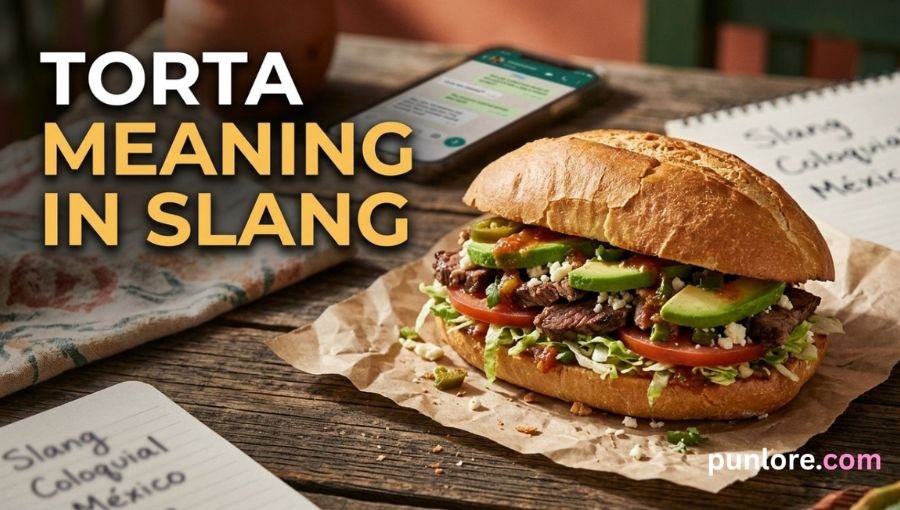
In Mexican Spanish, torta most commonly refers to a filled sandwich, especially one made with a crusty roll such as a telera or bolillo. In other Spanish-speaking regions, however, torta can refer to a cake or have a slang meaning connected with sexual orientation or gender expression. Some uses can also be insulting, so assuming one definition applies everywhere can lead to an awkward misunderstanding.
People increasingly encounter Spanish words through TikTok, Instagram, memes, bilingual conversations, music, and online communities. That makes regional slang more visible to English-speaking audiences.
This guide explains the different meanings, social tones, and cultural contexts so you can recognize what someone actually means before responding.
Quick Answer / Quick Definition of “Torta Meaning in Slang”
Torta can mean different things depending on the Spanish-speaking region. In Mexico, it commonly means a sandwich, while in some South American slang, it can have a sexual-orientation-related meaning and may be derogatory. The safest interpretation comes from the speaker’s country, sentence, tone, and surrounding context.
Detailed Meaning Breakdown
Primary Meaning
The most useful starting point is that torta isn’t automatically slang.
In Mexican Spanish, a torta is a popular sandwich. It usually consists of a bread roll filled with ingredients such as meat, beans, cheese, avocado, tomato, onion, or salsa. You might see torta de milanesa, torta de jamón, or torta ahogada on a Mexican menu.
For many Mexican speakers, therefore, there’s nothing secret, rude, or suggestive about the word. Someone saying, “Vamos por unas tortas,” may simply be suggesting that everyone go get sandwiches.
This is an easy distinction to miss if you learned Spanish mainly from textbooks. Personally, one of the clearest clues is whether the word appears alongside food-related words. Torta, queso, jamón, and salsa are probably describing lunch, not somebody’s personality.
There is another standard Spanish meaning. In several countries, torta can refer to a cake, tart, or similar baked food. The exact food varies by region.
So the first rule is simple: don’t label torta as slang just because you saw it in an informal online conversation.
Secondary Meanings
The slang question becomes more complicated because torta has regional meanings outside ordinary food vocabulary.
In parts of South America, especially in Argentine usage, torta can be used as slang for a lesbian woman. Depending on the speaker and setting, it may function as an identity label, casual slang, or an insult. The tone matters enormously.
That meaning should not be casually transferred to Mexican Spanish. A Mexican speaker saying torta is very often talking about a sandwich.
Online communities can make this even harder. A person in the United States might use a Spanish slang word learned from friends, a meme, music, or a particular Latino community. Their usage may not match the meaning someone from another Spanish-speaking country expects.
This is one reason Torta Meaning in Slang doesn’t have one universal definition. Slang belongs to communities, not dictionaries alone.
Rare or Misinterpreted Meanings
Some people assume that every unusual use of torta refers to someone’s body, attractiveness, or sexuality. That’s a risky shortcut.
Spanish has many regional expressions, and a word that sounds suggestive in one online conversation may be completely ordinary in another. A joke, caption, or comment can also intentionally play with multiple meanings.
There is another common mistake: treating torta as though it has the same meaning as the English word “cake.” In some Spanish varieties, it does. In Mexico, however, cake is generally pastel, while torta commonly means a sandwich.
The safest approach is to ask: Where is the speaker from, and what is happening in the conversation?
What “Torta Meaning in Slang” Means in Different Contexts
In Texting and Messaging
Text messages often remove the clues that make slang understandable. There’s no facial expression, accent, or surrounding conversation, so a single word can feel ambiguous.
Suppose someone texts, “¿Ya comiste? Hay tortas aquí.” In Mexican Spanish, the meaning is straightforward: there are sandwiches available.
Now imagine someone writes torta while discussing people, dating, or sexuality. The same word may have a completely different regional meaning.
Texting also encourages abbreviations, jokes, teasing, and code-switching between English and Spanish. A bilingual speaker might write, “Let’s grab unas tortas,” without translating the word because everyone in the chat understands it.
If you’re unsure, don’t automatically assume the term is offensive. A simple “Do you mean the sandwich?” can clear things up without making the conversation uncomfortable.
On Social Media Platforms
On Instagram, torta may appear in food captions, restaurant posts, jokes, or comments. A photograph of a Mexican sandwich is a strong contextual clue.
On TikTok, the word can be more unpredictable. Creators often use regional slang, bilingual humor, memes, and deliberately ambiguous language. A word can travel from one country to another while keeping only part of its original meaning.
On Snapchat, it may appear in casual messages or stories between friends. The relationship between the people posting and viewing the content becomes especially important.
On Threads, longer discussions can provide more context. A user may explain the regional meaning or debate whether an expression is offensive.
So social media doesn’t create one new definition. Instead, it mixes regional meanings together. A Mexican food post and an Argentine slang discussion can put the same word in completely different contexts.
In Dating and Relationships
Dating conversations require extra caution because slang involving identity can be sensitive.
If someone says, “She identifies as a torta,” the meaning may depend strongly on their regional Spanish and community. In some South American contexts, the term can refer to a lesbian woman. In another setting, the word might have nothing to do with sexuality.
You should also consider whether the speaker is describing themselves or labeling someone else. Self-identification and an outsider applying a slang term are not socially equivalent.
For example, a friend might jokingly use a regional expression about herself that would sound disrespectful if a stranger used it toward her. That’s common with reclaimed or community-specific language.
When romance, sexuality, or identity is involved, don’t guess from the word alone. Let the person clarify how they use it.
In Professional Communication
In professional communication, torta is generally safe only when you’re clearly discussing its ordinary food meaning.
For example, a Mexican restaurant employee might write, “Today’s special is a torta de pollo.” That’s ordinary culinary language.
Using a regional slang meaning for a coworker, customer, applicant, or client is a different matter. Even if you learned the expression from friends, the other person may interpret it as a slur or inappropriate label.
This is one area where being conservative helps. A workplace isn’t the place to test slang you only partly understand.
I’ve found a useful rule for unfamiliar expressions: if you couldn’t comfortably explain the word to a manager or client, don’t use it casually at work.
Cultural or Regional Differences
Regional variation is the biggest factor in understanding this word.
In Mexico, torta is strongly associated with a sandwich. In other Spanish-speaking countries, it can mean cake or another baked food. In certain South American slang contexts, it can carry an entirely different meaning involving sexual orientation.
Age also matters. Younger people may encounter a word through social media rather than local speech, while older speakers may use a regional meaning that isn’t familiar to younger audiences.
Bilingual Americans add another layer. Someone raised in a Mexican American household may use torta naturally for a sandwich while speaking mostly English. Another person with South American family roots may recognize a slang meaning immediately.
Therefore, the most accurate explanation of Torta Meaning in Slang is not one fixed translation. It is a set of meanings shaped by country, community, age, topic, and tone.
Tone, Psychology & Why People Use It
Why People Use It & What It Signals Socially
People use regional slang because it communicates more than a dictionary definition.
A slang word can signal belonging, familiarity, humor, identity, or shared culture. When bilingual friends use Spanish words inside an English conversation, they may be showing that they share a cultural background or understand the same online community.
Food-related use is usually straightforward. A person might say, “Those tortas were incredible,” because torta is simply the most natural word for the food they are describing.
In identity-related contexts, the social signal becomes more complicated. The speaker may be using a community term, teasing a friend, describing someone, or deliberately provoking a reaction.
The relationship between speakers matters. A word used between close friends can sound very different when a stranger says it.
Emotional Layer Behind It
The emotional tone can range from neutral to playful to offensive.
“Let’s get tortas after work” is neutral if the speakers mean Mexican sandwiches.
A joking social-media caption may use the word playfully because the audience understands the regional reference.
An identity-related use can feel cold, insulting, or discriminatory when it is directed at someone who doesn’t accept the label.
Tone isn’t contained in the word itself. It comes from the entire interaction.
Watch for surrounding clues: laughing language, insults, food references, discussion of relationships, or a person’s own identity. Those details often reveal more than the term does.
10 Real Conversation Examples (Explained)
1. “I’m starving. Let’s get tortas.”
Intended meaning: The speaker wants Mexican sandwiches.
Emotional tone: Casual and friendly.
Likely interpretation: A food suggestion, especially in Mexican Spanish or a Mexican American setting.
2. “My mom makes the best tortas.”
Intended meaning: Homemade sandwiches, most likely.
Emotional tone: Warm and personal.
Likely interpretation: The speaker is talking about food and family, not slang.
3. “That torta ahogada was insanely good.”
Intended meaning: A specific Mexican sandwich, traditionally served with sauce.
Emotional tone: Enthusiastic.
Likely interpretation: Clearly culinary because torta ahogada is a recognizable food expression.
4. “Wait, what does ‘torta’ mean here?”
Intended meaning: The person doesn’t understand the regional usage.
Emotional tone: Curious rather than judgmental.
Likely interpretation: They’re asking for clarification instead of assuming.
5. “She called herself a torta.”
Intended meaning: The speaker is reporting a self-description with a regional slang meaning.
Emotional tone: Neutral on its own.
Likely interpretation: The context likely involves sexuality or identity, but the exact meaning depends on the speaker’s region.
6. “Don’t call her that.”
Intended meaning: The listener considers the term inappropriate or offensive in this situation.
Emotional tone: Protective and serious.
Likely interpretation: Context has changed the word from casual slang to a potentially hurtful label.
7. “Anyone want tortas for lunch?”
Intended meaning: An invitation to eat sandwiches.
Emotional tone: Friendly and practical.
Likely interpretation: No slang meaning is suggested unless the surrounding conversation says otherwise.
8. “I saw ‘torta’ in a TikTok comment. Is that Spanish?”
Intended meaning: The viewer wants cultural or linguistic clarification.
Emotional tone: Curious.
Likely interpretation: The person recognizes that online slang can have regional meanings.
9. “My grandma calls that dessert a torta.”
Intended meaning: The family uses torta for a cake or baked dessert.
Emotional tone: Familiar and nostalgic.
Likely interpretation: This demonstrates regional variation rather than internet slang.
10. “I wouldn’t use that word around people I don’t know.”
Intended meaning: The speaker knows the expression can be sensitive.
Emotional tone: Cautious.
Likely interpretation: The conversation probably concerns a slang meaning that could be misunderstood or offensive outside its community.
Where Misunderstandings Happen
Context Confusion
The biggest problem is assuming that a Spanish word has one translation everywhere.
Someone who knows torta only as “sandwich” may be surprised by its use in a South American slang conversation. Someone who learned a slang definition online could make the opposite mistake and misunderstand an ordinary Mexican food reference.
Context solves much of the problem.
Look at the words immediately before and after torta. Food, restaurants, lunch, cooking, and ingredients point toward the culinary meaning. A discussion about sexuality or identity points somewhere else.
Generational Gap
Slang changes quickly.
A younger person may discover an expression through TikTok or another social platform and use it humorously without knowing its full regional history. An older speaker may recognize the same term differently.
This doesn’t necessarily mean one person is “right” and the other is “wrong.” They may simply have learned the word from different communities.
Platform Differences
The platform can influence how much context you receive.
A restaurant Instagram post gives you visual clues. A short TikTok comment may give you almost none. A private Snapchat message depends heavily on the relationship between the people involved.
Threads or another discussion-based platform may offer enough surrounding text to identify the intended meaning.
When context is thin, asking is smarter than guessing.
Similar Words, Symbols, or Abbreviations
| Term | Meaning | How It Differs from Torta Meaning in Slang |
|---|---|---|
| Pastel | Cake in much of Latin American Spanish | Usually refers to cake, not the Mexican sandwich meaning of torta. |
| Sándwich | Sandwich | A more general Spanish word for sandwich rather than the regional Mexican term. |
| Bolillo | A Mexican bread roll | Often used to make tortas but isn’t itself the completed sandwich. |
| Telera | A type of Mexican sandwich roll | Refers to the bread rather than the filled sandwich. |
| Bocadillo | Sandwich or snack in some Spanish varieties | Regional usage differs, and it doesn’t carry the same slang associations. |
| Slang | Informal language used by particular groups | Describes the type of language, not a translation of torta. |
| Joke | Humorous statement or situation | A torta reference can be a joke, but the word itself isn’t synonymous with “joke.” |
| Queer slang | Informal language related to LGBTQ+ communities | Some regional uses of torta may overlap with this area, but the terms aren’t interchangeable. |
| Cake | English word for a baked dessert | Corresponds to one possible Spanish meaning of torta in certain regions, but not all. |
When Not to Use “Torta Meaning in Slang”
Professional Risks
Avoid using a regional slang meaning toward a colleague unless you are completely certain of its meaning, audience, and acceptability.
Even if your intention is humorous, workplace communication can lack the personal trust that makes slang understandable. A word that feels harmless among friends may sound insulting in a meeting or email.
When discussing the term professionally, describe the regional meaning rather than casually applying it to a person.
Cultural Risks
The same Spanish word can carry different histories in different communities.
Using a term from one country and assuming people from another country use it the same way can come across as careless. This is especially important when the meaning relates to sexuality or identity.
Respectful language begins with recognizing that regional Spanish isn’t one single slang system.
Tone Risks
Sarcasm makes slang even harder to read.
A friend might use an expression playfully. A stranger could use the exact same word as an insult. Written comments make the distinction harder because facial expression and vocal tone disappear.
If you’re uncertain, choose a clearer word. There’s rarely a benefit to using slang you don’t fully understand.
Expert Tips for Using “Torta Meaning in Slang” Correctly
- Identify the country first. Mexican Spanish and Argentine Spanish can give the same word very different meanings.
- Look at the subject. Food-related words strongly suggest the culinary meaning.
- Don’t assume every online use is slang. Ordinary Spanish vocabulary appears frequently in social media.
- Pay attention to self-identification. A person describing themselves with a regional term isn’t necessarily inviting others to use it.
- Consider the relationship. Friends may share slang that would be inappropriate between strangers.
- Check the speaker’s tone. Humor, criticism, affection, and hostility can change how a word lands.
- Avoid using sensitive slang at work. Professional settings favor clear, neutral language.
- Don’t translate word-for-word. A dictionary definition may miss regional or cultural meaning.
- Ask politely when uncertain. “What does that mean in your region?” is often enough.
- Remember that context wins. The surrounding conversation is usually your best clue.
Frequently Asked Questions
What does “torta” mean in slang?
The slang meaning depends on the Spanish-speaking community. In Mexico, torta generally means a sandwich and isn’t inherently slang. In some South American contexts, the word can have a slang meaning connected with lesbian identity and may be offensive depending on how it’s used. Regional context is essential.
Is “torta” a positive or negative word?
It can be either, depending on the meaning. When referring to a Mexican sandwich, it is neutral and completely ordinary. When used as regional slang for a person, especially in discussions of sexuality, it may be neutral within a community, self-referential, humorous, or insulting. The speaker and situation determine the tone.
Can “torta” have a romantic meaning?
It can appear in conversations involving dating or sexuality because some regional slang uses the word in connection with lesbian identity. However, torta isn’t universally a romantic term. In Mexico, a dating conversation can contain torta simply because the people are discussing food, so surrounding context matters.
What does “torta” mean in Mexican Spanish?
In Mexican Spanish, torta most commonly means a sandwich, usually made with a bread roll and fillings such as meat, beans, cheese, vegetables, or salsa. Famous varieties include torta ahogada. This culinary meaning is so common that calling it slang in Mexico can be misleading.
Is “torta” offensive?
Not automatically. Its ordinary food meanings are not offensive. Some regional slang uses, however, can be sensitive or derogatory when applied to a person. If you’re unsure which meaning someone intends, don’t label the word as offensive immediately. Identify the country, topic, and relationship between the speakers first.
Why do people use “torta” on TikTok?
TikTok brings together speakers from many Spanish-speaking countries, so regional vocabulary travels quickly. A creator may use torta for food, humor, identity, or a local slang reference. Comments can then spread the expression to audiences unfamiliar with its original region, creating confusion about what the word means.
Does “torta” mean cake in Spanish?
In some Spanish-speaking regions, torta can refer to a cake or another baked dessert. The exact usage varies by country. In Mexico, however, pastel is commonly used for cake, while torta usually refers to a sandwich. This regional difference is one reason translations can be misleading.
How should I respond if someone calls a person a “torta”?
First, consider the speaker’s region and what they mean by the term. If you’re unsure, ask calmly what they mean rather than repeating the label. If the expression appears insulting or unwelcome, avoid using it yourself. Clear, neutral language is the safest choice when someone’s identity is involved.
Final Summary & Smart Usage Advice
Understanding Torta Meaning in Slang starts with one simple fact: there isn’t one universal meaning.
In Mexico, torta usually refers to a sandwich, and you’ll encounter the word in restaurants, family conversations, food posts, and everyday bilingual speech. In other Spanish-speaking regions, it can refer to cake or another baked food. In certain South American slang contexts, it can also describe a lesbian woman, with the emotional force ranging from community slang to an offensive label.
That regional variation explains why internet searches can produce seemingly conflicting answers. The definitions aren’t necessarily contradictory; they may belong to different Spanish-speaking communities.
Before interpreting the word, check three things: where the speaker is from, what the conversation is about, and how the word is being used. A photo of lunch strongly suggests the food meaning. A conversation about sexuality requires much more care.
Don’t rely on a single online definition, especially when a slang term concerns someone’s identity. And if you’re writing professionally, choose clear language instead of experimenting with regional slang.
Once you understand those distinctions, the term becomes much easier to recognize.
The memorable rule: with regional slang, context isn’t a detail—it is the meaning.
Also Read This: PMO Slang Meaning