GPI Meaning Slang: Definition, Context, Examples, and Modern Usage (2026 Guide)
You’re scrolling through Instagram and notice a friend posted photos from a dinner you weren’t invited to. You comment, “GPI 😂.” They probably know exactly what you mean—but if you’ve never seen the expression before, the message can be confusing. The GPI Meaning Slang search usually comes from people encountering the abbreviation in Spanish-language social media, texting, comments, or group chats.
Unlike many English abbreviations, this one has a strong connection to Latin American internet culture, especially casual online conversations.
The expression can look serious at first glance, but it’s often playful or sarcastic. The surrounding conversation matters a lot. A short “gpi” can be a genuine complaint, a joke between friends, or a teasing way to say, “Thanks for inviting me… apparently.”
Understanding the phrase is less about translating three letters and more about recognizing tone, context, and social intent. Here’s how it works.
Quick Answer / Quick Definition of “GPI Meaning Slang”
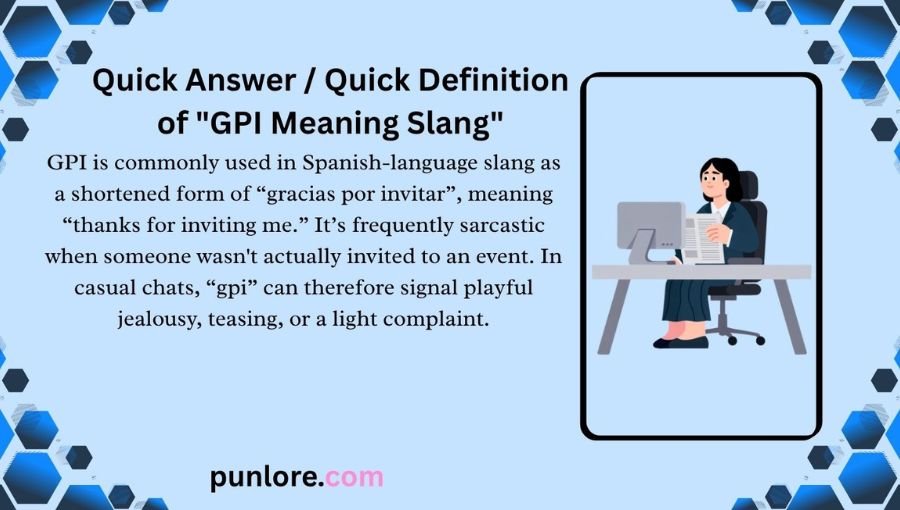
GPI is commonly used in Spanish-language slang as a shortened form of “gracias por invitar”, meaning “thanks for inviting me.” It’s frequently sarcastic when someone wasn’t actually invited to an event. In casual chats, “gpi” can therefore signal playful jealousy, teasing, or a light complaint.
Detailed Meaning Breakdown
Primary Meaning
The most common slang meaning of GPI is “gracias por invitar” or “thanks for inviting.”
The funny part is that the speaker often wasn’t invited at all.
For example:
“Todos fueron al concierto y nadie me dijo. GPI 😂”
The literal idea is “Everyone went to the concert and nobody told me. Thanks for inviting me.” The speaker isn’t genuinely thanking anyone. They’re teasing the group for leaving them out.
This sarcastic use is the heart of the expression. I’ve noticed that the surrounding situation usually makes the intended meaning obvious to people who regularly use Spanish internet slang.
Secondary Meanings
Depending on the conversation, gpi may be used more loosely to communicate:
- “I see you left me out.”
- “Thanks for including me… not.”
- “I would’ve liked an invitation.”
- “Guess I wasn’t invited.”
- “Wow, thanks for thinking of me.”
It can also appear as a standalone comment:
“GPI 😭”
In that case, the reader is expected to understand the social context from a photo, story, or previous conversation.
Rare or Misinterpreted Meanings
GPI isn’t a universal English abbreviation with one fixed slang definition.
In technical, business, medical, or academic contexts, the same letters can represent completely different terms. That’s why translating the abbreviation without checking the conversation can produce the wrong answer.
For slang, however, “gracias por invitar” is the key interpretation to remember.
What “GPI Meaning Slang” Means in Different Contexts
In Texting and Messaging
In private messages and group chats, GPI Meaning Slang usually points to playful social teasing.
Imagine your friends send pictures from a restaurant:
“Bro, gpi 😭”
The sender is probably joking that nobody invited them.
Another example:
“¿Fiesta hoy? Gpi.”
Here, the person is playfully calling attention to being excluded.
The expression doesn’t automatically mean the sender is genuinely upset. A laughing emoji, crying emoji, or casual relationship between the people involved can make the message much softer.
On Social Media Platforms
On Instagram, gpi commonly appears under photos, Stories, captions, or group-event posts. Someone might comment:
“GPI, ¿verdad? 😂”
On Snapchat, it may appear as a quick reaction to a friend’s Story showing an outing.
TikTok comments can use it after a creator posts about a trip, party, meal, or activity:
“GPI para la próxima 😭”
Threads can have a similar conversational use, especially when someone posts about an event their followers weren’t included in.
The platform doesn’t radically change the meaning. What changes is the tone and visibility. A public Instagram comment can feel more performative, while a private DM may sound more personal.
In Dating and Relationships
Romantic conversations can give gpi a slightly different emotional edge.
Suppose someone sees their partner went out with friends:
“Ahh, gpi 🥲”
That could be playful flirting, mild disappointment, or genuine irritation.
Context matters. If the couple normally jokes this way, it’s probably harmless teasing. If there’s already tension about communication or inclusion, the same three letters could sound passive-aggressive.
A useful clue is what happens next. Someone who follows “gpi” with laughing emojis is usually keeping things light. A serious follow-up may reveal that they actually felt excluded.
In Professional Communication
This is where caution helps.
Using gpi at work can be risky because coworkers may not recognize the slang or may interpret it as passive-aggressive.
For example, replying “GPI 😂” to a company event photo might seem funny among close colleagues. In a formal team channel, though, it could look unprofessional or imply resentment.
I’d avoid unexplained slang in emails, client conversations, formal announcements, and workplace situations where tone needs to be crystal clear.
Cultural or Regional Differences
The expression is strongly associated with Spanish-language internet culture, particularly informal communication in Latin American communities.
Its exact popularity can vary by country, age group, and online community. Younger social-media users are more likely to recognize abbreviations like this than someone who mainly uses traditional written Spanish.
That doesn’t mean every Spanish speaker uses “gpi.” Slang spreads unevenly, and local vocabulary changes quickly.
So if someone from another region asks what it means, don’t assume the abbreviation is universally understood.
Tone, Psychology & Why People Use It
Why People Use It & What It Signals Socially
The appeal of gpi is its brevity.
Instead of writing a full sentence about being left out, someone can type three letters and let the situation provide the joke.
It also creates a sense of shared internet culture. The person using it expects the other person to understand the reference without an explanation.
That makes it useful among friends who already have a relaxed relationship.
Emotional Layer Behind It
The emotional meaning can range from friendly teasing to genuine annoyance.
Friendly:
“GPI 😂😂”
Neutral/playful:
“Gpi next time.”
Colder:
“GPI.”
Notice how punctuation and emojis can change the feeling. A laughing emoji can soften the phrase, while a short message with no context may feel more pointed.
10 Real Conversation Examples (Explained)
- Message: “Fueron por tacos y ni avisaron. GPI 😂”
Meaning: “You went for tacos without telling me.”
Tone: Playful.
Interpretation: The person is teasing friends rather than making a serious accusation. - Message: “Gpi para la próxima 😭”
Meaning: “Invite me next time.”
Tone: Light and humorous.
Interpretation: They want to be included in the future. - Message: “¿Y esa fiesta? GPI.”
Meaning: “What party is that? Thanks for inviting me.”
Tone: Mildly sarcastic.
Interpretation: The person noticed they weren’t included. - Message: “Mi hermana salió con susie amigas. GPI 😔”
Meaning: A joking complaint about being left behind.
Tone: Slightly dramatic.
Interpretation: The emoji makes the complaint feel playful. - Message: “Todos en el viaje y yo trabajando. GPI.”
Meaning: “Everyone’s on the trip while I’m working.”
Tone: Teasing with a hint of frustration.
Interpretation: The speaker wishes they could have joined. - Message: “GPI por no decirme que venían.”
Meaning: “Thanks for not telling me you were coming.”
Tone: More direct.
Interpretation: The person may genuinely feel overlooked. - Message: “Vi susie historias. GPI 😂”
Meaning: “I saw your Stories. Thanks for inviting me.”
Tone: Clearly joking.
Interpretation: The sender discovered the outing online. - Message: “¿Cena familiar? GPI.”
Meaning: “Oh, family dinner? Guess I wasn’t invited.”
Tone: Depends on the relationship.
Interpretation: It could be playful or genuinely hurt. - Message: “GPI, yo también quería ir 😭”
Meaning: “Thanks for inviting me—I wanted to go too.”
Tone: Friendly but more sincere.
Interpretation: The person is expressing real disappointment. - Message: “GPI, jefe 😂”
Meaning: A joking response to a boss or colleague who went somewhere without them.
Tone: Informal and potentially risky.
Interpretation: Fine among close coworkers, but not ideal in formal communication.
Where Misunderstandings Happen
Context Confusion
The biggest problem with GPI Meaning Slang is that the abbreviation depends heavily on context.
Someone unfamiliar with Spanish slang may read “thanks for inviting” literally. But the speaker may actually mean the opposite: “You didn’t invite me.”
Look at the surrounding message, photo, event, and relationship before deciding how serious it is.
Generational Gap
Older users may be less familiar with internet abbreviations, while younger users may recognize them immediately.
A parent seeing “gpi” in a teenager’s comment could easily wonder whether it means something completely different.
That’s normal. Slang isn’t always passed evenly between generations.
Platform Differences
The same abbreviation can feel different depending on where it appears.
A public TikTok comment may be exaggerated for humor. A private WhatsApp message can feel more personal. An Instagram Story reply may simply be a quick joke.
The letters stay the same; the social setting changes.
Similar Words, Symbols, or Abbreviations
| Term | Meaning | How It Differs from GPI Meaning Slang |
|---|---|---|
| Gracias | Thank you | A normal Spanish word rather than sarcastic slang. |
| Invita | Invite | Refers directly to inviting someone. |
| Jaja | Haha | Shows laughter instead of exclusion. |
| LOL | Laughing out loud | English internet slang focused on humor. |
| BTW | By the way | Changes the subject rather than commenting on an invitation. |
| OMG | Oh my God | Expresses surprise or shock. |
| XD | Laughing/playful expression | Communicates amusement without the invitation reference. |
| GPI 😂 | “Thanks for inviting me” | Usually points humorously to being left out. |
When Not to Use “GPI Meaning Slang”
Professional Risks
Don’t assume coworkers or clients understand Spanish social-media slang.
A joke that works perfectly in a friend group may look sarcastic or disrespectful in a professional channel. When the relationship is formal, write the actual message instead.
Cultural Risks
Slang can be highly community-specific. Using it without understanding the cultural setting may make the message sound forced.
If you’re not comfortable with Spanish slang, a straightforward sentence is usually safer.
Tone Risks
The biggest danger is sounding passive-aggressive.
“GPI” can be funny between close friends, but it can also imply real disappointment. If you’re actually upset, saying what happened directly is often healthier.
Expert Tips for Using “GPI Meaning Slang” Correctly
- Know the audience. Use it with people who understand casual Spanish internet slang.
- Check the context. A party photo and a serious workplace message call for very different language.
- Use emojis carefully. 😂 or 😭 can make the teasing intent clearer.
- Don’t use it with strangers unless you’re confident they’ll understand.
- Keep it informal. This abbreviation belongs primarily in casual communication.
- Watch punctuation. A bare “GPI.” can feel sharper than “GPI 😂.”
- Don’t overuse it. Slang loses its humor when inserted everywhere.
- Consider the relationship. Close friends can usually handle more teasing.
- Say what you mean when necessary. If you’re genuinely hurt, don’t hide the issue behind slang.
- Remember regional variation. Not every Spanish speaker will interpret it immediately.
Frequently Asked Questions
1. What does GPI mean in slang?
In Spanish internet slang, GPI commonly means “gracias por invitar,” or “thanks for inviting me.” It is often sarcastic because the speaker wasn’t actually invited. The phrase is commonly used in casual messages, comments, Stories, and group conversations to tease friends about being left out.
2. Is GPI positive or negative?
It can be either, depending on context. Most casual uses are playful or sarcastic, rather than genuinely negative. However, someone can use it to express real disappointment. Emojis, punctuation, the relationship between the people, and what happened beforehand all help reveal the intended emotion.
3. Can GPI have a romantic meaning?
Yes, but it isn’t inherently romantic. Someone dating another person might use it jokingly after seeing their partner attend an event without them. In that setting, it can signal playful jealousy or a desire for attention. The romantic meaning comes from the relationship, not from the abbreviation itself.
4. How should I respond when someone says GPI?
If they’re joking, you can respond playfully: “Jajaja, next time!” or “You were invited in spirit 😂.” If they seem genuinely upset, acknowledge the feeling instead of joking back. A simple “Sorry, we should’ve told you” can prevent a small misunderstanding from becoming a bigger one.
5. Is GPI used only in Spanish?
The slang usage is primarily associated with Spanish-language online communication. English-speaking communities may use the letters for unrelated terms, so the surrounding conversation matters. If you see “gpi” in an English technical or professional discussion, don’t automatically assume it means “gracias por invitar.”
6. Why do people write GPI instead of the full phrase?
Internet slang is built around speed, familiarity, and shared context. Three letters are quicker than typing the complete expression, especially in comments and fast-moving group chats. The abbreviation also adds a playful insider quality because people familiar with the slang immediately understand the joke.
7. Is GPI rude?
Usually, no. Among friends, it is commonly a lighthearted way to joke about being excluded. Still, the phrase can sound rude or passive-aggressive if the relationship is tense. If you aren’t sure how the recipient will react, using a clearer and warmer sentence is the safer choice.
8. Does GPI mean the same thing on Instagram and TikTok?
Generally, yes when it’s being used as Spanish slang. Both platforms can feature it in comments, captions, replies, or messages after someone posts about an event. The difference is mostly in presentation: TikTok comments may be more humorous and public, while a private Instagram message can carry more personal emotion.
Final Summary & Smart Usage Advice
The simplest answer to GPI Meaning Slang is “gracias por invitar,” or “thanks for inviting me.” In online Spanish, however, the phrase is often intentionally sarcastic. Someone may write “gpi” after seeing friends at a party, restaurant, concert, trip, or other event they weren’t invited to.
That doesn’t automatically mean they’re angry. Context is everything. Among close friends, it can be nothing more than a funny complaint. In a romantic relationship, it might suggest playful jealousy. In a workplace, however, the same abbreviation could be misunderstood as passive-aggressive.
The best place to use it is an informal conversation where everyone understands the slang and the relationship is relaxed. Avoid relying on it when the message involves clients, formal workplace communication, unfamiliar people, or a serious disagreement.
Also remember that GPI isn’t a universal abbreviation. Outside Spanish-language slang, the same letters can represent unrelated terms.
If you’ve seen someone write “GPI” online, look at what happened immediately before it. A photo of friends having fun without the sender is a strong clue.
The easiest way to remember it: GPI usually means “thanks for inviting me”—especially when nobody actually did.
Also Read This: ASF Meaning in Text