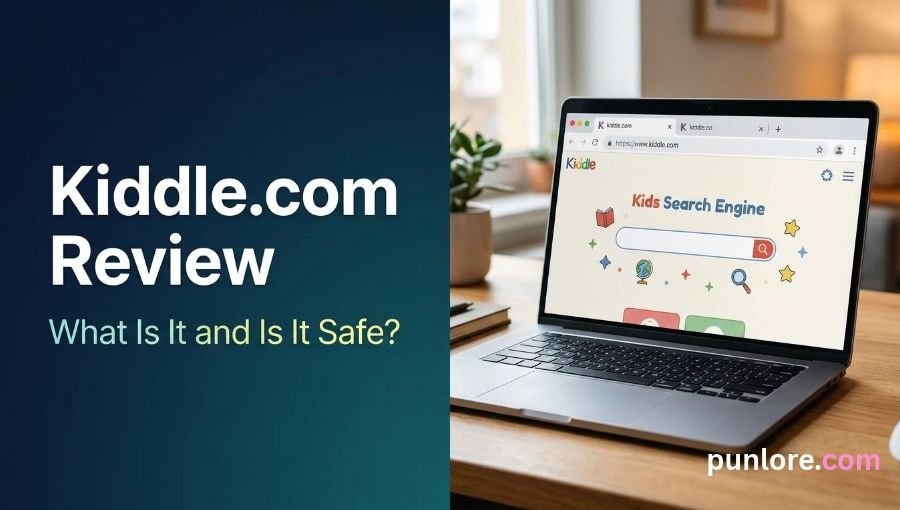
Kiddle com is a search term that can lead people to the child-friendly search engine Kiddle, but the exact domain matters. At the time of research, Kiddle.com and Kiddle.co displayed different purposes. Kiddle.com presented a domain landing page with information and relevant links, along with a notice that the domain might be for sale. Kiddle.co, meanwhile, identified itself as a visual search engine designed for children.
You can verify this distinction by visiting Kiddle.com and the official Kiddle.co website. This review examines what each domain offers, how Kiddle’s child-focused search system works, what its filtering can and cannot do, and which privacy and safety considerations parents should understand before letting children browse independently.
What Is Kiddle.com?
Kiddle.com is the exact domain entered in this review, and its current landing page does not present the child-friendly search service commonly associated with the name Kiddle. Instead, the page displays a short description offering information and links related to the domain and indicates that the domain may be available for purchase.
The page also links to terms and a privacy policy associated with Above.com. These documents describe Above.com’s services and data practices, rather than the child-focused search engine’s published policies.
This distinction is important because a familiar name does not establish that two websites are operated by the same organization. Someone looking for a children’s search engine should not assume that Kiddle.com provides the filtering and educational features advertised by Kiddle.co.
The current landing page also does not establish who ultimately owns the domain or whether it has any affiliation with the operator of Kiddle.co.
What Is Kiddle.co?
Kiddle.co is a visual search engine designed to make online information easier for children to find and understand. Its official About page explains that the service combines child-oriented search results, content filtering, large thumbnails, and readable text.
Rather than presenting every result in the same way, Kiddle describes a system that prioritizes pages according to their suitability and readability for younger users.
The service is powered by Google SafeSearch technology, but Kiddle explicitly states that it is not affiliated with Google LLC. It should therefore be understood as a separate child-focused search service, not an official Google product.
Kiddle is intended for children researching school subjects, animals, science, geography, history, and other topics. Parents and teachers may also use it to help younger learners find starting points for educational research.
Kiddle.com vs. Kiddle.co: What Is the Difference?
The difference between these domains is the most important finding for anyone searching for Kiddle.com.
| Website or Domain | Main Purpose | Important Differences |
|---|---|---|
| Kiddle.com | Domain landing page | Displays information and relevant links for the domain and states that it may be for sale. It does not currently present the child-focused search service. |
| Kiddle.co | Visual search engine for children | Provides child-oriented search results, visual presentation, content filtering, and links to additional resources. |
| Google SafeSearch | Search content filtering | Filters explicit results within Google Search rather than providing Kiddle’s separate child-focused interface. |
| KidzSearch | Child-focused search platform | Offers a separate search experience designed for children. Its features and filtering approach should be checked on its own website. |
| KidRex | Child-oriented search service | Another name associated with child-focused searching. Check the current service and its policies before relying on it. |
These services should not be treated as interchangeable. Similar names or overlapping audiences do not prove shared ownership, partnerships, or identical privacy practices.
For parents specifically looking for Kiddle’s visual search interface, Kiddle.co is the relevant starting point. Typing Kiddle.com instead may lead to a different destination.
How Does the Kiddle Search Engine Work?
Kiddle.co describes a search process that prioritizes child-oriented material while allowing users to discover broader information.
According to its official search explanation, results are generally organized into three groups.
- Results 1–3: Pages written specifically for children and selected by Kiddle editors.
- Results 4–7: Other pages that editors consider suitable and relatively easy for children to understand.
- Later results: Broader websites and reference material filtered through Google SafeSearch.
The precise results can vary according to the search query. These positions describe Kiddle’s stated approach rather than a guarantee that every search will follow an identical pattern.
Kiddle also describes a keyword-blocking mechanism intended to prevent certain inappropriate search terms from being submitted. Its website provides forms through which users can request additional keyword or website blocking.
This approach can make searching more manageable for younger users. However, filtering search results is not the same as controlling every website a child might visit after clicking a link.
Main Features of Kiddle.co
Child-Oriented Search Results
Kiddle aims to place pages created for younger audiences near the top of search results. This can help children find introductory explanations before encountering more advanced material.
It may be useful for school projects, general curiosity, and guided research. However, the suitability and accuracy of individual pages still depend on their publishers and content.
Large Thumbnails and Readable Text
The service uses large result thumbnails and larger text to help children scan the page and identify potentially relevant results.
These visual elements may make searching easier for early readers and children who benefit from a less crowded interface.
Content Filtering
Kiddle combines Google SafeSearch filtering with its own stated editorial selection and keyword-blocking processes.
The purpose is to reduce exposure to explicit or unsuitable search results. Filtering can reduce some risks, but it cannot guarantee that every result, image, advertisement, or linked page will be appropriate for every child.
Image and Video Searches
Kiddle has been described by its official and independent informational pages as supporting different types of searches, including images and videos. The exact options available may change, so parents should check the current interface before relying on a particular search category.
Website and Keyword Blocking Requests
Kiddle provides site-blocking and keyword-blocking options. These allow users to request that particular websites or search terms be restricted.
Such requests are useful as an additional layer of filtering, but they should not replace device-level parental controls or adult guidance.
Is Kiddle.com Legit?
The answer depends on which domain you mean.
Kiddle.com currently presents a domain landing page rather than the child-friendly search engine. Its page includes a notice that the domain may be for sale, and its linked legal documents refer to Above.com. Those observations describe the current page, but they do not independently establish every detail of the domain’s ownership or history.
Kiddle.co is the domain that identifies itself as the children’s search engine. Its published About page explains its features and clarifies that it is powered by Google SafeSearch but is not affiliated with Google LLC.
For anyone checking legitimacy, the following distinctions matter:
- A domain landing page is not evidence that a child-focused service is available there.
- A similar name does not prove that two domains share an operator.
- Google’s search technology does not make Kiddle an official Google product.
- A domain’s current appearance does not, by itself, establish its complete ownership history.
There is no basis in the observed Kiddle.com landing page alone to label the domain fraudulent. Equally, the landing page should not be treated as proof that it provides a children’s search service.
Is Kiddle Safe for Kids?
Kiddle.co is designed to reduce children’s exposure to inappropriate search results, but parents should not interpret its child-friendly purpose as a guarantee of complete online safety.
An independent assessment by Common Sense Media identifies educational benefits while also noting that some disturbing images or material may still appear in search results. Its review also discusses advertising and links to commercial websites.
This matters because a page can be suitable for a general educational search without being appropriate for every age group. A report about crime, wildlife, medicine, or current events may contain images or details that are unsettling for younger children even when the material is factual.
Parents can reduce potential risks by taking a few practical steps:
- Use Kiddle.co rather than assuming Kiddle.com is the same service.
- Explore the search results with younger children.
- Explain the difference between sponsored results and ordinary search results.
- Encourage children to ask for help if a page contains upsetting material.
- Use appropriate parental controls on the child’s device and browser.
- Review destination websites before allowing children to continue browsing independently.
Kiddle can be one part of a safer browsing routine, but it should not be the only safeguard.
Kiddle Privacy Policy and Data Collection
Privacy is particularly relevant when children use online search services.
Kiddle.co states on its About page that it does not collect personally identifiable information through its search service and that its logs are deleted every 24 hours. These are the service’s published claims and should be understood in that context.
Kiddle.com’s linked privacy policy is different. The privacy policy available on Kiddle.com identifies itself as an Above.com policy. It discusses information such as IP addresses, browser and operating system details, access times, and information users may provide when using Above.com services.
These are different policy documents for different website contexts. Parents should not apply Kiddle.co’s stated search privacy practices to Kiddle.com, or assume that the two domains have the same data practices.
Even when a search engine says it does not collect personally identifiable information, that statement does not automatically establish that every external website, advertising provider, or linked service follows the same practices.
For children, a sensible approach is to avoid sharing full names, home addresses, school details, passwords, private photographs, or other sensitive information through search forms or third-party websites.
Is Kiddle Free, and Does It Require an Account?
Kiddle.co is presented as a web-based search service, and its standard search experience does not require children to create a personal profile according to the European Commission’s Better Internet for Kids resource.
The resource describes Kiddle as a children’s search engine and encyclopedia that adapts search results for younger audiences. See the Better Internet for Kids Kiddle guide.
The current Kiddle.com landing page, however, does not present the same search service. Its terms link to Above.com’s broader services, so the requirements associated with those services should not be confused with Kiddle.co’s search experience.
For ordinary child-focused searches, begin at Kiddle.co and review the current page rather than relying on information attached to the similar .com address.
Benefits and Limitations of Kiddle.co
Kiddle.co has several practical benefits for children and their caregivers.
Potential benefits
- Search results are organized with younger readers in mind.
- Larger text and thumbnails can make results easier to scan.
- The service aims to filter explicit material.
- Editor-selected pages may provide accessible starting points for research.
- Blocking request forms offer an additional way to flag unsuitable results.
Limitations to understand
- Filtering cannot guarantee that every result is appropriate.
- Some educational material may contain disturbing images or sensitive subjects.
- Advertisements and commercial destinations may appear.
- A filtered result is not necessarily an authoritative or accurate source.
- Kiddle.co’s stated privacy practices do not automatically apply to external websites.
- Kiddle.com does not currently present the same child-focused search service.
For school assignments, children should learn to check the publisher, publication date, evidence, and agreement between multiple reliable sources. A child-friendly search engine can help locate information, but it does not replace source evaluation.
Alternatives to Kiddle for Children’s Searching
The right alternative depends on whether a family needs a child-focused interface, filtering within a general search engine, or broader educational resources.
Google SafeSearch: Google’s SafeSearch settings let users filter explicit content in Google Search. SafeSearch applies to Google Search and does not control content across every website or search engine.
KidzSearch: KidzSearch is another child-oriented search platform. Families can compare its current results, interface, and privacy information with Kiddle.co before choosing a service.
KidRex: KidRex is another option associated with child-focused searching. Check its current availability and filtering features directly rather than relying on descriptions published elsewhere.
Trusted educational resources: For specific subjects, established educational publishers, museums, libraries, and government education websites may offer more focused material than a general search engine. Teachers and parents can bookmark reliable resources for repeated use.
No single search option eliminates every online risk. Combining suitable search settings with age-appropriate guidance and device controls is more practical than relying on a search filter alone.
Frequently Asked Questions
What is Kiddle.com?
Kiddle.com currently displays a domain landing page with information and links related to the domain and a notice that it may be for sale. The child-friendly search engine associated with the Kiddle name operates at Kiddle.co.
Is Kiddle.com the same as Kiddle.co?
No, the domains currently display different content. Kiddle.com presents a domain landing page, while Kiddle.co identifies itself as a visual search engine designed for children. Similar names do not establish shared ownership.
Is Kiddle.co owned by Google?
Kiddle.co states that it is powered by Google SafeSearch but is not affiliated with Google LLC. Using Google’s search technology does not mean Google owns or operates the service.
Is Kiddle safe for children?
Kiddle.co is designed to filter unsuitable search results, but no search filter guarantees that every result will be appropriate. Parents should supervise younger children and review potentially disturbing material.
Does Kiddle.co require registration?
Kiddle’s standard search service is described as usable without creating a personal profile. Check the current website for any changes to its available features or requirements.
Does Kiddle collect personal information?
Kiddle.co states that it does not collect personally identifiable information through its search service and that its logs are deleted every 24 hours. This is the site’s published statement, not an independent guarantee covering every external service or linked website.
What are the alternatives to Kiddle?
Options include Google SafeSearch, KidzSearch, KidRex, and trusted educational websites. Their filtering methods, features, privacy practices, and availability differ, so families should assess each service individually.
Conclusion
Kiddle.com and Kiddle.co should not be confused. The .com domain currently displays a landing page that says the domain may be for sale, while Kiddle.co is the established child-friendly visual search engine described in this review. Kiddle.co offers child-oriented results, readable text, visual thumbnails, and filtering intended to reduce exposure to inappropriate content.
These features can support children’s online research, but they cannot guarantee that every result is suitable or that every linked website follows the same privacy practices. Parents seeking the Kiddle search experience should start at the official Kiddle.co address, review its current policies, and combine filtered searching with age-appropriate supervision and broader online safety measures.