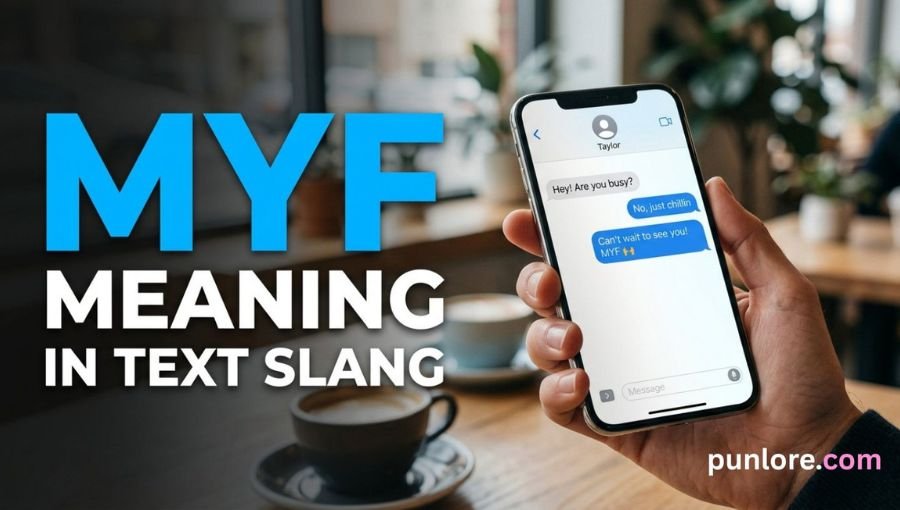
MYF Meaning in Text Slang: Definition, Context, Examples, and Modern Usage (2026 Guide)
If you’ve searched for MYF Meaning in Text Slang after seeing “MYF” in a text, DM, or social-media comment, you’re not alone. You might receive a message like, “Hey MYF, you coming tonight?” and wonder whether the sender simply means “my friend” or something more personal.
In casual texting, MYF most commonly means “my friend.” It can be a quick, friendly way to address someone without typing the full phrase. However, slang isn’t always universal. Depending on the person and conversation, MYF can sometimes have another meaning, including an affectionate phrase such as “miss your face.”
That flexibility is why this abbreviation can be confusing. The same three letters may sound friendly in one message and more affectionate in another. The surrounding words, relationship between the people, punctuation, emojis, and communication platform can all provide useful clues.
This guide breaks down the most likely meaning, alternative interpretations, real text examples, social-media usage, relationship context, tone, and situations where using MYF could cause confusion. Let’s start with the simplest definition.
Quick Answer / Quick Definition of “MYF Meaning in Text Slang”
MYF most commonly means “my friend” when used as casual text slang. It can be used to address someone warmly or informally, similar to “friend” or “buddy.” In some conversations, MYF may have another meaning, such as “miss your face,” so the surrounding context is essential.
In other words, MYF Meaning in Text Slang is usually friendly, but it isn’t completely universal.
Detailed Meaning Breakdown
Primary Meaning
The most straightforward interpretation of MYF in casual messaging is “my friend.”
Someone might write:
“What’s up, MYF?”
Here, MYF functions as a friendly form of address. The sender isn’t necessarily making a deep statement about the relationship. They may simply be using abbreviated language to make the message faster, shorter, or more casual.
You might see this style among friends, online acquaintances, gaming groups, or people who already have a relaxed communication style.
One useful rule is to read MYF as part of the entire sentence. If the message is about meeting up, joking around, or checking in, “my friend” will often make the most sense.
The phrase can also appear in lowercase as myf. Texting users don’t always care about capitalization, especially in quick messages.
Secondary Meanings
A less common interpretation is “miss your face.”
This version has a noticeably more affectionate feel. For example:
“Haven’t seen you in forever. MYF!”
In that context, the writer may be shortening a playful expression that means they miss seeing the other person.
This interpretation is more dependent on personal texting habits. It isn’t safe to assume every MYF means “miss your face.”
Another possibility is that the sender has created a personal abbreviation with friends or uses a niche community’s slang. Group chats often develop their own shorthand. What looks like a standard acronym may actually be an inside joke.
Rare or Misinterpreted Meanings
The biggest mistake people make with MYF Meaning in Text Slang is assuming that every three-letter abbreviation has one official definition.
MYF isn’t like a universally understood term such as “LOL.” Its meaning can change based on the person, community, and sentence.
If someone writes:
“Thanks, MYF!”
“my friend” could fit naturally.
If they write:
“MYF, I wish you were here.”
A more affectionate interpretation may be possible.
That doesn’t automatically make the message romantic. Context should decide the meaning, not the abbreviation alone.
What “MYF Meaning in Text Slang” Means in Different Contexts
In Texting and Messaging
In ordinary texting, MYF can work as a short, casual way to address someone as “my friend.”
For example:
“Good luck today, MYF. You’ve got this.”
The abbreviation keeps the message informal without changing its basic purpose.
Texting language often removes unnecessary words. People type “u,” “brb,” “idk,” and other shortened forms because speed matters more than formal grammar. MYF fits that general habit when both people understand it.
You may notice that some users put MYF at the beginning of a sentence while others place it after a greeting. Capitalization also varies.
A practical observation: when an abbreviation appears only once in a conversation, don’t overanalyze it. The rest of the message usually provides the strongest clue.
On Social Media Platforms
Social platforms create slightly different environments for slang.
On Instagram, MYF might appear in a DM, comment, or casual caption. A friend could comment, “Looking good, MYF!” to keep the interaction playful.
On Snapchat, where quick conversations and short messages are common, abbreviations can feel even more natural. A message such as “Where you at MYF?” is informal and conversational.
On TikTok, MYF could appear in comments or direct messages, but its meaning may depend heavily on the creator’s audience. Slang used by one community isn’t necessarily standard across TikTok.
On Threads, users may use MYF in replies or conversational posts, although more users may simply write “my friend” because public posts often favor readable language.
The platform changes the setting, but it doesn’t automatically change the definition. MYF Meaning in Text Slang still needs to be interpreted through context.
In Dating and Relationships
MYF can appear in romantic conversations, but seeing it doesn’t automatically mean the sender has romantic feelings.
Consider:
“Thanks for checking on me, MYF ❤️”
The heart emoji adds warmth, but the abbreviation itself still doesn’t prove romance.
A couple might also use MYF casually because they have developed their own texting habits. On the other hand, someone who is flirting might use an affectionate interpretation such as “miss your face.”
Look at the surrounding language. “MYF, see you tomorrow” is very different from “MYF, I can’t stop thinking about you.”
The relationship matters more than the three letters.
In Professional Communication
MYF is generally not a good choice for formal workplace communication.
A message such as:
“Please review the report, MYF.”
could confuse a coworker who doesn’t know the abbreviation. It may also make a professional message sound unnecessarily casual.
In an office, school, client conversation, application, or business email, write “my friend” only when that relationship and wording genuinely fit. Otherwise, use the person’s name or a professional greeting.
Slang works best when both sides already share the same communication style. Workplaces often contain people from different age groups and language backgrounds, so clarity should come first.
Cultural or Regional Differences
Slang isn’t distributed evenly across English-speaking communities.
An abbreviation familiar to one group may be completely unknown to another. American teenagers, international English speakers, gamers, and older adults can have very different texting vocabularies.
That matters when interpreting MYF Meaning in Text Slang. A U.S. user may encounter an abbreviation through social media, while someone elsewhere may use the same letters differently.
Regional culture isn’t the only factor. Age matters too. Younger users often experiment with rapidly changing online shorthand, while older users may prefer complete words.
When in doubt, ask. A simple “What does MYF mean here?” is better than confidently misunderstanding someone.
Tone, Psychology & Why People Use It
Why People Use It & What It Signals Socially
People shorten phrases for several reasons.
Speed is one. Three letters take less effort than typing two words.
Informality is another. Abbreviations make messages feel conversational rather than polished.
There is also a sense of belonging. Shared slang can signal that two people understand the same online culture or communication style.
When someone uses MYF, they may be signaling familiarity. But that signal is usually mild. It doesn’t automatically indicate a close friendship.
The social meaning comes from the complete message. A supportive sentence can make MYF sound warm. A sarcastic sentence can make the same letters feel teasing.
Emotional Layer Behind It
Tone is where MYF Meaning in Text Slang becomes more interesting.
A friendly version might look like:
“Morning MYF! Hope your exam goes well.”
That’s warm and encouraging.
A neutral version could be:
“MYF, are you still coming at 7?”
This sounds practical and casual.
A colder version is possible when punctuation or surrounding language changes:
“Sure, MYF.”
Without more context, that could even sound sarcastic.
Emojis can also shift the emotional layer. A heart, laughing emoji, or affectionate wording can make a message warmer. Short replies, periods, or blunt language can make it feel less friendly.
The abbreviation doesn’t carry the whole emotion. The sentence does.
10 Real Conversation Examples (Explained)
1. Friendly Check-In
Message: “Hey MYF, how have you been?”
Intended meaning: “Hey my friend, how have you been?”
Tone: Warm and casual.
Likely interpretation: The sender is greeting someone they consider a friend or friendly acquaintance.
2. Encouragement
Message: “You’re going to crush that interview, MYF!”
Intended meaning: A supportive message addressed to a friend.
Tone: Positive and enthusiastic.
Likely interpretation: The sender wants to encourage the recipient, not necessarily flirt with them.
3. Making Plans
Message: “MYF, what time are we meeting?”
Intended meaning: “My friend, what time are we meeting?”
Tone: Casual and practical.
Likely interpretation: The sender is treating MYF as a familiar form of address.
4. Affectionate Message
Message: “It’s been months. MYF!”
Intended meaning: Potentially “miss your face.”
Tone: Affectionate and playful.
Likely interpretation: Context suggests the person may be saying they miss seeing the recipient.
5. Social Media Comment
Message: “Great photo, MYF!”
Intended meaning: A friendly compliment.
Tone: Cheerful.
Likely interpretation: The commenter probably sees the recipient as a friend or friendly contact.
6. Gaming Chat
Message: “MYF, cover the left side!”
Intended meaning: A quick informal address during a game.
Tone: Direct but friendly.
Likely interpretation: The player is communicating quickly with a teammate.
7. Relationship Context
Message: “Goodnight, MYF ❤️”
Intended meaning: Could simply be “goodnight, my friend,” or a personalized affectionate expression.
Tone: Warm.
Likely interpretation: The heart makes the message more intimate, but it still doesn’t prove romantic intent.
8. Group Conversation
Message: “MYF, you forgot your jacket again.”
Intended meaning: A playful reminder.
Tone: Familiar and teasing.
Likely interpretation: The sender knows the person well enough to joke with them.
9. Ambiguous Message
Message: “Thanks, MYF.”
Intended meaning: Probably “thanks, my friend.”
Tone: Neutral to friendly.
Likely interpretation: Without more context, there’s no strong reason to read romance or sarcasm into it.
10. Emotional Conversation
Message: “I really needed someone to talk to. Thanks, MYF.”
Intended meaning: The sender is expressing appreciation to a trusted person.
Tone: Sincere and emotional.
Likely interpretation: Here, MYF reinforces a sense of friendship and support.
These examples show why there isn’t one perfect emotional translation. MYF Meaning in Text Slang changes subtly when the surrounding words change.
Where Misunderstandings Happen
Context Confusion
The biggest problem is assuming an abbreviation has only one definition.
Someone may read MYF as “my friend” while the sender intended something more personal. If the rest of the message doesn’t provide clues, guessing can create unnecessary confusion.
The safest approach is to consider the complete conversation.
Generational Gap
Younger and older users may interpret abbreviations differently.
Someone who spends a lot of time on social media may recognize unfamiliar slang quickly. Another person may see MYF and assume it’s a typo.
Neither reaction is unusual. Online language changes quickly, and not everyone learns the same vocabulary at the same speed.
Platform Differences
A private DM, public comment, gaming chat, and workplace message have different communication rules.
A slang term that feels normal between friends can look strange in a professional setting. Likewise, a public comment may need more context than a private message between close friends.
Similar Words, Symbols, or Abbreviations
| Term | Meaning | How It Differs from MYF Meaning in Text Slang |
|---|---|---|
| BFF | Best friend forever | Stronger and more specific friendship language |
| BF | Boyfriend or best friend | Meaning depends heavily on context |
| BUD | Buddy | A casual word rather than an abbreviation with multiple possible expansions |
| FR | For real | Shows agreement or sincerity rather than addressing a friend |
| IMO | In my opinion | Introduces a personal view |
| IDK | I don’t know | Expresses uncertainty rather than friendship |
| LOL | Laughing out loud | Expresses amusement |
| TY | Thank you | Expresses gratitude |
| WYD | What are you doing? | Asks a question rather than describing a relationship |
| HBU | How about you? | Returns a question to the other person |
The comparison makes one thing clear: MYF is primarily an address or relationship-related abbreviation, while many popular texting terms describe an action, reaction, or conversational function.
When Not to Use “MYF Meaning in Text Slang”
Professional Risks
Avoid MYF in formal emails, job applications, customer support messages, business proposals, and important workplace communication.
Even if you know what it means, the reader may not. Unfamiliar slang creates an unnecessary barrier.
A professional message should be clear on the first read. There are better places for experimentation with abbreviations.
Cultural Risks
Not every audience shares the same slang vocabulary.
International readers may interpret MYF differently, while someone unfamiliar with texting shorthand may not understand it at all. If the relationship crosses cultures or age groups, plain English is often the safer option.
This is particularly relevant when a message could have serious consequences.
Tone Risks
MYF can sound too familiar in a relationship that isn’t actually close.
Imagine receiving a message from a new manager saying, “Thanks, MYF.” Depending on the workplace culture, that could sound friendly, strange, or overly personal.
Tone should match the relationship. MYF Meaning in Text Slang works best when the sender and recipient already share an informal communication style.
Expert Tips for Using “MYF Meaning in Text Slang” Correctly
- Check the whole sentence first. Don’t interpret MYF in isolation.
- Start with “my friend” as the likely meaning when the conversation is clearly casual and friendly.
- Consider affectionate alternatives if the surrounding message talks about missing someone or seeing them.
- Look at the sender’s usual style. Personal texting habits are strong clues.
- Pay attention to emojis. They can make a neutral abbreviation feel warmer or more playful.
- Don’t assume romance. MYF alone isn’t evidence of romantic interest.
- Avoid it in formal communication. Clear, standard wording is usually better at work.
- Ask for clarification when necessary. A quick question can prevent a major misunderstanding.
- Consider the platform. A gaming chat may use slang more freely than a business DM.
- Match the other person’s tone. If they use informal shorthand, a casual response may feel natural; if they don’t, write normally.
One practical trick is to mentally expand the abbreviation before responding. If “my friend” makes the sentence sensible, that’s a strong contextual clue. If it sounds strange, consider another interpretation.
Frequently Asked Questions
1. What does MYF mean in texting?
In casual texting, MYF most commonly means “my friend.” It can be used as an informal way to address someone in a friendly conversation. However, MYF isn’t a universally standardized abbreviation, so another meaning may apply when the surrounding message suggests a different phrase.
2. Is MYF a positive or negative abbreviation?
MYF is generally neutral to positive when it means “my friend.” The emotional effect depends on the rest of the message, though. Supportive wording can make it warm, while sarcasm or blunt punctuation can change how it feels. The abbreviation itself doesn’t normally carry a negative meaning.
3. Can MYF have a romantic meaning?
It can appear in romantic or affectionate conversations, but MYF doesn’t automatically mean romance. Some people may use it in an affectionate phrase such as “miss your face,” while others simply mean “my friend.” Look at the relationship, wording, emojis, and previous messages before deciding what the sender intended.
4. How should I respond when someone texts MYF?
If you’re confident they mean “my friend,” simply respond naturally. You don’t need to repeat the abbreviation. For example, you could answer, “Hey! What’s up?” If you’re unsure what they mean, asking “What do you mean by MYF?” is completely reasonable and avoids guessing.
5. Does MYF always mean “my friend”?
No. Context determines the meaning. “My friend” is a common interpretation, but some users employ MYF as an abbreviation for another phrase. Personal texting habits, online communities, and the surrounding sentence can all affect the definition. Treat it as contextual slang rather than a fixed universal acronym.
6. Is MYF commonly used on Instagram and TikTok?
MYF can appear on Instagram and TikTok, particularly in comments, DMs, and informal conversations, but it isn’t among the most universally recognized social-media abbreviations. Because usage varies between communities, a reader shouldn’t assume every Instagram or TikTok appearance has exactly the same meaning.
7. Is MYF appropriate to use at work?
Usually, no, especially in formal communication. A coworker may understand it, but a manager, customer, client, or international colleague may not. Writing the full phrase or using the person’s name is clearer. Save MYF for situations where the relationship is informal and both people understand the shorthand.
8. What should I do if I can’t tell what MYF means?
Look for clues in the sentence and previous messages. If the conversation is friendly, “my friend” may fit naturally. If the person is discussing missing someone, another affectionate expansion might make sense. When neither interpretation fits, simply ask the sender. Clarification is better than confidently assuming the wrong meaning.
Final Summary & Smart Usage Advice
Understanding MYF Meaning in Text Slang is less about memorizing three letters and more about reading the situation around them.
In many casual conversations, MYF means “my friend.” It can be a short, friendly way to address someone in texts, DMs, social-media comments, gaming chats, and other informal spaces. Some people may use the same abbreviation for an affectionate phrase such as “miss your face,” which is why context matters.
The safest interpretation comes from combining several clues: the exact sentence, the relationship between the sender and recipient, the platform, the person’s usual texting style, and any emojis or punctuation.
Don’t automatically interpret MYF as romantic. Don’t assume it has one universal definition. And don’t use it in formal professional communication unless you know the audience will understand it.
If someone sends you MYF and you’re unsure, you don’t need to decode it like a secret message. Read the surrounding conversation first. If the meaning still isn’t clear, ask.
The simplest takeaway is this: MYF usually signals friendly informality, but the conversation around it determines what the sender really means.
Also Read This: GPI Meaning Slang



Pingback: PMO Slang Meaning: Definition & Examples 2026
Pingback: Torta Meaning in Slang: 2026 Definition & Uses
Pingback: Akeem Meaning: Definition, Origin & Uses 2026
Pingback: Yurrr Mean in Text: Meaning & Examples 2026
Pingback: What Does Unc Mean Slang? 2026 Meaning & Uses
Pingback: Zesty Meaning Slang: Definition & Examples 2026
Pingback: IFYKYK Meaning in Text: 2026 Guide & Examples
Pingback: GFE Meaning: Definition, Context & Examples 2026
Pingback: Honey Pack Meaning: Definition & Slang Guide 2026
Pingback: WWA Meaning: What Does WWA Mean? 2026 Guide