WTV Meaning in Text: Definition, Context, Examples, and Modern Usage (2026 Guide)
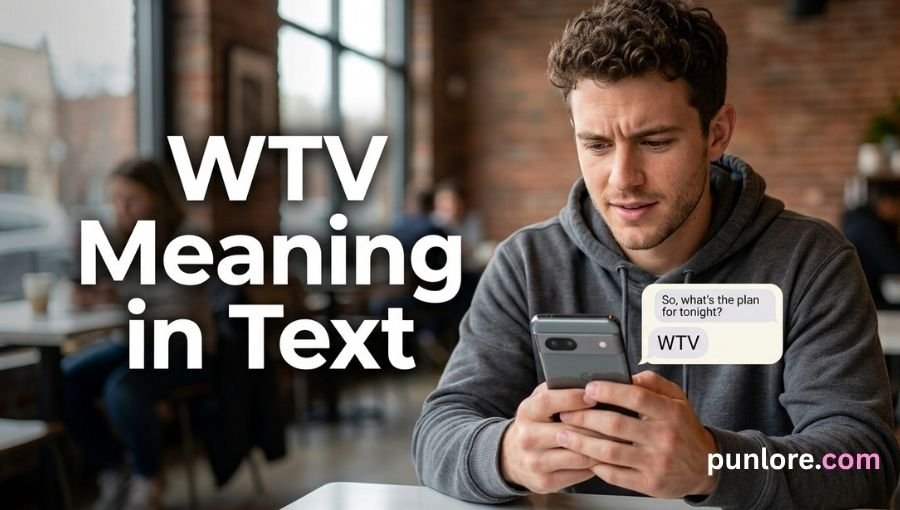
You send a friend a detailed plan for Saturday. Their reply arrives: “WTV.” You pause for a second. Are they agreeing? Annoyed? Do they simply not care? That small moment explains why so many people search for the WTV meaning in text.
Short forms move fast through texting, Snapchat, TikTok, Instagram, and group chats, but tone doesn’t always travel with them. The same three letters can sound relaxed, playful, dismissive, or even a little cold.
WTV is especially common among younger internet users because it saves time and matches casual online speech. Still, understanding the abbreviation isn’t just about memorizing a definition. The surrounding conversation, punctuation, relationship, and platform can all change how it feels.
I’ve seen “wtv” end a completely harmless conversation and, in another chat, create an unnecessary argument. Context really is the difference.
This guide explains what the abbreviation means, how people use it, what emotions may sit behind it, and how to respond without guessing blindly.
Quick Answer / Quick Definition of “WTV Meaning in Text”
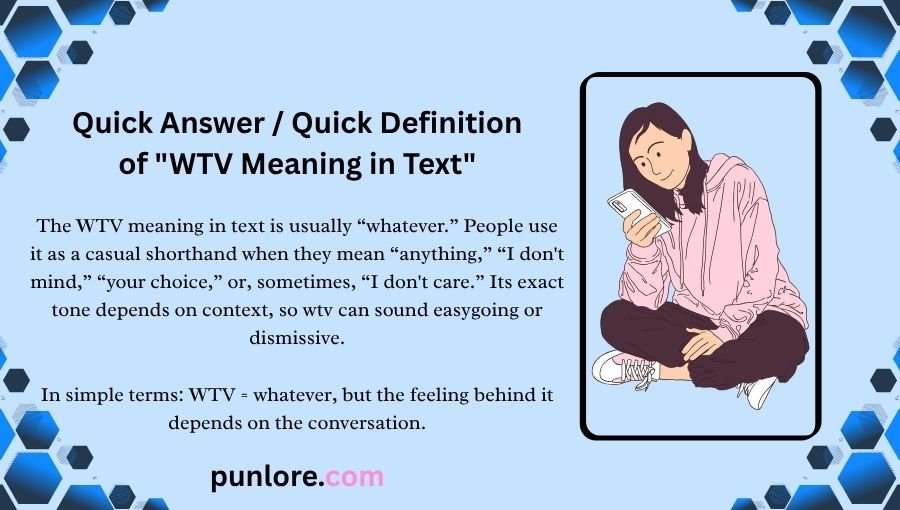
The WTV meaning in text is usually “whatever.” People use it as a casual shorthand when they mean “anything,” “I don’t mind,” “your choice,” or, sometimes, “I don’t care.” Its exact tone depends on context, so wtv can sound easygoing or dismissive.
In simple terms: WTV = whatever, but the feeling behind it depends on the conversation.
Detailed Meaning Breakdown
Primary Meaning
The main meaning of wtv is whatever.
For example:
“Do you want pizza or burgers?”
“Wtv, I’m good with either.”
Here, the person isn’t rejecting the question. They’re saying they have no strong preference. This is one of the most neutral and common uses.
The WTV meaning in text becomes especially clear when someone is responding to a choice, suggestion, or uncertain plan. It often means, “I’m flexible.”
Secondary Meanings
WTV can also mean “anything is fine” or “you decide.”
A friend might write, “We can watch wtv movie you want.” In that sentence, it doesn’t mean “I don’t care” in a rude way. It simply means whichever.
It can also signal that someone doesn’t want to spend more energy discussing a minor issue. For instance: “Wtv time works for everyone is fine with me.”
That relaxed attitude is common in fast-moving group chats.
Rare or Misinterpreted Meanings
WTV usually isn’t a hidden code, a secret symbol, or a separate word with a fixed meaning. People occasionally assume it always means anger or disrespect. That’s not true.
Lowercase “wtv” can feel casual. “WTV.” with a period may feel firmer. “WTV!!!” can sound dramatic or sarcastic.
The letters stay the same. The context changes the message.
What “WTV Meaning in Text” Means in Different Contexts
In Texting and Messaging
In ordinary texting, the WTV meaning in text usually comes down to “whatever” or “anything you want.”
Example:
“Should I pick you up at 7 or 8?”
“Wtv is easier for you.”
Intended meaning: You choose.
That response sounds cooperative because the sender adds a helpful phrase after the abbreviation. Compare it with a bare “wtv.” A one-word reply can feel much less warm.
On Social Media Platforms
On Instagram, wtv may appear in captions or comments to show a carefree attitude: “Wearing wtv I want.”
On Snapchat, it often appears in quick, informal replies because conversations move quickly: “Wtv lol, send the pic.”
On TikTok, people may use it in comments or captions to brush off criticism: “People will hate on wtv you do anyway.”
On Threads, where text-based conversation can be more opinion-driven, “wtv” may sound dismissive when replying to an argument: “Wtv, agree to disagree.”
In DMs and stories, punctuation and emojis can strongly affect tone. A casual “wtv 😭” feels very different from “WTV.”
In Dating and Relationships
The WTV meaning in text can become tricky in romantic conversations.
Example:
“Where do you want to go tonight?”
“Wtv, surprise me.”
That can sound playful and trusting.
But consider this:
“Are you still upset with me?”
“Wtv.”
Now the likely message is very different. The sender may be frustrated, emotionally tired, or unwilling to continue the discussion.
In relationships, short answers often carry more emotional weight because people know each other’s normal communication style.
In Professional Communication
WTV is usually best avoided at work.
Imagine receiving this message from a coworker:
“Which version should we send to the client?”
“Wtv.”
Even if the writer means “either version is okay,” the reply may look careless or unprofessional. A clearer alternative is: “Either version works for me.”
I’ve found that abbreviations are safest when there is no chance of ambiguity. Workplace messages often need clarity more than speed.
Cultural or Regional Differences
The basic meaning of wtv is widely understood among English-speaking internet users, especially in the United States. However, the abbreviation may be less familiar to older adults, formal speakers, or people who learned English outside online culture.
Age can matter too. Teenagers and younger adults may see it as ordinary chat language. Someone who rarely uses social media might read it as abrupt.
Regional differences are usually less important than digital culture and generation. The more familiar someone is with internet slang, the more natural wtv will seem.
Tone, Psychology & Why People Use It
Why People Use It & What It Signals Socially
People use wtv because it’s quick. It can also signal a low-pressure attitude.
Sometimes the message is, “I trust your decision.” Other times, it’s, “This isn’t worth arguing about.”
That difference is psychological. Short slang can help people avoid sounding overly serious. It can also create emotional distance when someone doesn’t want to explain themselves.
A person typing “wtv, let’s go” is usually moving the conversation forward. A person typing only “wtv” may be stepping away from it.
Emotional Layer Behind It
The WTV meaning in text can carry several emotional tones:
Friendly: “Wtv you pick, I’ll be happy 😊”
The sender sounds relaxed and cooperative.
Neutral: “Wtv works for the group.”
There is no strong preference.
Cold: “Wtv.”
The sender may be annoyed or disengaged.
Playful: “Wtv, you’re still taking me for ice cream.”
The abbreviation becomes part of a joke.
This is why reading one abbreviation without the surrounding messages can be misleading.
10 Real Conversation Examples (Explained)
- Message: “Do you want coffee or tea?” — “Wtv, both sound good.”
Intended meaning: Either choice is fine. Emotional tone: Easygoing. Likely interpretation: No preference. - Message: “What should we wear to the party?” — “Wtv fits the theme.”
Intended meaning: Follow the event’s style. Emotional tone: Practical. Likely interpretation: The sender is giving flexible guidance. - Message: “I said sorry already.” — “Wtv.”
Intended meaning: The sender doesn’t want to continue. Emotional tone: Cold or frustrated. Likely interpretation: The issue may not be resolved. - Message: “You pick the movie.” — “Wtv, but no horror.”
Intended meaning: Any choice within one limit. Emotional tone: Relaxed. Likely interpretation: The sender has a small preference. - Message: “People are talking about your post.” — “Wtv, let them talk.”
Intended meaning: Ignore other people’s opinions. Emotional tone: Defiant. Likely interpretation: The sender is brushing off criticism. - Message: “Should I call tonight?” — “Wtv time you’re free ❤️”
Intended meaning: Call whenever convenient. Emotional tone: Warm. Likely interpretation: The person wants to talk. - Message: “The restaurant is booked.” — “Wtv, let’s find another one.”
Intended meaning: The problem isn’t a big deal. Emotional tone: Calm. Likely interpretation: Move on and make a new plan. - Message: “Are you mad at me?” — “Wtv makes you think that?”
Intended meaning: A variation meaning “what makes you think that?” Emotional tone: Questioning or defensive. Likely interpretation: The sender wants an explanation. - Message: “I think my outfit looks weird.” — “Wtv, you look great.”
Intended meaning: Stop worrying about the small detail. Emotional tone: Reassuring and casual. Likely interpretation: The sender is trying to encourage confidence. - Message: “We can keep arguing if you want.” — “WTV.”
Intended meaning: The sender is done discussing it. Emotional tone: Strongly dismissive. Likely interpretation: Give the conversation some space.
Where Misunderstandings Happen
Context Confusion
The biggest problem with the WTV meaning in text is that “whatever” has both neutral and negative uses.
“Wtv works for you” sounds flexible.
“Wtv.” after an argument may sound like a verbal shrug.
Always read the message before and after it. One word rarely tells the whole story.
Generational Gap
Younger users often treat abbreviations as normal conversation shortcuts. Older users may expect complete words and sentences.
A parent, manager, or teacher might not understand wtv at all. Another person may understand it but consider it rude.
When you don’t know the reader’s communication style, spelling out whatever or using a clearer phrase is safer.
Platform Differences
Platform culture matters.
A TikTok comment can be blunt because public comments are often short and fast. A private relationship DM may feel more personal. A Snapchat reply can be casual simply because the app encourages quick exchanges.
The same letters can therefore carry different weight depending on where the conversation happens.
Similar Words, Symbols, or Abbreviations
| Term | Meaning | How It Differs from WTV Meaning in Text |
|---|---|---|
| IDC | I don’t care | Usually more directly indifferent |
| IDK | I don’t know | Shows uncertainty rather than flexibility |
| NVM | Never mind | Withdraws a statement or request |
| IG | I guess | Shows uncertainty or mild agreement |
| IKR | I know, right? | Expresses strong agreement |
| TBH | To be honest | Introduces a frank opinion |
| BRB | Be right back | Explains a temporary absence |
| SMH | Shaking my head | Shows disappointment or disbelief |
| K | Okay | Can sound neutral or cold depending on context |
| IDC, WTV | I don’t care, whatever | Combining them makes the message much more dismissive |
When Not to Use “WTV Meaning in Text”
Professional Risks
Don’t use wtv when clarity matters.
Avoid it in emails, client messages, formal requests, performance discussions, job applications, or communication with someone you don’t know well. The abbreviation can make you seem uninterested.
Instead of “wtv works,” say “I’m flexible and can work with either option.”
Cultural Risks
Not everyone knows internet slang.
If you’re speaking with an international audience or someone unfamiliar with English abbreviations, wtv may confuse them. Clear language is more inclusive.
When communication crosses cultures, simple words usually work best.
Tone Risks
Avoid a bare “wtv” when someone is sharing feelings, asking for help, or discussing a serious problem.
For example, replying “wtv” to “I’m worried about tomorrow” can sound uncaring even if you didn’t mean it that way.
When emotions are involved, add context. A few extra words can prevent a bad impression.
Expert Tips for Using “WTV Meaning in Text” Correctly
- Use wtv mainly in casual conversations with people who understand internet slang.
- Add a few words after it when you want to sound cooperative: “Wtv works best for you.”
- Avoid sending “wtv” alone during an argument unless you truly mean to end the discussion.
- Pay attention to punctuation; “wtv” and “WTV.” can feel different.
- Use a warm emoji or phrase when the topic could otherwise sound cold.
- Don’t use it in formal emails, client communication, or important workplace decisions.
- Match the other person’s communication style instead of forcing slang into every message.
- If you mean “I don’t know,” use IDK rather than wtv.
- If you mean “I don’t care,” consider whether that bluntness is really what you want to communicate.
- When in doubt, write the full thought. Clarity beats speed.
Frequently Asked Questions
What does WTV mean in a text?
WTV usually means “whatever.” It can show that a person has no preference, is open to any option, or wants to dismiss a topic. The surrounding conversation tells you which meaning is most likely. A friendly phrase after wtv usually makes the tone clearer.
Is WTV positive or negative?
It can be either. “Wtv you want is fine” is usually neutral or positive because it shows flexibility. A short “wtv” after an argument may feel negative. The abbreviation itself isn’t rude; the situation, wording, punctuation, and relationship create the tone.
What does WTV mean from a girl or guy?
WTV generally has the same basic meaning regardless of gender: whatever. Don’t assume it has a special hidden meaning because of who sent it. Look at the topic, previous messages, and the person’s normal texting style before deciding whether it sounds friendly, playful, or annoyed.
Can WTV be romantic?
Yes, but usually only through context. “Wtv time you’re free, I want to see you” can sound affectionate and flexible. By itself, however, wtv isn’t a romantic abbreviation. The romantic feeling comes from the rest of the message and the relationship between the two people.
How should I respond to WTV in a text?
Match your response to the situation. If the person seems flexible, make a decision: “Okay, let’s do 7.” If they seem annoyed, you can gently ask, “Are you sure you’re okay with that?” If their meaning is unclear, a calm follow-up is better than guessing.
Does WTV mean “I don’t care”?
Sometimes, but not always. That’s one of the most common misunderstandings. “Wtv restaurant is fine” means the person doesn’t have a preference. “Wtv” after a disagreement may mean they no longer care to discuss the issue. The difference is emotional context.
Is WTV rude?
WTV can sound rude when it is used as a one-word response to something serious or emotional. In casual conversations, it may be completely harmless. Adding context makes it safer. “Wtv works for you” is generally much warmer than simply typing “wtv.”
What does WTV mean on Snapchat, TikTok, or Instagram?
On these platforms, wtv still usually means “whatever,” but the tone can change with the format. On Snapchat, it often appears in fast private chats. On TikTok, it may dismiss criticism. On Instagram, it can appear in carefree captions, comments, stories, and DMs.
Final Summary & Smart Usage Advice
The WTV meaning in text is simple at its core: it usually means “whatever.” What makes the abbreviation interesting is its flexibility. It can mean “your choice,” “anything is fine,” “I’m not worried about it,” or “I don’t want to talk about this anymore.”
That’s why context matters so much.
WTV works best in casual chats with friends, family members, or people who understand your tone. It can be useful when you’re genuinely flexible and don’t have a strong preference. Adding a few extra words often makes your meaning much clearer.
The biggest mistakes are using it alone in an emotional conversation, assuming everyone understands internet slang, or putting it into professional communication where it may look careless.
Before you send it, ask yourself one quick question: Will the other person understand how I mean this? If the answer is no, write a little more.
You now have the full picture: meaning, tone, context, examples, misunderstandings, and smart alternatives.
Final takeaway: WTV may be short, but the conversation around it determines what it really says.
Also Read This: What Does WS Mean in Text



Pingback: NTM Meaning Slang: Definition & Examples 2026