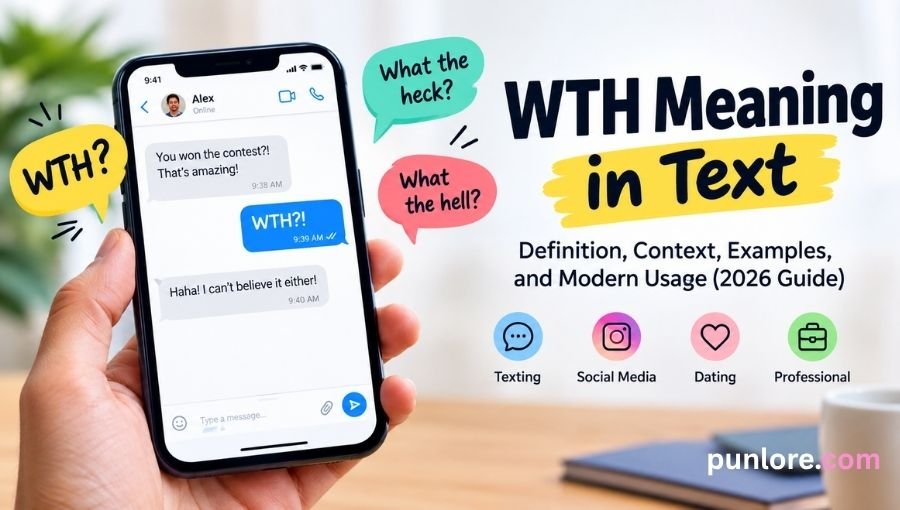
WTH Meaning in Text: Definition, Context, Examples, and Modern Usage (2026 Guide)
Have you ever opened a text from a friend and seen “WTH?” with no idea what they meant? Understanding WTH Meaning in Text is easier than it may seem. Imagine getting an unexpected message, seeing a shocking photo, or hearing surprising news. Your first reaction might be, “What just happened?” That is exactly the kind of moment when someone might type WTH.
This abbreviation is commonly used to express surprise, confusion, disbelief, or frustration. Depending on the situation, WTH can stand for “What the heck?” or “What the hell?” The intended tone usually depends on the surrounding words, punctuation, emojis, and relationship between the people chatting.
I often see short internet abbreviations create confusion because the same three letters can feel playful in one conversation and annoyed in another. That’s why knowing only the literal meaning isn’t enough.
In this guide, you’ll learn what WTH means, how people use it in texts and social media, what it can signal in relationships, and when it’s better to avoid it.
Quick Answer / Quick Definition of “WTH Meaning in Text”
WTH meaning in text usually refers to “What the heck?” or “What the hell?” It expresses surprise, confusion, disbelief, frustration, or mild shock. The abbreviation is common in texts, DMs, comments, and casual online conversations. In simple terms, WTH is a quick emotional reaction to something unexpected or confusing.
Detailed Meaning Breakdown
Primary Meaning
The most common meaning of WTH is “What the heck?” or “What the hell?” It works as a reaction rather than a formal question.
For example:
“WTH happened to your car?”
Here, the sender is surprised by the car’s condition and wants an explanation.
The phrase can also stand alone:
“WTH?!”
That usually communicates strong surprise or confusion without needing additional words.
Secondary Meanings
Depending on the person, WTH may be understood as “What the heck,” “What the hell,” or occasionally a softer variation such as “What the what.”
The first two interpretations are by far the most common. Some people choose WTH specifically because it lets them express frustration without typing profanity directly.
For example:
“WTH, why is the meeting at 6 a.m.?”
This sounds annoyed and surprised rather than seriously angry.
Rare or Misinterpreted Meanings
WTH doesn’t always carry the same emotional weight. Some people use it jokingly, especially when reacting to a friend’s unusual behavior.
A message such as:
“WTH 😂 You actually bought that?”
may be playful rather than hostile.
One useful observation is that punctuation and emojis often reveal more about the intended mood than the abbreviation itself.
What “WTH Meaning in Text” Means in Different Contexts
In Texting and Messaging
In ordinary texting, WTH is a fast reaction to something surprising, confusing, ridiculous, or irritating.
For example:
“WTH are you talking about?”
This could mean genuine confusion. But:
“WTH 😂 That was hilarious.”
has a completely different emotional flavor.
Capital letters, question marks, repeated punctuation, and emojis can change the feeling. “WTH?” sounds curious, while “WTH!!!” can sound much more shocked.
On Social Media Platforms
On Instagram, Snapchat, TikTok, and Threads, WTH can appear in comments, captions, stories, and DMs.
On TikTok, someone might comment:
“WTH did I just watch?”
On Instagram, a friend could reply to a strange story:
“WTH 😭”
Snapchat conversations often use it as an instant reaction to photos or videos. On Threads, it may appear in casual discussions when someone disagrees with or questions a post.
The platform doesn’t fundamentally change the definition, but the surrounding culture can influence the tone and intensity.
In Dating and Relationships
In romantic conversations, WTH can be playful, confused, or irritated.
For example:
“WTH, you remembered our first date? ❤️”
That sounds pleasantly surprised.
But:
“WTH? Why didn’t you tell me?”
could signal frustration or hurt.
When you see WTH from a romantic partner, don’t automatically assume they’re angry. Look at the words before and after it, along with the relationship’s usual communication style.
In Professional Communication
WTH is generally too casual for formal workplace communication.
Sending:
“WTH is happening with this project?”
to a close coworker might be acceptable in a relaxed workplace, but sending it to a manager or client could appear disrespectful.
A safer alternative is:
“Could you clarify what happened with the project?”
Professional communication benefits from clarity without unnecessary emotional language.
Cultural or Regional Differences
WTH is widely understood in American online English, especially among people familiar with internet slang and texting abbreviations.
However, familiarity varies by age, language background, and online experience. Someone who rarely uses social media may understand the individual words but not recognize WTH immediately.
In international conversations, a plain phrase such as “What happened?” may be clearer.
Tone, Psychology & Why People Use It
Why People Use It & What It Signals Socially
People use WTH because it is short, expressive, and emotionally recognizable.
Typing three letters can communicate a reaction almost instantly. It can also soften a potentially stronger phrase by replacing the full wording with an abbreviation.
A message like:
“WTH 😂”
often signals casual disbelief between friends.
From my experience with online language, these abbreviations work almost like digital facial expressions. They help show an immediate reaction when the other person can’t see your face or hear your voice.
Emotional Layer Behind It
The same abbreviation can sound friendly, neutral, or cold.
Friendly:
“WTH 😂 You really wore that?”
Neutral:
“WTH is going on?”
Cold or irritated:
“WTH were you thinking?”
The surrounding vocabulary matters. Emojis may soften the expression, while blunt wording or multiple exclamation marks can make it feel confrontational.
10 Real Conversation Examples (Explained)
1. Surprise
Message: “WTH?! You won the contest?”
Meaning: The sender is genuinely surprised.
Tone: Excited and shocked.
Likely interpretation: Positive disbelief.
2. Confusion
Message: “WTH does this button do?”
Meaning: The person doesn’t understand something.
Tone: Curious and slightly confused.
Likely interpretation: A request for help.
3. Funny Reaction
Message: “WTH 😂 Why did you send me that?”
Meaning: The sender finds the situation funny.
Tone: Playful.
Likely interpretation: Friendly teasing.
4. Mild Frustration
Message: “WTH, the website is down again.”
Meaning: Something annoying happened unexpectedly.
Tone: Frustrated.
Likely interpretation: Complaint rather than anger toward a person.
5. Shock
Message: “WTH! They canceled the event?”
Meaning: The sender didn’t expect the cancellation.
Tone: Strong surprise.
Likely interpretation: Genuine disbelief.
6. Relationship Confusion
Message: “WTH happened after I left?”
Meaning: The person wants an explanation.
Tone: Curious but possibly concerned.
Likely interpretation: They need context.
7. Playful Teasing
Message: “WTH 😭 You actually ate the whole pizza?”
Meaning: The sender is joking about someone’s behavior.
Tone: Lighthearted.
Likely interpretation: Friendly humor.
8. Serious Irritation
Message: “WTH were you thinking?”
Meaning: The sender strongly disagrees with someone’s decision.
Tone: Irritated.
Likely interpretation: Confrontational.
9. Unexpected News
Message: “WTH, you’re moving to Texas?”
Meaning: The sender just learned surprising news.
Tone: Shocked and curious.
Likely interpretation: They want to know more.
10. Social Media Reaction
Message: “WTH is this video 😭”
Meaning: The content is strange, funny, or confusing.
Tone: Amused disbelief.
Likely interpretation: Casual online reaction.
Where Misunderstandings Happen
Context Confusion
The biggest problem is tone. WTH doesn’t automatically tell you whether someone is joking or angry.
Compare “WTH 😂” with “WTH.” The first may feel playful, while the second can appear cold or annoyed.
Generational Gap
Younger internet users may recognize WTH instantly, while older or less digitally active readers may not.
A person unfamiliar with abbreviations could interpret the message incorrectly or simply ask what it means.
Platform Differences
A phrase that feels normal in a TikTok comment may feel inappropriate in a business email.
Online communities develop their own communication habits. Always consider where the conversation is happening before judging the tone.
Similar Words, Symbols, or Abbreviations
| Term | Meaning | How It Differs from WTH |
|---|---|---|
| WTF | What the f*** | Usually stronger and more profane |
| OMG | Oh my God | Focuses more on surprise or excitement |
| What? | Direct question | Less slang-heavy and more neutral |
| IDK | I don’t know | Expresses uncertainty rather than surprise |
| SMH | Shaking my head | Often signals disappointment or disbelief |
| LOL | Laughing out loud | Signals humor rather than confusion |
| BRUH | Casual reaction | Often expresses disbelief, annoyance, or amusement |
| WTF?! | Strong shocked reaction | More intense and explicit than WTH |
When Not to Use “WTH Meaning in Text”
Professional Risks
Avoid WTH in formal emails, client messages, job applications, reports, and official communication.
Even when intended casually, it can make your writing appear careless or overly informal.
Cultural Risks
Not everyone interprets internet slang the same way. If you’re communicating with someone from a different language or cultural background, plain English is often safer.
Tone Risks
Don’t use WTH when emotions are already high. In an argument, the abbreviation can make a message sound more aggressive than intended.
If clarity matters more than speed, write the complete thought instead.
Expert Tips for Using “WTH Meaning in Text” Correctly
- Use WTH mainly in casual conversations.
- Check the surrounding context before interpreting someone’s tone.
- Use emojis when they genuinely help clarify a playful reaction.
- Avoid it in formal workplace communication.
- Don’t assume WTH always means anger.
- Remember that punctuation can change the perceived emotion.
- Use plain language with people unfamiliar with texting slang.
- Consider the relationship between you and the recipient.
- Don’t use it during sensitive conversations unless the tone is clearly appropriate.
- When confused by someone’s message, ask what they meant instead of assuming.
Frequently Asked Questions
1. What does WTH mean in texting?
WTH usually means “What the heck?” or “What the hell?” It is commonly used when someone feels surprised, confused, shocked, or annoyed. The abbreviation itself doesn’t determine the exact emotion. The surrounding message, punctuation, relationship, and conversation topic help reveal whether the sender is joking, curious, frustrated, or genuinely upset.
2. Is WTH a bad word?
WTH is not normally considered a swear word by itself because it is an abbreviation. However, it can represent “What the hell,” which contains mild profanity. Some people use it as a cleaner alternative to stronger expressions. If you’re communicating in a formal or sensitive setting, choosing neutral wording is still the better option.
3. Can WTH be positive?
Yes. WTH can express positive surprise when the surrounding conversation is friendly. For example, “WTH, you actually came!” could show excitement rather than anger. Emojis, exclamation marks, and affectionate language can make the intended emotion clearer. Never judge the abbreviation alone when deciding whether a message is positive.
4. Can WTH be used romantically?
It can be used between romantic partners, but it isn’t inherently romantic. A partner might write “WTH, you look amazing!” as a playful compliment or use it during an argument. The relationship context changes the emotional meaning. Pay attention to the complete sentence rather than treating the abbreviation as a romantic signal.
5. How should I respond to WTH?
Your response should match the situation. If someone sounds confused, explain what happened. If they’re joking, you can respond playfully. If the message seems angry, stay calm and ask what concerns them. A simple “What happened?” or “What do you mean?” can prevent unnecessary misunderstandings.
6. What does WTH mean on Snapchat?
On Snapchat, WTH generally has the same meaning as in regular texting: “What the heck?” or “What the hell?” Users may send it as a quick reaction to a photo, video, story, or message. Because Snapchat conversations are often informal, the abbreviation can sound playful, shocked, confused, or mildly annoyed.
7. Is WTH rude?
WTH can be mildly rude depending on how it’s used. “WTH 😂” between close friends may be harmless, while “WTH were you thinking?” can sound insulting. The wording around the abbreviation determines much of its impact. When you’re speaking to someone you don’t know well, a more neutral expression reduces the chance of sounding disrespectful.
8. Why do people type WTH instead of the full phrase?
People choose WTH because it is quick and expressive. Texting often favors short forms that communicate emotion without requiring a complete sentence. It can also make a reaction feel less explicit than writing the full phrase. In fast conversations, three letters can communicate surprise or disbelief almost instantly.
Final Summary & Smart Usage Advice
Understanding WTH meaning in text comes down to one simple idea: it’s usually a quick way to say “What the heck?” or “What the hell?” It can communicate surprise, confusion, disbelief, frustration, or playful shock.
The abbreviation is most natural in texts, DMs, social media comments, and casual conversations. With close friends, it may sound funny and relaxed. In romantic conversations, it can express anything from playful surprise to genuine frustration, depending on the surrounding words.
The biggest mistake is assuming WTH always means anger. It doesn’t. Context controls the tone. An emoji, punctuation mark, or even one extra sentence can completely change how the message feels.
It’s also smart to keep WTH out of formal communication unless you’re in an unusually casual workplace where slang is clearly accepted. When professionalism matters, write what you actually mean.
If someone sends you WTH and you’re unsure how to interpret it, look at the complete conversation before reacting.
The easiest rule to remember: WTH is short, but its tone comes from the context around it.
Also Read This: SN Meaning in Text


Pingback: BSFS Meaning: What Does BSFS Mean in Text & Slang?