Poison Tree Tattoo Meaning: Definition, Context, Examples, and Modern Usage (2026 Guide)
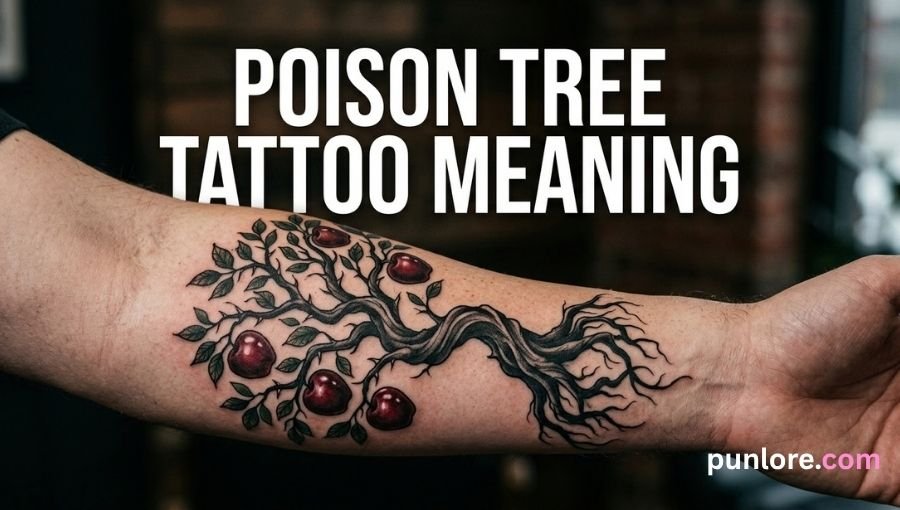
You see a tattoo of a dark tree, its branches twisting upward while small red fruits hang from the ends. At first glance, it looks beautiful. Then you learn the story behind it: anger that was never addressed, pain that grew quietly, or a difficult experience that changed someone forever. That is where the poison tree tattoo meaning becomes much deeper than the image itself.
People searching for this design are often trying to understand more than a tattoo. They want to know what the tree, fruit, roots, thorns, or dark imagery could represent—and whether the symbolism is negative, emotional, spiritual, or connected to William Blake’s famous poem A Poison Tree.
The design has also become popular because modern tattooing often blends literary references with personal experiences. A person may choose a poison tree after heartbreak, betrayal, grief, anger, recovery, or a period of personal transformation.
There isn’t one universal interpretation. The meaning depends heavily on the elements included in the artwork and the story of the person wearing it.
This guide breaks down the symbolism, emotional meanings, cultural context, social-media usage, conversation examples, and practical considerations so you can understand the design clearly.
Quick Answer / Quick Definition of “Poison Tree Tattoo Meaning”
The poison tree tattoo meaning usually represents hidden anger, resentment, emotional pain, consequences, or personal growth after a difficult experience. It can also reference William Blake’s poem A Poison Tree, where suppressed anger grows into something destructive. For some people, however, the image symbolizes healing, survival, transformation, or learning to confront difficult emotions.
Detailed Meaning Breakdown
Primary Meaning
The most common interpretation centers on anger that is allowed to grow.
This symbolism comes largely from William Blake’s 1794 poem A Poison Tree. In the poem, the speaker describes anger toward a friend being openly addressed and disappearing, while anger toward an enemy is hidden. That concealed anger grows into a tree bearing a poisonous apple.
A tattoo inspired by that idea can represent emotions that weren’t expressed when they should have been.
The tree becomes a visual metaphor for emotional growth—but not necessarily healthy growth. Roots can represent the original hurt. The trunk can symbolize years of accumulated emotion. Branches may represent the ways resentment spreads through someone’s life, while fruit can represent the eventual consequences.
I’ve noticed that the strongest interpretations often come from this layered symbolism rather than from the tree alone.
Secondary Meanings
The image can have several other meanings depending on the wearer.
Resilience is one possibility. A person might view the tree as proof that they survived an experience that once felt overwhelming.
Transformation is another. Something painful happened, but it became part of the person’s story and identity.
The design can also symbolize boundaries. Someone who has experienced betrayal may use the poisonous fruit as a reminder that not everyone deserves access to their life.
For others, the tattoo is about recognizing their own difficult emotions. Instead of pretending anger doesn’t exist, the artwork acknowledges it.
That makes the symbol surprisingly personal. Two people can have nearly identical tattoos while attaching completely different stories to them.
Rare or Misinterpreted Meanings
A dark tree isn’t automatically a symbol of evil.
Some viewers may assume that poisonous fruit represents danger, death, revenge, or hostility. Those interpretations are possible, but they’re not universal.
Likewise, the design doesn’t necessarily mean that the wearer is angry at someone right now. It may refer to past anger that has already been processed.
Another common mistake is assuming every poison tree tattoo directly references Blake’s poem. Some designs simply use the contrast between beauty and danger as their central concept.
The safest interpretation is therefore contextual: look at the artwork, accompanying symbols, and the wearer’s explanation before assigning a specific meaning.
What “Poison Tree Tattoo Meaning” Means in Different Contexts
In Texting and Messaging
The phrase isn’t normally used as a special texting abbreviation or slang term. If someone sends a picture of this tattoo in a message, however, the image can carry an emotional message.
For example:
“Thinking about getting this for everything I kept inside.”
Here, the tattoo represents suppressed feelings rather than literal poison.
Someone might also text:
“The tree is about what happens when anger grows.”
That explanation points directly toward the literary symbolism associated with Blake.
A different message could be much lighter:
“I just love the gothic look of the branches and fruit.”
In that situation, the person may care more about the visual style than the deeper symbolism.
On Social Media Platforms
On Instagram, the image may appear as a carefully photographed tattoo with a caption explaining its personal story. A caption such as “What I couldn’t say became part of me” gives the design an introspective tone.
TikTok often encourages storytelling. Someone might show the finished tattoo and explain the experience that inspired it, making the symbolism part of a longer personal narrative.
On Snapchat, the design may appear more casually in a story or private message. The explanation could be brief.
Threads can lean toward discussion, so someone might post the tattoo alongside a question about whether anger should be expressed or controlled.
The platform changes the presentation, but the underlying symbolism stays flexible.
In Dating and Relationships
In a relationship context, the tattoo can suggest betrayal, heartbreak, unresolved resentment, or emotional boundaries.
For example:
“I got this after realizing I kept forgiving people who hurt me.”
That doesn’t necessarily mean the wearer is still angry. It may describe a lesson learned from past relationships.
Another person could interpret the fruit as a reminder not to repeat unhealthy relationship patterns.
Dating partners shouldn’t automatically assume the tattoo is a warning directed at them. The image may have been chosen years before the relationship began.
If you’re curious, asking respectfully is better than making assumptions.
In Professional Communication
This phrase isn’t generally appropriate as professional jargon.
If a tattoo is visible in a workplace discussion, describing it as a personal symbol about resilience or emotional growth may be clearer than expecting coworkers to understand the literary reference.
A professional setting also isn’t the right place to assume that someone’s tattoo reveals their personality or emotional history.
For example, saying, “That must mean you’re an angry person,” could easily cross a personal boundary.
The design belongs to the individual. Its symbolism doesn’t give other people permission to diagnose their experiences.
Cultural or Regional Differences
The basic themes of anger, consequence, mortality, and transformation can travel across cultures, but interpretations vary.
People familiar with English literature may immediately connect the image with William Blake. Someone unfamiliar with the poem may instead see a gothic tree, fantasy artwork, or a symbol of danger.
Age can also influence recognition. A reader who encountered Blake in school may identify the reference quickly, while another person may never have heard of the poem.
Tattoo traditions also differ. Some cultures place strong symbolic value on trees as representations of life, ancestry, family, or spiritual connection. Adding poisonous fruit changes that traditional imagery and creates a more complex contrast.
Spiritual, Numerology, or Cultural Meaning
The design doesn’t have one fixed numerological meaning.
Its cultural and literary significance is much stronger than any universal number association. The most recognizable literary connection is William Blake’s A Poison Tree.
Trees themselves have broad symbolic meanings in many traditions. They can represent life, roots, family, wisdom, connection, endurance, and the passage of time.
A poisonous tree introduces another layer: something that looks alive or beautiful can contain danger beneath the surface.
This contrast is one reason the image works so well as tattoo symbolism.
Some people also use the design in a spiritual or personal-growth sense. The roots may represent old wounds, while new leaves can suggest recovery. In that interpretation, the tattoo isn’t celebrating resentment. It’s acknowledging a difficult chapter and the lessons that came from it.
The spiritual meaning therefore depends on the surrounding imagery and the person’s own beliefs.
Tone, Psychology & Why People Use It
Why People Use It & What It Signals Socially
A tattoo like this can communicate a complicated emotional idea without requiring a long explanation.
The wearer might be saying:
“I remember what happened.”
Or:
“I know what unspoken anger can become.”
Or simply:
“Something painful shaped me.”
That’s different from openly advertising hostility.
The symbolism can also provide a sense of ownership. Turning a painful experience into artwork gives the wearer control over how that experience is represented.
There’s a striking quality to this kind of tattoo: it can look dark while actually representing self-awareness.
Emotional Layer Behind It
The emotional tone changes according to the design.
A black tree with bare branches may feel somber, lonely, or reflective.
A tree covered in red fruit can create a more dramatic or dangerous impression.
A design with flowers, fresh leaves, or sunlight may shift the message toward healing and renewal.
Adding names, dates, broken chains, butterflies, birds, or quotes can make the story even more specific.
For example, a poison tree surrounded by new leaves might communicate, “This happened, but it didn’t destroy me.”
That’s a very different emotional message from a tree with thorns and a single dark fruit.
10 Real Conversation Examples (Explained)
1. “What does your tree represent?”
Intended meaning: The person is genuinely asking about the symbolism.
Emotional tone: Curious and respectful.
Likely interpretation: The wearer can explain their personal story rather than being forced into a fixed interpretation.
2. “Mine is about anger I never talked about.”
Intended meaning: The tattoo represents suppressed emotion.
Emotional tone: Vulnerable and reflective.
Likely interpretation: The wearer is describing past emotional conflict, not necessarily current hostility.
3. “I got the apple because of Blake’s poem.”
Intended meaning: The artwork has a direct literary connection.
Emotional tone: Thoughtful and intellectual.
Likely interpretation: The fruit is probably central to the tattoo’s symbolism.
4. “It just looked cool, honestly.”
Intended meaning: The person chose the artwork primarily for aesthetics.
Emotional tone: Casual.
Likely interpretation: Don’t assume there is a traumatic story behind the tattoo.
5. “The roots are everything I survived.”
Intended meaning: The roots represent past struggles.
Emotional tone: Resilient and emotional.
Likely interpretation: The tattoo is being used as a reminder of endurance.
6. “Please don’t think this is about you.”
Intended meaning: Someone may be worried that a partner will interpret the design personally.
Emotional tone: Reassuring.
Likely interpretation: The tattoo probably predates the relationship or represents an older experience.
7. “The fruit is poisonous, but the tree is still alive.”
Intended meaning: Pain and survival can coexist.
Emotional tone: Philosophical.
Likely interpretation: The wearer sees the tattoo as a symbol of surviving something difficult.
8. “I want one after my breakup.”
Intended meaning: The tattoo may commemorate a relationship ending.
Emotional tone: Emotional and transitional.
Likely interpretation: It could symbolize heartbreak, lessons, freedom, or anger depending on the person’s story.
9. “Why is your tattoo so dark?”
Intended meaning: The observer is reacting to the visual style.
Emotional tone: Neutral, though it can sound judgmental.
Likely interpretation: The wearer may explain either the artistic or symbolic side.
10. “It’s a reminder to deal with things before they grow.”
Intended meaning: The tree represents the consequences of ignoring emotions.
Emotional tone: Mature and reflective.
Likely interpretation: This is one of the clearest connections to the poem’s central idea.
Where Misunderstandings Happen
Context Confusion
The biggest problem is assuming that the artwork has one official definition.
A poison tree may represent anger for one person, grief for another, and simply gothic aesthetics for someone else.
Even small visual details can change the message. A blooming tree feels different from a dead tree. A bright apple feels different from a rotten one.
Context matters more than a dictionary-style definition.
Generational Gap
Older viewers may associate the design with literature, mythology, or traditional tree symbolism.
Younger tattoo enthusiasts may encounter it through social media, where visual aesthetics often spread independently of their original cultural context.
That doesn’t make one interpretation more legitimate. It simply shows how symbols evolve.
Platform Differences
Online images can lose their original explanation.
A tattoo photographed on Instagram may be reposted to TikTok or Pinterest without the caption that explained its meaning. Viewers then create their own interpretations.
This is especially common with literary tattoos. The original reference can disappear while the visual symbol remains.
Similar Words, Symbols, or Abbreviations
| Term | Meaning | How It Differs from Poison Tree Tattoo Meaning |
|---|---|---|
| Dead Tree Tattoo | Mortality, loss, endings, or emptiness | Usually lacks the specific idea of poisonous growth or suppressed anger |
| Tree of Life Tattoo | Life, family, connection, and growth | Generally has a more positive and life-affirming symbolism |
| Apple Tattoo | Temptation, knowledge, desire, or personal meaning | Focuses on the fruit rather than the entire tree and its growth |
| Thorn Tattoo | Pain, protection, hardship, or boundaries | Uses thorns as the central symbol rather than poisonous fruit |
| Black Tree Tattoo | Mystery, grief, darkness, or artistic expression | Can be dark without implying resentment or emotional consequences |
| Gothic Tree Tattoo | Dark beauty, fantasy, mystery, or alternative aesthetics | May have no specific literary or emotional meaning |
| Resilience Tattoo | Survival and overcoming hardship | Usually emphasizes recovery rather than the danger of suppressed emotion |
| William Blake Tattoo | Literary symbolism connected with Blake’s work | May reference several poems or ideas rather than specifically A Poison Tree |
| Dark Nature Tattoo | Nature combined with darker visual themes | A broader category that doesn’t require the anger-and-consequence symbolism |
When Not to Use “Poison Tree Tattoo Meaning”
Professional Risks
If you’re discussing someone’s tattoo at work, avoid assigning a personal meaning without asking.
Saying, “So this must represent your anger issues,” can make a casual conversation uncomfortable very quickly.
When discussing the design professionally—for example, in a tattoo studio or publication—use neutral language such as “possible symbolism” rather than claiming that every wearer has the same motivation.
Cultural Risks
Don’t assume that every tree symbol comes from Western literature.
Tree imagery has deep significance in many cultures and belief systems. A person’s design may draw from family traditions, mythology, religion, nature, literature, or several influences at once.
Respect the explanation given by the person who chose the tattoo.
Tone Risks
Words such as revenge, poison, hatred, and death can make the tattoo sound more aggressive than the wearer intended.
Sometimes the design is about healing.
Sometimes it’s simply beautiful.
If you are writing a caption or explaining your own tattoo, choose language that reflects the meaning you actually want people to understand.
Expert Tips for Using “Poison Tree Tattoo Meaning” Correctly
- Ask before assuming. A tattoo’s visual symbolism isn’t a biography.
- Look at the whole design. Fruit, roots, flowers, thorns, and surrounding objects can change the interpretation.
- Consider the literary connection. If the design includes an apple or hidden anger themes, Blake’s poem may be relevant.
- Separate symbolism from personality. A dark tattoo doesn’t automatically indicate a dark personality.
- Explain your own story clearly. If it’s your tattoo, a short personal caption can prevent misunderstandings.
- Use “can symbolize” rather than “always means.” Tattoo symbolism is personal.
- Consider placement. A discreet design may be deeply personal, while a highly visible one may be chosen partly for artistic impact.
- Don’t over-romanticize pain. A tattoo can acknowledge difficult experiences without glorifying suffering.
- Think about future meaning. Your relationship with an old experience may change, and the artwork can still evolve with you.
- Let the design carry some mystery. You don’t owe every viewer a complete explanation.
Frequently Asked Questions
1. What does a poison tree tattoo mean?
The poison tree tattoo meaning commonly relates to suppressed anger, resentment, emotional pain, consequences, or transformation. It is often inspired by William Blake’s A Poison Tree, where hidden anger metaphorically grows into a poisonous tree. However, many people personalize the image to represent survival, boundaries, grief, or lessons learned.
2. Is a poison tree tattoo negative?
Not necessarily. The imagery can look dark, but the meaning isn’t automatically negative. Some people use it to represent a painful past, while others see it as a reminder to communicate emotions before they become destructive. Flowers, new leaves, or light in the artwork can shift the symbolism toward healing and renewal.
3. Can a poison tree tattoo have a romantic meaning?
Yes. Someone might choose the design after heartbreak, betrayal, an unhealthy relationship, or an emotional lesson. It can represent feelings that grew inside a relationship or the consequences of leaving emotions unspoken. That doesn’t mean the tattoo is aimed at a current partner; its story may belong entirely to a previous relationship.
4. What does the apple mean in a poison tree tattoo?
The apple can symbolize the consequence or visible result of emotions that have been allowed to grow. When the artwork references Blake’s poem, the apple is particularly significant because it represents the outcome of concealed anger. Outside that literary context, an apple may also represent temptation, knowledge, danger, desire, or personal symbolism.
5. Is a poison tree tattoo connected to William Blake?
It can be. William Blake’s poem A Poison Tree, published in 1794, is the best-known literary association. The poem contrasts anger that is openly addressed with anger that is hidden and allowed to grow. A tattoo based on that idea may use roots, branches, leaves, and poisonous fruit to visualize the emotional progression.
6. What do the roots represent in this tattoo design?
Roots can symbolize the origin of an emotion or experience. In a personal interpretation, they might represent childhood experiences, old wounds, memories, family history, or feelings that existed for years beneath the surface. They can also simply be an artistic element, so the wearer remains the best person to explain their intended meaning.
7. What does a poison tree tattoo say about the person wearing it?
It doesn’t provide enough information to make a reliable judgment about someone’s personality. The wearer could be referencing literature, aesthetics, grief, recovery, anger, personal boundaries, or a completely different story. The safest interpretation is that the tattoo has personal significance only when the wearer confirms what it means.
8. What does the poison tree tattoo mean if it has flowers or new leaves?
Flowers and new leaves can introduce a strong renewal or healing theme. Instead of focusing entirely on toxicity or resentment, the design may show that something difficult happened but growth continued afterward. A tree that contains both poisonous fruit and healthy new growth can symbolize accepting the past without allowing it to define the future.
Final Summary & Smart Usage Advice
The poison tree tattoo meaning is ultimately about the relationship between emotion, growth, and consequence. Its strongest literary connection comes from William Blake’s A Poison Tree, where concealed anger grows metaphorically into something dangerous. That idea gives the design a natural connection to resentment, communication, emotional wounds, and the consequences of leaving feelings unaddressed.
But that’s only one interpretation.
A person may choose this imagery to represent heartbreak, survival, personal boundaries, grief, transformation, or a difficult chapter that shaped them. Another person may simply love the contrast between a beautiful tree and poisonous fruit.
The artwork itself can offer clues. Roots may suggest the origin of pain. Branches can represent growth or spreading consequences. Fruit can symbolize results, temptation, or danger. Flowers and new leaves can introduce ideas of recovery and renewal.
When discussing someone else’s tattoo, don’t assume the darkest possible meaning. Ask.
When designing your own, think about what you want the image to communicate years from now—not only what it represents today.
The smartest way to understand this symbol is simple: a poison tree can represent what grows from what we choose to hide, but the final meaning belongs to the person who wears it.
Also Read This: Syau Meaning in Text



Pingback: LCR Mean in Text: Definition & Examples 2026
Pingback: What’s SND Mean in Text? Meaning & Examples 2026