DTM Meaning in Text: Definition, Context, Examples, and Modern Usage (2026 Guide)
You’re texting a friend about weekend plans when they suddenly reply, “DTM?” You pause for a second. Is it a question, an abbreviation, or something else? If you’ve recently seen DTM Meaning in Text, you’re not alone. Short texting abbreviations can save time, but they can also create confusion when you don’t know what the letters stand for.
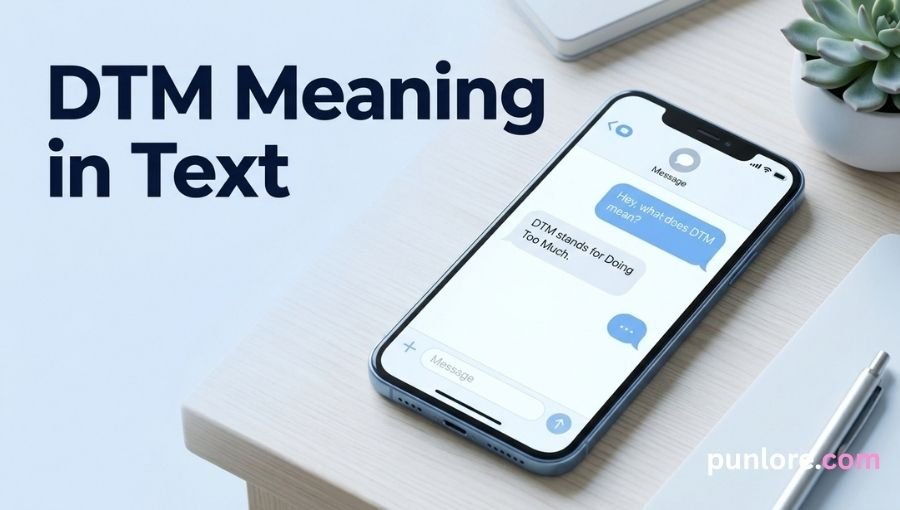
In most everyday conversations, DTM means “Doing Too Much.” People use it when someone is overreacting, putting in excessive effort, being dramatic, or taking a situation further than necessary. However, the exact feeling behind DTM depends heavily on the conversation.
I’ve noticed that short abbreviations like this often look harsher than they actually are. A friend may use DTM jokingly, while another person might use it as a genuine criticism.
This guide explains the DTM meaning in text, how people use it across social media and relationships, and how to understand its tone without guessing.
Quick Answer / Quick Definition of “DTM Meaning in Text”
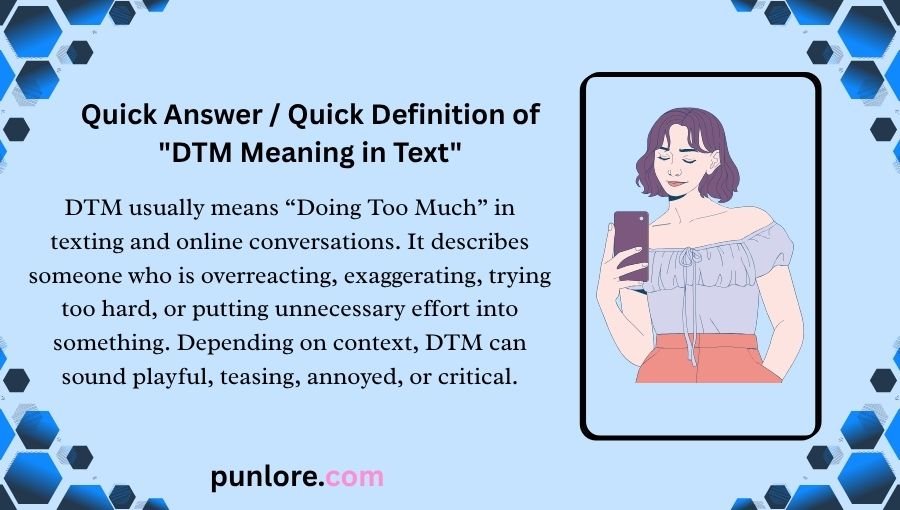
DTM usually means “Doing Too Much” in texting and online conversations. It describes someone who is overreacting, exaggerating, trying too hard, or putting unnecessary effort into something. Depending on context, DTM can sound playful, teasing, annoyed, or critical.
Detailed Meaning Breakdown
Primary Meaning
The most common DTM meaning in text is “Doing Too Much.” Someone may type it when they think another person is going beyond what the situation requires.
For example:
“You bought 20 gifts for her birthday? You’re DTM 😂”
Here, the speaker probably isn’t seriously angry. They’re saying the person is being extra or putting in a lot of unnecessary effort.
DTM can also describe behavior that feels overly dramatic:
“Bro, you called him five times? DTM.”
The basic idea is simple: you’re doing more than necessary.
Secondary Meanings
In some conversations, DTM can have other interpretations. The meaning may depend on the community, subject, or platform.
For example, some people may use DTM as shorthand for “Down to Meet” when discussing plans. A dating conversation could include:
“You DTM tonight?”
In that situation, the intended meaning is likely “Are you down to meet tonight?”
Because abbreviations are highly context-dependent, you shouldn’t automatically assume every DTM means “Doing Too Much.”
Rare or Misinterpreted Meanings
DTM can occasionally be misunderstood because several phrases can share the same initials. That’s especially common when someone encounters the abbreviation without surrounding context.
If the conversation involves criticism, drama, or excessive behavior, “Doing Too Much” is usually the natural interpretation. If you’re discussing plans to meet someone, another meaning may fit better.
What “DTM Meaning in Text” Means in Different Contexts
In Texting and Messaging
In everyday texting, DTM is commonly used to call out behavior that seems excessive.
For example:
“You really made a whole presentation for a two-minute meeting. DTM.”
The speaker is saying that the other person put far more effort into the situation than needed.
A close friend might use it casually, while someone you’re not familiar with could make it sound more critical. Context and relationship matter.
On Social Media Platforms
On Instagram, Snapchat, TikTok, and Threads, DTM can appear in comments, captions, stories, and direct messages.
A TikTok comment might say:
“The editing is DTM 😭”
On Instagram, someone could comment:
“You DTM with these decorations.”
Snapchat conversations tend to use abbreviations casually because messages are often quick and informal. Threads can be slightly more conversational, so the meaning may depend more heavily on the surrounding post.
In Dating and Relationships
In dating conversations, DTM often describes someone who is coming on too strongly or making a situation unnecessarily intense.
For example:
“We just started talking and you already planned our vacation. DTM 😂”
Here, DTM is probably playful. It suggests that the person is moving too quickly.
Still, tone matters. If someone says, “You’re DTM and it’s getting uncomfortable,” they’re setting a boundary rather than joking.
In Professional Communication
DTM is generally too informal for professional communication.
A coworker might understand it in a casual group chat, but an email to a manager should use clearer wording such as “That may be more than necessary” or “I think we’re overcomplicating this.”
Using slang at work can create unnecessary ambiguity, especially when the recipient isn’t familiar with internet abbreviations.
Cultural or Regional Differences
Online slang spreads quickly across age groups and regions, but people don’t always interpret abbreviations identically.
Younger users who frequently communicate through social media may recognize DTM immediately. Someone who rarely uses texting slang may need the phrase explained.
That’s why the surrounding conversation is often more useful than the abbreviation itself.
Tone, Psychology & Why People Use It
Why People Use It & What It Signals Socially
People use DTM because it’s short, expressive, and flexible. Instead of typing “You’re doing way too much,” they can simply write “DTM.”
It can signal teasing between friends, mild criticism, or genuine frustration.
I find that the relationship between the speakers often matters more than the abbreviation. A close friend can make DTM sound funny, while the same three letters from a stranger can feel dismissive.
Emotional Layer Behind It
The emotional tone can range from friendly to cold.
“Girl, you’re DTM 😂”
This usually sounds playful.
“You’re DTM. Seriously.”
This sounds more annoyed.
“Stop DTM.”
That version is direct and may indicate frustration.
The punctuation, emojis, previous messages, and relationship can all change how the phrase feels.
10 Real Conversation Examples (Explained)
- Message: “You changed your outfit five times. DTM.”
Meaning: You’re putting too much effort into choosing an outfit.
Tone: Playful. Interpretation: Friendly teasing. - Message: “Bro, it’s just a small mistake. You’re DTM.”
Meaning: You’re overreacting to something minor.
Tone: Casual. Interpretation: The speaker wants you to relax. - Message: “You made a spreadsheet for our movie night? DTM 😂”
Meaning: The planning is excessive.
Tone: Amused. Interpretation: The speaker finds it funny. - Message: “Why are you still arguing about this? DTM.”
Meaning: You’re continuing a disagreement unnecessarily.
Tone: Irritated. Interpretation: The speaker wants the argument to end. - Message: “You sent flowers after one date? DTM.”
Meaning: The romantic gesture may be too much, too soon.
Tone: Teasing. Interpretation: The relationship may be moving quickly. - Message: “That apology was five paragraphs. DTM.”
Meaning: The apology was much longer than necessary.
Tone: Light criticism. Interpretation: Keep things simpler. - Message: “You don’t need to prove anything. You’re DTM.”
Meaning: You’re trying too hard to impress people.
Tone: Supportive but direct. Interpretation: The speaker wants you to ease up. - Message: “He blocked everyone over one comment. DTM.”
Meaning: His reaction was excessive.
Tone: Critical. Interpretation: The behavior seems disproportionate. - Message: “You cleaned the entire house before I came over? DTM 😭”
Meaning: You went far beyond what was necessary.
Tone: Affectionate. Interpretation: The effort is appreciated but amusing. - Message: “DTM with the questions today.”
Meaning: You’re asking too many questions.
Tone: Depends on context. Interpretation: It could be joking or mildly annoyed.
Where Misunderstandings Happen
Context Confusion
The biggest problem with DTM is that abbreviations don’t carry enough information by themselves. A person may understand “Doing Too Much,” while another may interpret the letters differently.
Looking at the messages immediately before and after DTM usually resolves the confusion.
Generational Gap
Someone who regularly uses internet slang may see DTM as completely normal. Another person may read it as random letters.
This difference can be especially noticeable between younger and older texters.
Platform Differences
The same abbreviation can feel different depending on where it appears. A laughing TikTok comment may feel playful, while a short DTM reply during an argument can feel much sharper.
Similar Words, Symbols, or Abbreviations
| Term | Meaning | How It Differs from DTM Meaning in Text |
|---|---|---|
| Extra | Excessive or dramatic | Describes behavior without being an abbreviation |
| Overreacting | Reacting too strongly | Focuses specifically on emotional reaction |
| Doing the most | Being excessively dramatic | Very close in meaning to DTM |
| Try-hard | Someone trying excessively | Often focuses on effort to impress |
| Chill | Relax or calm down | Gives advice rather than describing behavior |
| IMO | In my opinion | Shows an opinion rather than excessiveness |
| IDK | I don’t know | Expresses uncertainty |
| FYI | For your information | Provides information rather than criticism |
When Not to Use “DTM Meaning in Text”
Professional Risks
Avoid DTM in formal emails, reports, customer messages, or important workplace conversations. Clear language is safer when tone matters.
Cultural Risks
Not everyone knows internet slang. If the recipient isn’t familiar with DTM, the message may create confusion instead of saving time.
Tone Risks
DTM can sound dismissive when used during a serious argument. If someone is genuinely upset, saying “You’re DTM” may make the situation worse.
Expert Tips for Using “DTM Meaning in Text” Correctly
- Use DTM mainly in casual conversations.
- Check whether the person understands common texting slang.
- Consider your relationship before using it.
- Add context if the meaning could be unclear.
- Use an emoji when you want a playful tone.
- Avoid DTM during serious emotional conversations.
- Don’t use it in formal workplace writing.
- Remember that tone depends heavily on the surrounding messages.
- If someone misunderstands it, explain what you meant.
- When in doubt, write “doing too much” instead.
Frequently Asked Questions
1. What does DTM mean in texting?
DTM most commonly means “Doing Too Much.” People use it when someone appears to be overreacting, trying too hard, acting dramatically, or putting unnecessary effort into something. The phrase can be playful or critical depending on the conversation, relationship, punctuation, and surrounding messages.
2. Is DTM positive or negative?
DTM isn’t automatically positive or negative. Friends may use it as harmless teasing, while someone in an argument may use it as criticism. For example, “You’re DTM 😂” can be humorous, whereas “Stop DTM” may communicate genuine frustration.
3. Can DTM be romantic?
Yes. In dating conversations, DTM can describe someone moving too quickly or making a romantic situation more intense than expected. For instance, planning an elaborate future after one date might lead someone to jokingly say, “You’re DTM.”
4. How should I respond when someone says DTM?
Your response should match the tone. If they’re joking, you can laugh it off with something like “Maybe a little 😂.” If they sound annoyed, ask what they think you’re doing too much about. Clarifying the situation can prevent a small misunderstanding from becoming an argument.
5. Does DTM always mean “Doing Too Much”?
No. Context can change the meaning of an abbreviation. “Doing Too Much” is the common interpretation in casual slang, but DTM can represent other phrases in specific conversations. Look at the subject being discussed before deciding what the sender intended.
6. What does DTM mean on Instagram?
On Instagram, DTM commonly carries the same slang meaning, “Doing Too Much.” It may appear in comments, DMs, Stories, or captions when someone thinks a person is being excessive, dramatic, or putting in unnecessary effort.
7. Why do people say DTM instead of “doing too much”?
The abbreviation is faster and fits the informal style of texting and social media. Short forms also make messages feel more casual. For regular online conversations, typing three letters can communicate an idea that would otherwise require several words.
8. Is DTM rude?
DTM isn’t inherently rude, but it can sound rude depending on the situation. Among close friends, it may be harmless teasing. During a serious disagreement or with someone you barely know, the same phrase could feel dismissive or judgmental.
Final Summary & Smart Usage Advice
The most common DTM meaning in text is “Doing Too Much.” It’s used when someone appears to be overreacting, trying too hard, acting dramatically, or putting more effort into something than necessary.
The phrase is especially common in casual texting, social media comments, DMs, and conversations between friends. Its tone can change quickly, though. A laughing emoji may make DTM sound playful, while a short “Stop DTM” can feel much more serious.
There are also situations where DTM may represent another phrase, particularly when the conversation involves making plans or meeting someone. That’s why context should always come first.
For everyday slang, DTM works well when you’re confident the other person understands it. In professional or sensitive conversations, plain English is usually clearer.
Once you understand the surrounding context, the abbreviation becomes much easier to interpret. Don’t judge the meaning from the three letters alone. Look at who sent it, what they were discussing, and how they said it.
The easiest rule to remember: DTM usually means “Doing Too Much,” but context tells you exactly what the sender means.
Also Read This: IGHT Mean in Text