Alr Meaning in Text: Definition, Context, Examples, and Modern Usage (2026 Guide)
Alr Meaning in Text is something many people search for after seeing “alr” in a text, DM, comment, or social media conversation. Imagine you’re making plans with a friend and they suddenly reply, “alr, see you at 7.” You may understand the message from context, but if you’ve never seen the abbreviation before, you might wonder exactly what those three letters mean.
The abbreviation is commonly used as a short, casual form of “alright” or “all right.” People use it when they want to agree, acknowledge something, confirm a plan, or simply keep a conversation moving without typing the full word.
Texting language changes quickly, and short abbreviations like this are especially common in informal digital conversations. You’ll see them in messages, DMs, comments, and replies across popular social platforms.
The interesting part is that a tiny reply like “alr” can sometimes feel friendly, neutral, or even slightly cold depending on the surrounding words and punctuation.
Let’s break down exactly what Alr Meaning in Text is, how people use it in different situations, and what the tone may suggest.
Quick Answer / Quick Definition of “Alr Meaning in Text”
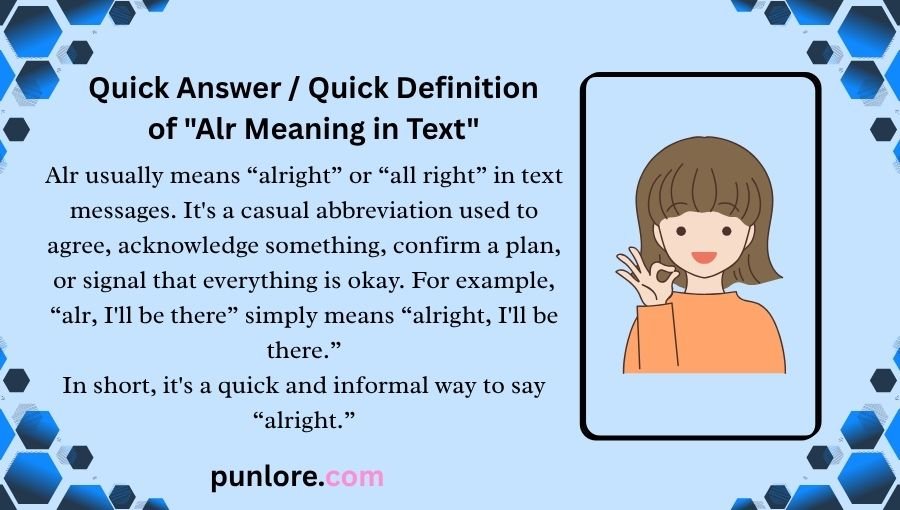
Alr usually means “alright” or “all right” in text messages. It’s a casual abbreviation used to agree, acknowledge something, confirm a plan, or signal that everything is okay. For example, “alr, I’ll be there” simply means “alright, I’ll be there.”
In short, it’s a quick and informal way to say “alright.”
Detailed Meaning Breakdown
Primary Meaning
The most common meaning is “alright” or “all right.”
Someone might type “alr” when they want to acknowledge what another person said without writing the entire word. It’s especially common in fast conversations.
For example:
- “Alr, sounds good.”
- “Alr I’ll call you later.”
- “Alr, got it.”
- “Alr we can go tomorrow.”
In each case, the abbreviation works as a shortened version of “alright.”
It doesn’t usually introduce a completely different meaning. The surrounding sentence determines whether it means agreement, acknowledgment, acceptance, or reassurance.
Secondary Meanings
In some conversations, “alr” can function slightly differently depending on context.
It may mean:
“Okay.”
“Alr, I’ll do it” can simply mean “Okay, I’ll do it.”
“Sure.”
“Alr, let’s meet there” can communicate agreement with a suggestion.
“I understand.”
“Alr, I get what you’re saying” acknowledges information.
“Everything is fine.”
Someone answering “I’m alr” may be saying they’re alright, although “alr” is less common in that exact construction than the full word.
The key point is that the abbreviation normally stays close to the idea of alright or okay.
Rare or Misinterpreted Meanings
Because texting abbreviations aren’t standardized like formal dictionary terms, people can occasionally interpret “alr” differently.
A reader unfamiliar with texting slang might wonder whether it represents another phrase or abbreviation. In most casual conversations, however, the intended meaning is clear from the sentence around it.
One common mistake is assuming that “alr” automatically sounds rude. It doesn’t. The tone depends heavily on punctuation, surrounding words, timing, and the relationship between the people.
What “Alr Meaning in Text” Means in Different Contexts
In Texting and Messaging
In ordinary texting, Alr Meaning in Text is generally straightforward: the person means “alright.”
It’s often used when someone wants to respond quickly.
Example:
“Can you bring some snacks?”
“Alr, I’ll grab some.”
Here, the reply shows agreement and confirms that the person will do it.
You might also see:
“Alr, give me five minutes.”
That means the person understands the request and is asking for a little time.
In my experience, this is where the abbreviation feels most natural because texting already encourages short, informal replies.
On Social Media Platforms
On Instagram, Snapchat, TikTok, and Threads, the abbreviation can appear in comments, captions, DMs, and story replies.
On Instagram, someone might comment:
“Alr this is actually funny.”
On Snapchat, a quick reply could be:
“Alr, send it.”
TikTok comments may use it as part of a reaction:
“Alr, that ending got me.”
Threads conversations can also use it when someone casually agrees with another person’s post or reply.
The platform doesn’t fundamentally change the definition. What changes is the style of conversation. Public comments may make it sound playful or reactive, while a private DM can make it more conversational.
In Dating and Relationships
In romantic conversations, context becomes more important.
Suppose someone says:
“Want to grab coffee Saturday?”
“Alr, Saturday works.”
That’s a simple confirmation.
But imagine this:
“Are you still upset?”
“Alr.”
That response could feel less warm because it’s extremely short. The recipient may wonder whether the person is genuinely okay or simply ending the conversation.
So Alr Meaning in Text doesn’t automatically communicate romantic interest, disinterest, affection, or irritation. The surrounding conversation does much of that work.
In Professional Communication
You may occasionally see “alr” in informal workplace chats, particularly between coworkers who already communicate casually.
For example:
“Meeting moved to 3.”
“Alr, thanks.”
Still, it’s generally better to use “alright,” “okay,” or “sounds good” in formal emails, client messages, applications, and official documents.
Short abbreviations can look overly casual when the relationship or situation calls for professionalism.
Cultural or Regional Differences
The abbreviation is mainly associated with informal digital English, especially among people comfortable with texting slang.
Age and online habits can influence how familiar someone is with it. Younger internet users may recognize it instantly, while someone who rarely uses messaging abbreviations may find it unclear.
Regional differences usually affect familiarity more than the basic definition. The meaning remains close to “alright.”
Tone, Psychology & Why People Use It
Why People Use It & What It Signals Socially
People shorten words in texts for a simple reason: speed and convenience.
Typing “alr” takes less effort than typing “alright.” Over dozens of messages, those small shortcuts become normal.
The abbreviation can also make a conversation feel relaxed. A friend saying “alr lol” usually sounds more casual than someone writing “Alright, understood.”
There is also a social element. Online conversations develop their own shorthand, and people naturally copy expressions they see frequently.
Emotional Layer Behind It
Tone depends on what surrounds the abbreviation.
Friendly:
“Alr haha, I’ll see you soon!”
Neutral:
“Alr, I’ll send it tonight.”
Potentially cold:
“Alr.”
The last example isn’t necessarily angry. It simply provides very little emotional information. That’s why short replies can sometimes be misunderstood.
I’ve found that punctuation matters too. “Alr!” can feel energetic, while “Alr.” may appear more final or serious.
10 Real Conversation Examples (Explained)
- Message: “Alr, I’ll meet you outside.”
Meaning: The person agrees to the meeting arrangement. Tone: Casual and cooperative. Likely interpretation: They accept the plan. - Message: “Alr lol, you got me.”
Meaning: They’re admitting the other person made a good point or joke. Tone: Playful. Likely interpretation: Friendly amusement. - Message: “Alr, give me ten minutes.”
Meaning: They acknowledge the request but aren’t ready yet. Tone: Neutral. Likely interpretation: They need a short delay. - Message: “Alr! That’s actually exciting.”
Meaning: The person agrees while showing enthusiasm. Tone: Positive. Likely interpretation: Genuine excitement. - Message: “Alr.”
Meaning: A basic acknowledgment. Tone: Ambiguous. Likely interpretation: Could be neutral, rushed, or slightly distant. - Message: “You can choose the restaurant.”
Reply: “Alr, I’ll pick one.”
Meaning: The person accepts responsibility for choosing. Tone: Helpful. Likely interpretation: Straightforward agreement. - Message: “Alr then, I’ll stop asking.”
Meaning: The person may be accepting the other person’s decision. Tone: Potentially frustrated. Likely interpretation: The context suggests more emotion than the abbreviation itself. - Message: “Alr bro, drive safe.”
Meaning: The speaker acknowledges the conversation and adds a caring statement. Tone: Friendly. Likely interpretation: Casual concern. - Message: “Alr, thanks for letting me know.”
Meaning: The person has received the information. Tone: Polite and neutral. Likely interpretation: Simple acknowledgment. - Message: “Alr, I understand your point now.”
Meaning: The speaker says they’ve understood an explanation. Tone: Calm and receptive. Likely interpretation: The disagreement or confusion may be settling down.
Where Misunderstandings Happen
Context Confusion
The biggest problem is reading too much emotion into a very short abbreviation.
“Alr” doesn’t contain enough information by itself to prove whether someone is happy, annoyed, bored, or simply busy.
Look at the full conversation, not one three-letter response.
Generational Gap
People who regularly use internet slang may see “alr” as completely ordinary. Someone unfamiliar with abbreviations might interpret it as a typo.
This is especially likely when two people have very different texting habits.
Platform Differences
A one-word reply in a private Snapchat conversation may feel normal. The same reply during a serious personal conversation could seem dismissive.
The platform doesn’t change the dictionary meaning, but it can influence the social expectations surrounding the message.
Similar Words, Symbols, or Abbreviations
| Term | Meaning | How It Differs from Alr Meaning in Text |
|---|---|---|
| Alright | Okay; acceptable | Full form rather than an abbreviation |
| Okay | Agreement or acknowledgment | More universal and less slang-like |
| K | Okay | Much shorter and can sound colder |
| Okk | Okay | Often adds a softer or more playful feel |
| Sure | Agreement or acceptance | Can express willingness rather than simple acknowledgment |
| Yep | Yes | Directly confirms something |
| Bet | Okay; agreed | More slang-heavy and often signals confidence |
| Got it | I understand | Focuses on understanding information |
| Fine | Acceptable or okay | Tone can sound positive, neutral, or irritated depending on context |
When Not to Use “Alr Meaning in Text”
Professional Risks
Avoid abbreviations like “alr” when writing formal emails, job applications, academic messages, business proposals, or customer communications.
A full word is clearer and creates fewer questions about tone.
For example, instead of:
“Alr, I’ll review it.”
A professional message could say:
“Alright, I’ll review it.”
Cultural Risks
Not everyone uses online shorthand. If you’re communicating with someone unfamiliar with texting slang, a shortened expression can create unnecessary confusion.
When clarity matters more than speed, spelling out the word is usually safer.
Tone Risks
The shortest version can sometimes sound abrupt.
“Alr” is generally casual, but “Alr.” may be interpreted as a conversation closer. If you’re trying to sound especially warm, adding context can help.
“Alr, sounds good!” feels very different from simply “Alr.”
Expert Tips for Using “Alr Meaning in Text” Correctly
- Use “alr” for casual conversations, especially with friends.
- Use it when you mean “alright” or “okay.”
- Don’t assume the abbreviation communicates a specific emotion.
- Read the surrounding messages before interpreting someone’s tone.
- Add words such as “sounds good” when you want to sound warmer.
- Avoid it in formal emails and important professional communication.
- Remember that unfamiliar readers may think it’s a typo.
- Use punctuation carefully because it can affect perceived tone.
- Don’t use abbreviations when the message involves sensitive or serious information.
- Match the other person’s communication style instead of forcing slang into every conversation.
Frequently Asked Questions
1. What does “alr” mean in texting?
“Alr” most commonly means “alright” or “all right.” People use it as a casual abbreviation when they want to acknowledge something, agree with a suggestion, confirm a plan, or show that they understand. Its exact emotional tone comes from the rest of the conversation rather than the abbreviation itself.
2. Is “alr” positive or negative?
It can be either neutral or positive, and sometimes it may sound slightly cold depending on context. “Alr, sounds good!” is clearly friendly, while a standalone “Alr.” gives less emotional information. You shouldn’t assume someone is upset simply because they used the shorter form.
3. Can “alr” be used romantically?
Yes. Couples and people who are dating can use it naturally in casual conversations. However, the abbreviation itself doesn’t indicate romantic interest. A message such as “Alr, I’ll see you tonight” mainly confirms a plan. The affectionate meaning, if any, comes from the broader conversation.
4. How should I respond to “alr”?
Your response should match the situation. If the person is confirming plans, you can continue with the next detail. If they seem distant, don’t immediately assume something is wrong. A simple “Sounds good!” or a relevant follow-up question can keep the conversation moving naturally.
5. What does “alr” mean on Snapchat?
On Snapchat, “alr” generally has the same meaning as in ordinary texting: “alright.” Because Snapchat conversations are usually quick and informal, users may use the abbreviation to acknowledge a message, agree to something, or move the conversation forward without typing the full word.
6. What does “alr” mean on Instagram?
On Instagram, it can appear in DMs, comments, or story replies and usually means “alright.” For example, someone replying “Alr, send me the picture” is simply agreeing and giving the next instruction. The surrounding words determine whether the reply sounds playful, neutral, or serious.
7. Is “alr” the same as “okay”?
They’re very close, but they’re not identical in every sentence. “Alr” is generally a shortened form of “alright,” while “okay” is a separate word with broader uses. Both can acknowledge information or show agreement, but “alr” has a distinctly informal texting style.
8. Why do people type “alr” instead of “alright”?
The main reason is convenience. Texting encourages quick responses, so people often shorten familiar words. “Alr” is easy to type and widely recognizable among people who use online slang. It can also make a message feel more relaxed and conversational than formal wording.
9. Does “alr” mean “all right”?
Yes. In most texting situations, “alr” is a shortened representation of “alright,” which can also be written as “all right.” The exact spelling someone prefers doesn’t usually change the intended meaning. Context remains the best way to determine the speaker’s intended tone.
10. Is “alr” rude?
Not by itself. The abbreviation is normally casual rather than inherently rude. However, a one-word response can feel dismissive when someone expects a detailed or emotional answer. If the conversation is serious, consider the person’s other messages, punctuation, and usual communication style before deciding what their reply means.
11. What does “alr” mean from a friend?
From a friend, it usually means “alright,” “okay,” or “sure.” Friends often use it when confirming plans or acknowledging information. Whether it feels enthusiastic or indifferent depends on the rest of the message. “Alr bro, let’s go” sounds much warmer than simply “Alr.”
12. Should I use “alr” at work?
It depends on the workplace and relationship, but it’s safer to avoid it in formal communication. In a relaxed team chat, coworkers may understand it immediately. For clients, managers, official documents, or important written records, “alright,” “okay,” or “sounds good” communicates more clearly.
Final Summary & Smart Usage Advice
The simple answer is that Alr Meaning in Text usually refers to “alright” or “all right.” It’s a casual abbreviation used in texts, DMs, comments, and other informal digital conversations.
You’ll commonly see it when someone wants to acknowledge information, agree with a plan, confirm a request, or quickly move a conversation forward. The abbreviation itself isn’t automatically positive, negative, romantic, or rude.
The surrounding message matters.
For example, “Alr, sounds good!” clearly feels friendly, while “Alr.” can seem more abrupt because it provides almost no emotional context. That’s why it’s risky to judge someone’s feelings from those three letters alone.
For everyday conversations with friends, the abbreviation is generally easy to understand. In professional or formal situations, spelling out “alright” is usually clearer and more appropriate.
The biggest mistake is treating a short abbreviation like it has one fixed emotional meaning. Texting language is flexible, and people develop different habits based on age, platform, friendship, and communication style.
Now you can recognize the abbreviation without overthinking it.
Remember: “alr” usually means “alright,” but the conversation around it tells you the tone.
Also Read This: Chalant Mean in Text