SMH Meaning in Text: Definition, Context, Examples, and Modern Usage (2026 Guide)
You’re texting a friend about a ridiculous thing that happened at work. They reply, “SMH, I can’t believe you did that.” You understand they’re reacting, but you may still wonder exactly what the abbreviation means and how serious the reaction is. SMH Meaning in Text is usually “shaking my head.”
People use it to express disbelief, disappointment, annoyance, embarrassment, or amused frustration. It can be serious or playful depending on the surrounding message and relationship between the people texting.
The abbreviation remains common because short-form communication keeps evolving across texting, social media, comments, and DMs. Someone seeing it for the first time may also wonder whether it sounds rude, sarcastic, romantic, or even angry.
The good news is that the basic meaning is simple. What changes is the tone and context. Here’s how to recognize those differences.
Quick Answer / Quick Definition of “SMH Meaning in Text”
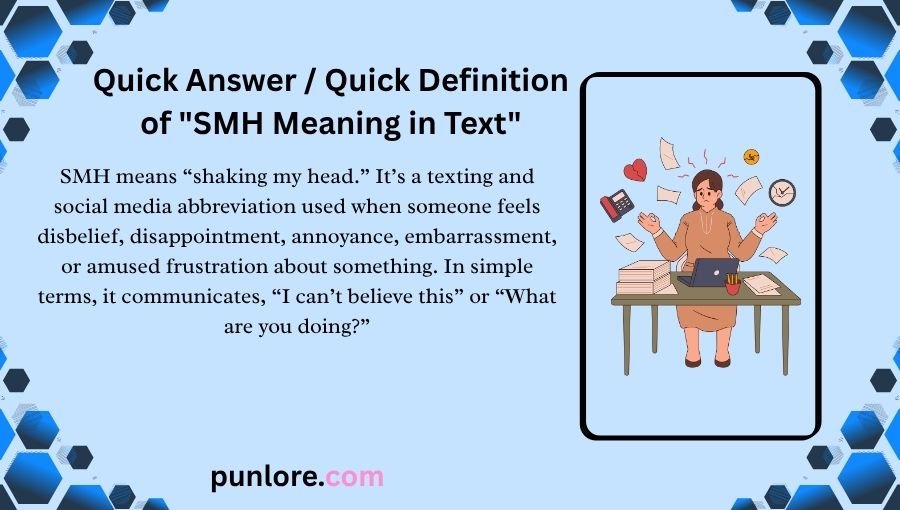
SMH means “shaking my head.” It’s a texting and social media abbreviation used when someone feels disbelief, disappointment, annoyance, embarrassment, or amused frustration about something. In simple terms, it communicates, “I can’t believe this” or “What are you doing?”
Detailed Meaning Breakdown
Primary Meaning
The primary meaning of SMH Meaning in Text is “shaking my head.”
It describes a figurative reaction rather than something the person necessarily does physically. When someone writes “SMH,” they’re signaling that another person’s action, statement, or situation seems unbelievable, foolish, disappointing, or frustrating.
For example:
“You forgot your keys again? SMH.”
The writer probably isn’t literally sitting there shaking their head. They’re expressing mild frustration.
A useful way to remember it is: SMH = disbelief or disapproval in shorthand.
Secondary Meanings
The same abbreviation can carry softer meanings depending on context. It might express:
- Amusement: “SMH 😂 you really ordered three desserts.”
- Disbelief: “SMH, they canceled the concert again.”
- Disappointment: “You didn’t even call her back? SMH.”
- Frustration: “SMH, my internet stopped working again.”
- Embarrassment: “I sent that email to the wrong person. SMH.”
The words around the abbreviation usually reveal which emotion is intended.
Rare or Misinterpreted Meanings
Although “shaking my head” is overwhelmingly the standard interpretation in casual online communication, abbreviations can occasionally have other meanings in specialized communities.
That’s why context matters. A person discussing texting, Instagram comments, or a casual conversation almost certainly means shaking my head.
Don’t automatically interpret the abbreviation as anger. A close friend may use it jokingly, especially alongside laughing or crying-laughing emojis.
What “SMH Meaning in Text” Means in Different Contexts
In Texting and Messaging
In everyday texting, SMH Meaning in Text usually communicates a quick emotional reaction.
For example:
“You left your phone at home again? SMH.”
This sounds mildly annoyed but probably not hostile. Another person might write:
“SMH 😂 I can’t believe you actually wore that.”
Here, the laughing emoji changes the mood. The phrase becomes playful teasing.
Capitalization doesn’t usually matter. SMH, smh, and Smh generally carry the same meaning.
One small detail makes a big difference: punctuation. “SMH.” can feel more serious than “smh 😂,” even though the underlying abbreviation hasn’t changed.
On Social Media Platforms
On Instagram, Snapchat, TikTok, and Threads, the abbreviation often appears in comments, captions, stories, and DMs.
On TikTok, someone might comment “smh” under a funny mistake. On Instagram, a friend could reply to your Story with “SMH 😂.” On Snapchat, it may appear in a quick reaction to something you sent. Threads can use it in public discussions where someone disagrees with a post.
The platform doesn’t change the dictionary meaning. It changes the social setting.
Public comments can make the abbreviation seem sharper because other people can see the reaction. Private DMs generally allow more room for playful interpretation.
In Dating and Relationships
In romantic conversations, SMH can be either affectionate teasing or genuine irritation.
For example:
“You seriously watched the movie without me? SMH.”
Between partners, this may be playful. But:
“You ignored my messages all day. SMH.”
could signal genuine disappointment.
The relationship itself matters. A partner who frequently jokes may use the abbreviation warmly, while the same message from someone you’re arguing with can sound cold.
If you’re unsure, look at the conversation immediately before it rather than interpreting the abbreviation alone.
In Professional Communication
In professional communication, SMH is generally better avoided.
A coworker may understand it perfectly, but a manager, client, recruiter, or customer could view it as too casual or disrespectful. Something like:
“SMH, we missed the deadline again.”
may sound judgmental even if you intended humor.
In workplace writing, clearer language is safer. Try “I’m concerned about the missed deadline” or “I’m surprised this happened again.”
Personally, I’d reserve the abbreviation for casual conversations unless you know the workplace culture extremely well.
Cultural or Regional Differences
The basic meaning is fairly consistent among English-speaking internet users, particularly in the United States. However, age and online habits can influence how natural it feels.
Younger users who regularly communicate through social platforms may recognize SMH instantly. Some older adults may understand it but use it less often.
There isn’t a major American-versus-British difference in the core definition. The bigger variation comes from individual communication style.
Tone, Psychology & Why People Use It
Why People Use It & What It Signals Socially
People use abbreviations because they make emotional reactions quick and recognizable.
Writing “SMH” can feel less formal than writing, “I am disappointed by your decision.” That informality is part of its appeal.
It also lets someone react without writing a full sentence. A three-letter response can communicate, “I saw what happened, and I have thoughts about it.”
Sometimes the brevity is the point.
Emotional Layer Behind It
The emotional range can be broad:
Friendly:
“SMH 😂 You really bought another pair of sneakers?”
Neutral:
“SMH. They forgot to include my order.”
Cold:
“SMH. That’s all I have to say.”
The abbreviation itself doesn’t determine the emotion. Context, punctuation, emojis, and the relationship between the speakers do.
That’s why the same three letters can feel funny in one conversation and harsh in another.
10 Real Conversation Examples (Explained)
1. Forgetting Something
Message: “You forgot your wallet again? SMH.”
Meaning: The speaker is mildly frustrated.
Tone: Familiar and teasing.
Likely interpretation: A playful complaint between people who know each other.
2. A Funny Mistake
Message: “SMH 😂 You put the milk in the cabinet.”
Meaning: The speaker finds the mistake amusing.
Tone: Lighthearted.
Likely interpretation: They’re laughing rather than seriously criticizing.
3. Bad Customer Service
Message: “SMH, they charged me twice.”
Meaning: The speaker is frustrated by the situation.
Tone: Negative but not necessarily directed at the recipient.
Likely interpretation: A complaint or expression of disbelief.
4. Dating
Message: “You really canceled our date five minutes before? SMH.”
Meaning: The speaker feels disappointed.
Tone: Cold or irritated.
Likely interpretation: The relationship may need a conversation.
5. Sports
Message: “SMH, he missed that wide-open shot.”
Meaning: The player made a surprising mistake.
Tone: Disappointed but casual.
Likely interpretation: Normal sports-fan frustration.
6. Family Chat
Message: “Dad tried to fix the Wi-Fi again. SMH.”
Meaning: The speaker is joking about a familiar situation.
Tone: Affectionate humor.
Likely interpretation: Family teasing.
7. Online Comment
Message: “SMH, people are still arguing about this?”
Meaning: The commenter finds the ongoing argument ridiculous.
Tone: Dismissive.
Likely interpretation: Mild criticism of the discussion.
8. Work Situation
Message: “SMH, the presentation file wasn’t saved.”
Meaning: The speaker is frustrated by an avoidable problem.
Tone: Annoyed.
Likely interpretation: A reaction to the situation, not necessarily an insult.
9. Friend’s Bad Decision
Message: “You drove an hour without checking the address? SMH.”
Meaning: The friend made an obviously avoidable mistake.
Tone: Teasing with genuine disbelief.
Likely interpretation: “I can’t believe you did that.”
10. Self-Directed Humor
Message: “SMH, I just searched for my glasses while wearing them.”
Meaning: The writer is laughing at their own mistake.
Tone: Self-deprecating and funny.
Likely interpretation: No criticism of another person at all.
Where Misunderstandings Happen
Context Confusion
The biggest problem with SMH Meaning in Text is that three letters don’t provide much emotional detail.
“SMH” after a joke can be playful. The same abbreviation after an argument may sound dismissive.
Read the entire exchange before deciding what someone meant.
Generational Gap
Different generations can assign different levels of seriousness to internet abbreviations.
Someone unfamiliar with texting slang may see “SMH” and assume the writer is angry. A frequent social media user may read exactly the same message as casual teasing.
Neither interpretation is automatically correct.
Platform Differences
Public comments can feel more confrontational because the reaction is visible to an audience. A private Snapchat or text message usually has more interpersonal context.
The abbreviation stays the same, but the social pressure around it changes.
Similar Words, Symbols, or Abbreviations
| Term | Meaning | How It Differs from SMH |
|---|---|---|
| LOL | Laughing out loud | Signals amusement rather than disbelief |
| OMG | Oh my God | Expresses surprise, shock, or excitement |
| WTF | What the fuck | Usually much stronger and more profane |
| IDK | I don’t know | Expresses uncertainty rather than reaction |
| TBH | To be honest | Introduces an honest opinion or statement |
| Facepalm | A gesture of frustration or embarrassment | More directly represents embarrassment or disbelief |
| SMDH | Shaking my damn head | Stronger version of SMH |
| BRUH | Casual reaction to something surprising or ridiculous | More conversational and often more playful |
When Not to Use “SMH”
Professional Risks
Avoid SMH in formal emails, job applications, customer complaints, presentations, and important workplace messages.
Even if everyone understands it, the abbreviation can make a serious point sound immature or dismissive.
Cultural Risks
Not everyone interprets slang at the same speed. If you’re communicating with someone unfamiliar with internet abbreviations, plain English is clearer.
You don’t need slang to make a reaction understandable.
Tone Risks
Don’t use it when the other person is sharing something vulnerable, unless your relationship clearly supports that kind of humor.
For example, replying “SMH” to someone describing a serious personal problem could easily come across as insensitive.
Expert Tips for Using “SMH Meaning in Text” Correctly
- Use it for casual conversations, not formal communication.
- Add an emoji when you want to make playful intent obvious.
- Consider the relationship before sending it.
- Read the entire conversation to understand the emotional context.
- Avoid using it during serious arguments unless you deliberately want a dismissive tone.
- Don’t assume everyone knows internet abbreviations.
- Use lowercase smh when you want a softer, casual appearance.
- Pair it with words when the meaning could otherwise be unclear.
- Don’t use it to mock someone who’s discussing a sensitive issue.
- If someone sends it and you’re confused, simply ask what they mean rather than guessing.
Frequently Asked Questions
1. What does SMH mean in texting?
SMH stands for “shaking my head.” It’s commonly used when someone reacts to something unbelievable, frustrating, disappointing, silly, or amusing. The exact feeling depends on context. A friend might use it as a joke, while someone in an argument could use it to show genuine annoyance or disapproval.
2. Is SMH positive or negative?
Usually, SMH carries a negative or critical reaction, but it isn’t automatically hostile. It can be playful, especially between friends. An accompanying emoji, joking message, or familiar relationship can soften it considerably. The safest interpretation is mild disbelief until the surrounding conversation provides stronger emotional clues.
3. Can SMH be used romantically?
Yes. Couples and people who are dating may use SMH when teasing each other or expressing mild frustration. For instance, “You ate the last slice? SMH 😂” is probably playful. However, “SMH, you ignored me again” sounds more serious. Romantic context doesn’t change the definition; it changes the emotional meaning.
4. How should I respond to SMH?
First, consider why the person sent it. If they’re joking, you can joke back. If they’re annoyed, acknowledge the issue. A response such as “Haha, okay, fair point” works for playful situations, while “I get why you’re frustrated” fits a more serious exchange.
5. What does SMH mean on Instagram?
On Instagram, SMH generally means “shaking my head.” It can appear in comments, DMs, Story replies, or captions. People commonly use it to react to something surprising, silly, disappointing, or ridiculous. Because public comments have an audience, the abbreviation can sometimes sound more judgmental than it would in a private message.
6. What does lowercase “smh” mean?
Lowercase “smh” normally has exactly the same meaning as uppercase SMH. Capitalization is mainly a stylistic choice. Lowercase writing may feel more relaxed or conversational, while uppercase can give the reaction slightly more visual emphasis. Neither version represents a different abbreviation.
7. What is the difference between SMH and SMDH?
SMDH usually means “shaking my damn head.” It intensifies the original expression by adding “damn.” As a result, SMDH can sound more frustrated, emphatic, or dramatic. SMH is the more neutral and widely appropriate version for casual conversations.
8. Does SMH always mean someone is angry?
No. Anger is only one possible interpretation. SMH can communicate amusement, embarrassment, disappointment, disbelief, or mild frustration. Someone saying “SMH 😂” after a friend’s silly mistake probably isn’t angry. Looking at the words, emojis, punctuation, and relationship around the abbreviation gives you a much better reading.
Final Summary & Smart Usage Advice
SMH Meaning in Text is straightforward: it usually means “shaking my head.” People use it as a quick reaction to something they find unbelievable, frustrating, disappointing, embarrassing, silly, or amusing.
The tricky part isn’t the definition. It’s the tone.
In a text from a close friend, SMH may be affectionate teasing. In a public comment, it may sound dismissive. In a romantic conversation, it can range from playful banter to genuine disappointment. At work, meanwhile, it’s usually better to replace it with clear, professional language.
Remember that capitalization doesn’t substantially change the meaning. SMH, smh, and Smh all point to the same basic expression.
When you’re deciding whether to use it, ask yourself three things: Who am I talking to? What happened? Could my tone be misunderstood? Those questions will prevent most problems.
And if someone sends you SMH, don’t panic over three mysterious letters. Read the surrounding message first. Context almost always tells you whether they’re laughing, teasing, disappointed, or genuinely irritated.
The simple takeaway: SMH means “shaking my head,” but the conversation around it determines what that reaction really feels like.
Also Read This: White Heart Emoji Meaning