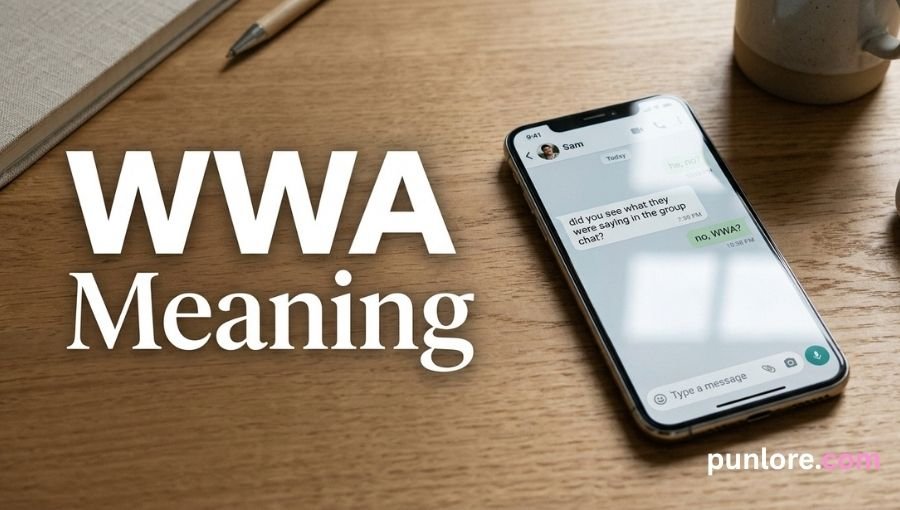
WWA Meaning: Definition, Context, Examples, and Modern Usage (2026 Guide)
Imagine getting a text that simply says, “WWA?” You pause for a second. Is the person asking what happened? Are they upset? Or does the abbreviation mean something completely different? That small moment of confusion is exactly why people search for WWA meaning.
Short abbreviations are common in texts, comments, DMs, and social media, but their meanings can change depending on the conversation.
In casual online communication, WWA most commonly means “What Went Wrong?” It is usually a way to ask what caused a problem, disappointment, argument, or unexpected outcome. However, WWA isn’t a universal abbreviation with only one definition. In some settings, it can represent an organization, title, name, or industry-specific term.
The rise of short-form messaging has made context more important than ever. A three-letter abbreviation can save time, but it can also create confusion when the recipient doesn’t know which meaning the sender intended.
So, what does WWA actually mean, and how should you respond when you see it? Let’s break down the meaning, tone, examples, and situations where this abbreviation works best.
Quick Answer / Quick Definition of “WWA Meaning”
WWA usually means “What Went Wrong?” in casual texting and online conversations. People use it to ask what caused a problem or why something didn’t work out. The exact meaning can vary by context, so the surrounding message, platform, and relationship between the people involved should always be considered.
Detailed Meaning Breakdown
Primary Meaning
The most useful interpretation of WWA meaning in casual messaging is “What Went Wrong?”
Someone may use it after hearing that a plan failed, a relationship ended, a project was rejected, or an expected result didn’t happen.
For example:
“You said the interview went badly. WWA?”
The sender isn’t necessarily blaming the other person. They’re asking for an explanation.
The phrase can sound curious, concerned, or slightly direct. A close friend might use it casually, while someone you barely know could make it feel more intrusive.
Secondary Meanings
WWA can have other meanings outside everyday slang. Abbreviations are often reused by different communities, businesses, organizations, and industries.
Depending on the setting, WWA might refer to a proper name, organization, event, program, or specialized term. In those situations, interpreting it as “What Went Wrong?” would be incorrect.
This is one reason context matters so much. If WWA appears in a business document, event listing, academic discussion, or specialized forum, check the surrounding language before assuming it’s texting slang.
Rare or Misinterpreted Meanings
A common mistake is treating every three-letter abbreviation as if it has one fixed dictionary definition.
That’s not how online language works.
The WWA meaning in a private message can be completely different from WWA used as an organizational abbreviation. Capitalization can also provide clues, although it isn’t a reliable rule by itself.
If you’re unsure, the safest response is simple: “What do you mean by WWA?”
That question is clearer than guessing.
What “WWA Meaning” Means in Different Contexts
In Texting and Messaging
In everyday texts, WWA is generally a quick way to ask “What Went Wrong?”
It often appears after someone mentions a negative outcome without explaining it.
For example:
“She said the trip was a disaster.”
“WWA?”
The second person wants to know what happened.
Another example might be:
“I didn’t get the job.”
“Oh no. WWA?”
Here, the abbreviation expresses curiosity and concern rather than criticism.
In my experience with conversational abbreviations, the surrounding sentence usually tells you more than the abbreviation itself.
On Social Media Platforms
The WWA meaning can carry slightly different tones on Instagram, Snapchat, TikTok, and Threads.
On Instagram, it might appear in a DM after someone posts about a disappointing experience. A friend could ask, “WWA?” after seeing a vague Story.
On Snapchat, short abbreviations fit naturally into fast, informal conversations. A message such as “WWA with the game?” could ask why a game went badly.
On TikTok, users may use abbreviations in comments or private messages, but slang varies heavily by community. WWA isn’t a universally recognized TikTok-specific term.
On Threads, a user might use it conversationally when discussing an event, disagreement, or failed plan.
Platform culture matters, but there isn’t one official social-media definition of WWA.
In Dating and Relationships
In dating conversations, WWA can ask why a relationship or interaction changed.
For example:
“You two stopped talking? WWA?”
The question could mean, “What went wrong between you?”
The emotional effect depends heavily on the relationship. From a close friend, it may sound caring. From a stranger, it might feel nosy.
After a breakup, the abbreviation can also sound more serious because the person may be asking about conflict, incompatibility, or a painful event.
A softer alternative is often better:
“If you’re comfortable sharing, what happened?”
That gives the other person room to decide how much they want to explain.
In Professional Communication
Using WWA at work is usually a poor choice unless everyone in the conversation already understands the abbreviation.
A colleague might interpret it correctly, but a manager, client, customer, or international coworker may not.
Instead of:
“WWA with the campaign?”
write:
“What went wrong with the campaign?”
Professional communication rewards clarity. Saving two or three words isn’t worth creating uncertainty.
This is especially true in emails, reports, contracts, customer support messages, and formal documentation.
Cultural or Regional Differences
The WWA meaning isn’t guaranteed to be identical across countries, age groups, or online communities.
English-language internet slang changes quickly. Younger users may understand abbreviations that older readers don’t recognize, while regional communities may develop their own shorthand.
That doesn’t mean WWA has a fixed regional definition. Rather, familiarity can differ.
When communicating across cultures or generations, spelling out the phrase is usually the safest option.
Tone, Psychology & Why People Use It
Why People Use It & What It Signals Socially
People shorten phrases because messaging is fast. Three letters can replace a complete question.
When someone writes “WWA?”, they’re usually signaling that they want the story behind an outcome.
It can suggest:
- Curiosity
- Concern
- Surprise
- Interest in the situation
- A desire for an explanation
The abbreviation doesn’t automatically communicate anger or sympathy. The rest of the conversation supplies that emotional information.
Emotional Layer Behind It
Tone can shift dramatically.
Friendly:
“WWA? You seemed excited about the trip yesterday.”
This sounds concerned and interested.
Neutral:
“WWA with the project?”
This simply asks for an explanation.
Cold or demanding:
“WWA?”
After an argument, that same three-letter message could feel impatient or confrontational.
The punctuation and timing matter, too. A question mark, emoji, previous disagreement, or very short reply can change how the message feels.
10 Real Conversation Examples (Explained)
- Message: “The concert got canceled. WWA?”
Meaning: What caused the cancellation?
Tone: Curious.
Interpretation: The sender wants the reason, not necessarily someone to blame. - Message: “You said you were going to call her. WWA?”
Meaning: What happened with that plan?
Tone: Casual.
Interpretation: A friend is asking for an update. - Message: “WWA with your interview?”
Meaning: What went wrong during the interview?
Tone: Concerned.
Interpretation: The sender wants to understand why it didn’t go well. - Message: “We aren’t seeing each other anymore.”
Reply: “WWA?”
Meaning: What caused the relationship to end?
Tone: Curious and personal.
Interpretation: The question may invite a deeper explanation. - Message: “The restaurant was terrible.”
Reply: “WWA?”
Meaning: What was bad about it?
Tone: Interested.
Interpretation: The sender wants details. - Message: “Our team lost in the final.”
Reply: “WWA in the second half?”
Meaning: What went wrong during that part of the game?
Tone: Analytical.
Interpretation: The sender wants to understand the turning point. - Message: “I deleted the post.”
Reply: “WWA? It looked fine.”
Meaning: Why did you remove it?
Tone: Surprised.
Interpretation: The sender doesn’t understand the decision. - Message: “The deal fell through.”
Reply: “WWA on their side?”
Meaning: What caused the other party to withdraw?
Tone: Businesslike.
Interpretation: The sender is asking about the cause. - Message: “He suddenly stopped replying.”
Reply: “WWA before that?”
Meaning: Did something happen before he stopped responding?
Tone: Supportive and investigative.
Interpretation: The sender suspects there was an earlier event. - Message: “WWA?” after a heated argument
Meaning: What caused this situation to go wrong?
Tone: Potentially confrontational.
Interpretation: Without context, the recipient may hear it as demanding rather than caring.
Where Misunderstandings Happen
Context Confusion
The biggest problem is assuming that an abbreviation has only one definition.
If WWA appears in a specialized conversation, “What Went Wrong?” may not make sense at all. Look at the words surrounding it before deciding what the sender intended.
Generational Gap
Younger and older users often have different levels of familiarity with texting shorthand.
Someone who regularly uses abbreviations may consider WWA obvious. Another person may see three capital letters and have no idea what they mean.
There’s nothing wrong with asking for clarification.
Platform Differences
Abbreviations don’t have identical popularity everywhere.
A phrase that makes sense in a private Snapchat conversation may look strange in a professional LinkedIn message. Likewise, a community-specific abbreviation on TikTok shouldn’t automatically be treated as standard English slang.
Similar Words, Symbols, or Abbreviations
| Term | Meaning | How It Differs from WWA |
|---|---|---|
| WTH | What the heck/hell | Expresses surprise or frustration rather than asking specifically what went wrong |
| WTF | What the f*** | Much stronger and often vulgar |
| What happened? | Asking for an explanation | Fully spelled out and clearer than WWA |
| Why? | Asking for a reason | More direct and doesn’t necessarily suggest something went wrong |
| IDK | I don’t know | Gives information about the speaker’s knowledge |
| TBH | To be honest | Introduces an opinion or candid statement |
| IMO | In my opinion | Signals a personal view |
| OMG | Oh my God | Expresses surprise, excitement, or shock |
| BRB | Be right back | Refers to leaving and returning to a conversation |
When Not to Use “WWA Meaning”
Professional Risks
Don’t rely on WWA in formal emails, workplace reports, customer communication, or important business discussions.
Even when the intended meaning seems obvious, abbreviations can create unnecessary ambiguity.
Write “What went wrong?” instead. It’s only slightly longer and much harder to misunderstand.
Cultural Risks
Some readers may not recognize internet shorthand at all. This becomes more important when communicating internationally or with people who use English as a second language.
Clear language is usually the more respectful choice when your audience is broad.
Tone Risks
A short message can sound harsher than intended.
“WWA?” may sound curious between close friends but demanding after a disagreement. If the subject is sensitive, use a warmer sentence instead.
Expert Tips for Using “WWA Meaning” Correctly
- Check the context first. Don’t assume the abbreviation always means “What Went Wrong?”
- Know your audience. Friends may understand shorthand that coworkers don’t.
- Use it casually. It fits informal conversations better than formal writing.
- Consider the emotional situation. A sensitive topic deserves a softer question.
- Don’t use it with strangers when the meaning could be unclear.
- Spell it out at work. Clarity matters more than saving a few characters.
- Look at nearby words. They often reveal the intended meaning.
- Ask for clarification if another definition seems possible.
- Watch your punctuation. “WWA?” can feel different after an argument.
- Prefer natural language when you’re discussing serious or personal matters.
Frequently Asked Questions
1. What does WWA mean in texting?
In casual texting, WWA commonly means “What Went Wrong?” It is used to ask about the reason behind a failed plan, disappointing result, disagreement, or unexpected situation. However, WWA isn’t an official universal texting abbreviation, so context should always be checked before assuming this definition.
2. Is WWA positive or negative?
WWA itself isn’t inherently positive or negative. Its emotional tone depends on the situation. After bad news, it may sound concerned or curious. During an argument, the same abbreviation can feel demanding. The sender’s relationship with you, previous messages, and punctuation all influence how you’ll likely interpret it.
3. Can WWA have a romantic meaning?
Yes, WWA can appear in romantic conversations when someone asks what went wrong in a relationship or dating situation. For example, a friend might ask “WWA?” after hearing about a breakup. The abbreviation itself isn’t a romantic term, though; the surrounding relationship context gives it that meaning.
4. How should I respond to “WWA?”
Answer according to how comfortable you are sharing information. If you want to explain, briefly describe what happened. If the question feels too personal, you can say, “I’d rather not get into it right now.” You don’t have to provide a detailed explanation simply because someone asks.
5. Does WWA always mean “What Went Wrong?”
No. That’s the key distinction to remember. WWA can function as an abbreviation for different names, organizations, subjects, or terms depending on the setting. In informal messaging, “What Went Wrong?” is a reasonable interpretation, but specialized contexts may use the letters differently.
6. Is WWA commonly used on Instagram and Snapchat?
It can appear in informal Instagram and Snapchat conversations, particularly when someone wants to ask what happened after a disappointing event. However, it isn’t a platform-specific official abbreviation. Usage varies between friend groups, communities, and age groups, so don’t assume every user will recognize it.
7. Is WWA appropriate for work emails?
Generally, no. Although a coworker might understand it, WWA can look overly casual or ambiguous in professional writing. If you’re asking about a problem at work, write “What went wrong?” instead. The complete phrase is clearer for managers, clients, customers, and people outside your immediate team.
8. What is the safest way to understand WWA?
Look at the sentence, conversation, platform, and relationship between the people involved. If the discussion concerns a failed event or problem, “What Went Wrong?” may fit naturally. If the context is organizational or specialized, another definition may apply. When uncertain, simply ask what the sender means.
Final Summary & Smart Usage Advice
The most common casual WWA meaning is “What Went Wrong?” It’s a short way to ask why something failed, changed, or didn’t happen as expected.
You may see it in texts, DMs, comments, or conversations between people who are comfortable with informal shorthand. The abbreviation can communicate curiosity, concern, surprise, or even frustration depending on the situation.
The biggest mistake is assuming that WWA has one universal definition. Abbreviations are highly dependent on context. A casual message may use WWA as slang, while a professional or specialized setting may use the same letters for an entirely different term.
For everyday conversations, WWA works best when both people understand texting shorthand. For work, sensitive subjects, unfamiliar audiences, and important communication, spelling out “What went wrong?” is the safer choice.
If someone sends you “WWA?” and you’re unsure, don’t overthink it. Look at the conversation first. If the meaning still isn’t clear, ask.
The simple rule: context determines the meaning, and clarity beats clever shorthand when the stakes are high.
Also Read This: Honey Pack Meaning