PPM Meaning: Definition, Context, Examples, and Modern Usage (2026 Guide)
Imagine checking a water-quality report and seeing “PPM: 5.” You may wonder whether that means five percent, five milligrams, or something completely different. That small abbreviation can cause surprising confusion. The most common answer to PPM meaning is parts per million, a measurement used to describe very small concentrations.
You’ll see it in water testing, air quality, chemistry, environmental science, food production, and many technical reports.
But PPM isn’t limited to one field. Depending on the subject, it can also mean pages per minute, project portfolio management, pulse-position modulation, price per mille, and other specialized terms.
That’s why context matters. A laboratory report and a business meeting can use the same three letters while referring to completely different ideas.
This guide explains the main definitions, everyday contexts, examples, possible misunderstandings, and practical usage. By the end, you’ll know how to recognize the intended meaning quickly.
Quick Answer / Quick Definition of “PPM Meaning”
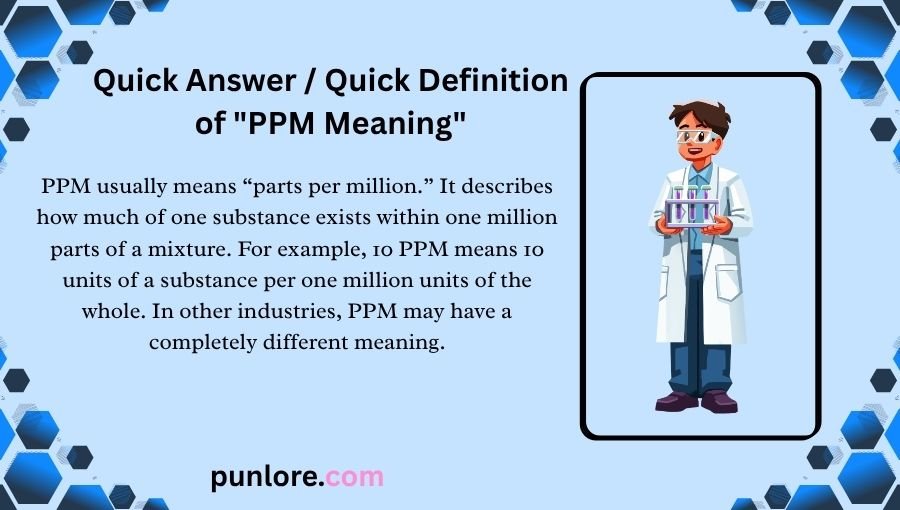
PPM usually means “parts per million.” It describes how much of one substance exists within one million parts of a mixture. For example, 10 PPM means 10 units of a substance per one million units of the whole. In other industries, PPM may have a completely different meaning.
Detailed Meaning Breakdown
Primary Meaning
The most widely recognized PPM meaning is parts per million.
It is a concentration measurement. Think of one million tiny pieces making up a whole. If one of those pieces represents a particular substance, its concentration is 1 PPM.
For example, if a water sample contains 3 PPM of a chemical, that means roughly three parts of that chemical occur for every one million parts of the water mixture.
PPM is useful because percentages can become awkward when quantities are extremely small. 1 PPM equals 0.0001%.
You’ll commonly encounter it in drinking-water reports, pollution measurements, chemical analysis, soil testing, and manufacturing.
Secondary Meanings
The correct interpretation depends heavily on the industry.
In printing or office equipment, PPM can mean pages per minute, describing printer speed. A printer rated at 30 PPM can theoretically produce 30 pages per minute under specified conditions.
In business, project portfolio management is another established meaning. It refers to managing multiple projects together so an organization can balance resources, risks, costs, and strategic goals.
In advertising, PPM may refer to price per mille, where mille means one thousand. The abbreviation is closely related to pricing models based on impressions.
In electronics and communications, PPM can stand for pulse-position modulation, a technique for representing information by changing the position of pulses in a signal.
Rare or Misinterpreted Meanings
Some people assume PPM always refers to a measurement of concentration. That’s not necessarily true.
A printer specification, project-management document, and laboratory result can all use PPM legitimately.
The safest approach is simple: look at the surrounding words. If you see chemicals, water, contaminants, or concentration, “parts per million” is probably intended. If you see printers, projects, advertising, or electronics, another definition may fit better.
One small detail often gives it away: the unit appears alongside related technical terms.
What “PPM Meaning” Means in Different Contexts
In Texting and Messaging
There isn’t one universally accepted texting definition for PPM. Unlike common abbreviations such as LOL or BRB, it isn’t a standard everyday chat shortcut.
If someone texts, “The report says 8 PPM,” they’re almost certainly discussing parts per million. If a coworker writes, “The new printer runs at 40 PPM,” they mean pages per minute.
For example:
“The chlorine level is 2 PPM.”
Here, the meaning is a concentration measurement.
In casual messaging, it’s better not to assume a hidden slang definition. Ask for clarification when the context doesn’t make the meaning obvious.
On Social Media Platforms
PPM doesn’t have a single standard slang meaning on Instagram, Snapchat, TikTok, or Threads.
On Instagram, a science creator might write, “Lead levels above this PPM can be dangerous,” using the scientific meaning. A technology account could use PPM while discussing printer performance.
On TikTok, the acronym may appear in an educational video about water quality or pollution. On Threads, it could appear in a professional discussion about project portfolio management.
The platform doesn’t determine the definition. The topic does.
In Dating and Relationships
PPM isn’t a standard romantic abbreviation in mainstream American texting.
If you see it in a dating conversation, don’t automatically assume it has a romantic meaning. The person could be discussing work, science, advertising, or another subject entirely.
For example:
“My presentation is about 50 PPM lead exposure.”
That’s technical, not romantic.
If someone sends only “PPM?” without context, a natural response would be, “What do you mean by PPM?” That’s clearer than guessing.
In Professional Communication
Workplaces use PPM frequently, but the intended definition varies by department.
A laboratory may use it for parts per million. A printer manufacturer may use it for pages per minute. A project-management team may use it for project portfolio management.
For example:
“The printer is rated at 35 PPM.”
Here, PPM describes output speed.
In another meeting:
“PPM will help us prioritize the software projects.”
Here, it refers to project portfolio management.
The risk is ambiguity. When writing for a mixed audience, spell out the term the first time.
Cultural or Regional Differences
The core technical meanings of PPM generally remain stable across English-speaking regions. However, workplace terminology can vary by industry and country.
A technical specialist may immediately understand “parts per million,” while a business manager may associate PPM with portfolio management.
Age can also affect familiarity. Younger social-media users may expect an abbreviation to be slang, while a scientist is more likely to read it as a measurement.
When in doubt, context beats assumptions.
Tone, Psychology & Why People Use It
Why People Use It & What It Signals Socially
PPM is primarily a functional abbreviation. People use it because writing “parts per million” repeatedly is cumbersome, especially in technical documents.
It can also signal that the speaker is working within a specialized field.
A chemist might naturally write “25 PPM.” A project manager might say “PPM process.” Neither is necessarily trying to sound formal. They’re using familiar industry language.
I’ve found that the surrounding vocabulary usually reveals the intended meaning faster than the abbreviation itself.
Emotional Layer Behind It
Unlike expressive texting abbreviations, PPM normally carries little emotional meaning.
“Water contains 4 PPM nitrate” is neutral.
“Can you send me the PPM report?” is professional and direct.
“Why did you put 100 PPM in the document?” could sound critical, but the emotional tone comes from the sentence, not the abbreviation.
So don’t read friendliness, anger, romance, or sarcasm into PPM by itself.
10 Real Conversation Examples (Explained)
1. Water Testing
Message: “The sample came back at 6 PPM.”
Meaning: Six parts per million of the substance were detected.
Tone: Neutral and technical.
Likely interpretation: A laboratory or environmental measurement.
2. Printer Shopping
Message: “This model prints 28 PPM.”
Meaning: It can produce about 28 pages per minute under stated test conditions.
Tone: Informational.
Likely interpretation: A printer specification.
3. Workplace Planning
Message: “We’re introducing PPM across the department.”
Meaning: The organization is adopting project portfolio management.
Tone: Professional.
Likely interpretation: A project or business-management discussion.
4. Environmental News
Message: “Air pollution reached 90 PPM.”
Meaning: A pollutant concentration was reported at that level.
Tone: Serious and factual.
Likely interpretation: An environmental measurement.
5. Chemistry Class
Message: “Convert 2 PPM into a percentage.”
Meaning: The student is converting a concentration into another form.
Tone: Academic.
Likely interpretation: A science exercise.
6. Social Media Comment
Message: “What does 15 PPM mean here?”
Meaning: The commenter doesn’t understand the measurement.
Tone: Curious.
Likely interpretation: They need context or an explanation.
7. Advertising
Message: “The campaign uses a PPM pricing model.”
Meaning: The cost is calculated per thousand units or impressions, depending on the specific advertising setup.
Tone: Businesslike.
Likely interpretation: Marketing terminology.
8. Electronics
Message: “The transmitter uses PPM.”
Meaning: Pulse-position modulation is being used to encode information.
Tone: Technical.
Likely interpretation: An electronics or communications discussion.
9. Casual Clarification
Message: “PPM?”
Meaning: The sender wants the abbreviation explained.
Tone: Neutral, possibly confused.
Likely interpretation: The previous context wasn’t clear.
10. Project Meeting
Message: “Let’s review the PPM dashboard tomorrow.”
Meaning: Most likely a project portfolio management dashboard, although the organization could define the acronym differently.
Tone: Professional.
Likely interpretation: A business-planning conversation.
Where Misunderstandings Happen
Context Confusion
The biggest problem is that one abbreviation has several established definitions.
Someone discussing water chemistry and someone discussing printers can both say “PPM” correctly. Trouble begins when the audience doesn’t know the subject.
A simple solution is to define the abbreviation on first use.
Generational Gap
Older and younger readers may approach abbreviations differently. Someone familiar with laboratory reports may instantly recognize PPM, while a casual social-media user may wonder whether it’s slang.
That doesn’t mean one interpretation is right and the other is wrong. Their experiences simply differ.
Platform Differences
Social platforms don’t give PPM a universal meaning.
A TikTok about chemistry and a LinkedIn post about business operations can use the same acronym differently. Always read the surrounding post before interpreting it.
Similar Words, Symbols, or Abbreviations
| Term | Meaning | How It Differs from PPM |
|---|---|---|
| % | Percent | Parts per hundred rather than parts per million |
| PPB | Parts per billion | Represents a much smaller concentration |
| PPT | Parts per trillion or other meanings | Usually represents an even smaller concentration in scientific contexts |
| mg/L | Milligrams per liter | Expresses mass per volume rather than the general ratio of parts |
| PPM | Parts per million | Describes one part in one million |
| CPM | Cost per mille | Commonly refers to advertising cost per thousand impressions |
| RPM | Revolutions per minute | Measures rotational speed |
| PPS | Pages per second or other meanings | Depends on technical context and isn’t the same concentration unit |
When Not to Use “PPM Meaning”
Professional Risks
Don’t use the acronym without explanation when your audience may not know the field.
Instead of writing, “The PPM was acceptable,” write “The concentration was 4 parts per million (PPM).”
That small addition removes unnecessary ambiguity.
Cultural Risks
Avoid assuming that everyone recognizes specialized abbreviations. Technical shorthand can feel exclusionary when readers aren’t familiar with it.
Plain language is especially useful in public health, consumer information, and community communication.
Tone Risks
Using unexplained technical language can make a simple message sound unnecessarily complicated.
The issue isn’t PPM itself. It’s whether the reader has enough context to understand it.
Expert Tips for Using “PPM Meaning” Correctly
- Check the subject first. Chemistry, printers, business, and electronics use PPM differently.
- Spell it out initially. Write “parts per million (PPM)” for a general audience.
- Don’t treat it as universal slang. It has no single standard texting definition.
- Look at nearby units. Words such as concentration, contaminant, or chemical strongly suggest the measurement meaning.
- Watch the number’s purpose. A printer’s PPM is a speed rating, not a concentration.
- Consider your audience. Specialists may understand the abbreviation immediately; general readers may not.
- Don’t confuse PPM with percent. One PPM is far smaller than one percent.
- Clarify business usage. In management documents, define what your organization means by PPM.
- Avoid guessing in ambiguous chats. Ask what the sender means.
- Use plain English when clarity matters most. A few extra words can prevent a major misunderstanding.
Frequently Asked Questions
1. What does PPM stand for?
The most common PPM meaning is parts per million. It is a measurement used to express a very small concentration of one substance within a larger mixture. However, PPM can also mean pages per minute, project portfolio management, pulse-position modulation, or other specialized terms.
2. Is PPM the same as percent?
No. PPM and percent describe different scales. 1 PPM equals 0.0001%, while 1% equals 10,000 PPM. That’s why PPM is useful for quantities that are too small to describe conveniently as ordinary percentages.
3. What does PPM mean in water testing?
In water testing, PPM usually means parts per million and describes the concentration of a dissolved substance or contaminant. For certain dilute water solutions, one PPM is often approximately comparable to one milligram per liter, although the exact relationship depends on the substance and conditions.
4. What does PPM mean on a printer?
For printers, PPM generally means pages per minute. It describes how quickly a printer can produce pages under a manufacturer’s testing method. Actual speed can vary because of document complexity, print settings, color use, paper handling, and other factors.
5. Does PPM have a romantic meaning in texting?
There is no widely established romantic meaning for PPM in standard American texting. If someone uses it during a dating conversation, the surrounding messages are essential. Don’t assume the abbreviation is flirtatious or intimate without additional context.
6. What does PPM mean in business?
In business, PPM commonly stands for project portfolio management. It involves overseeing a group of projects as a portfolio, helping organizations allocate resources, manage risks, and choose projects that support broader strategic goals.
7. How do you know which PPM definition someone means?
Look at the words surrounding the abbreviation. Chemicals, pollution, water, and concentration point toward parts per million. Printers suggest pages per minute. Projects and portfolios suggest project portfolio management. If the context remains unclear, asking directly is the safest option.
8. Is PPM a positive or negative term?
PPM is generally neutral. It doesn’t inherently communicate approval, criticism, affection, or negativity. Its meaning comes from the information surrounding it. A high concentration may be concerning in one scientific context, while a high printer PPM may simply indicate faster performance.
9. What does 10 PPM mean?
In a concentration context, 10 PPM means approximately 10 parts of a substance for every one million parts of the total mixture. The exact interpretation can depend on how the measurement was taken and what substance is being measured.
10. What is 1 PPM as a percentage?
One PPM is equal to 0.0001%. This conversion helps show why the unit is useful for very small concentrations. Instead of writing a long decimal percentage, technical professionals can use PPM as a compact and easier-to-read measurement.
11. Can PPM mean pages per minute?
Yes. In printing, PPM commonly means pages per minute. A printer rated at 40 PPM is advertised as capable of producing up to 40 pages per minute under the relevant testing conditions. It should not be confused with the concentration-related definition.
12. What does PPM mean in project management?
In project management, PPM usually means project portfolio management. It focuses on managing multiple projects together rather than viewing each project in isolation. Organizations use it to compare priorities, resources, costs, risks, and strategic value across their project portfolios.
Final Summary & Smart Usage Advice
The most common PPM meaning is parts per million, a measurement for very small concentrations. It appears frequently in water quality, chemistry, environmental science, manufacturing, and other technical fields.
But that’s only one definition. PPM can also mean pages per minute, project portfolio management, pulse-position modulation, price per mille, and other specialized terms.
The key is context.
If you’re reading a laboratory report, PPM probably describes concentration. If you’re comparing printers, it likely describes pages per minute. If you’re sitting in a business meeting about multiple projects, it may refer to project portfolio management.
PPM isn’t normally a romantic texting abbreviation, and it doesn’t have one universal social-media meaning. When the surrounding information isn’t clear, don’t guess. Ask what the sender means.
For professional writing, the smartest approach is to spell out the term on first use and put the abbreviation in parentheses. After that, PPM is usually clear enough for readers who understand the subject.
You now have the essential framework for interpreting the acronym without relying on assumptions.
Memorable takeaway: when you see PPM, read the context before reading the abbreviation.
Also Read This: OHRD Meaning in Text



Pingback: Gooning Meaning TikTok: Definition & Usage 2026