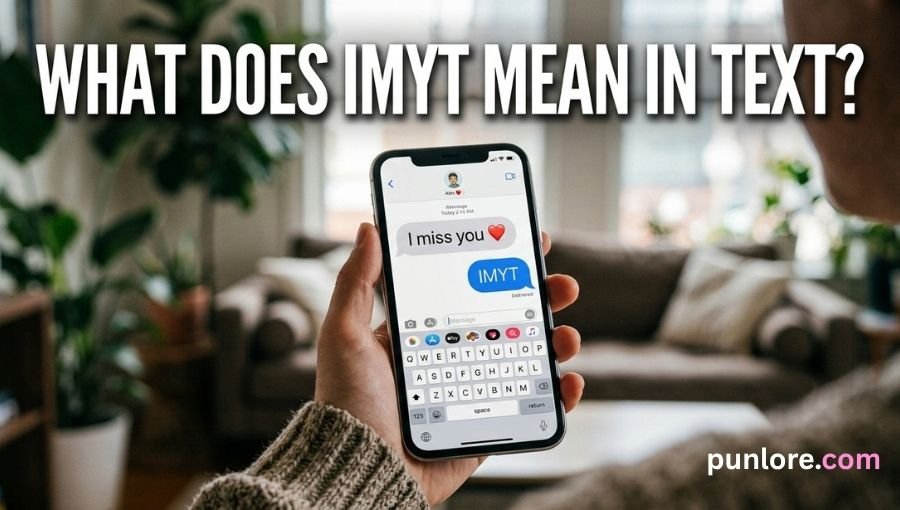
What Does IMYT Mean in Text: Definition, Context, Examples, and Modern Usage (2026 Guide)
Imagine getting a text from someone you care about: “I miss you.” You want to reply warmly, but instead of typing a full sentence, you see four letters in your head: IMYT. If you’ve come across this abbreviation and wondered what it means, you’re not alone. What Does IMYT Mean in Text is a common search because short texting abbreviations can be confusing, especially when they’re used in personal conversations.
Unlike more familiar terms such as LOL or BRB, IMYT isn’t used equally often by everyone. Its meaning also depends on the message around it.
The good news is that the basic meaning is simple. Once you understand the abbreviation, the emotional tone, and the situation where it appears, reading it becomes much easier.
This guide explains the meaning, examples, relationship context, social media use, possible misunderstandings, and smart ways to respond.
Quick Answer / Quick Definition of “What Does IMYT Mean in Text”
IMYT usually means “I Miss You Too.” It is a casual texting abbreviation used to return someone’s expression of missing you. For example, if a friend texts “Miss you!” you might reply “IMYT.” In simple terms, it means “I feel the same way—I miss you too.”
Detailed Meaning Breakdown
Primary Meaning
The most common meaning of IMYT is “I Miss You Too.” The abbreviation is normally used when another person has already said they miss you.
For example:
“Wish you were here. I miss you.”
“IMYT ❤️”
The reply doesn’t introduce a new idea. Instead, it mirrors the other person’s feeling.
When people ask What Does IMYT Mean in Text, this is the definition they usually need. It belongs to the broader family of texting shorthand designed to save time while keeping conversations personal.
The phrase can sound affectionate without necessarily being romantic. A close friend, family member, or romantic partner could use it.
Secondary Meanings
Unlike some abbreviations with several widely accepted definitions, IMYT has one dominant texting meaning.
Still, context can slightly change the emotional message. “IMYT” from a longtime friend may feel warm and friendly. The same letters from a romantic partner can carry much stronger emotional weight.
Capitalization doesn’t usually matter. You might see:
- IMYT
- imyt
- Imyt
They generally communicate the same thing.
Rare or Misinterpreted Meanings
Some abbreviations can have specialized meanings in business, gaming, medicine, or technical communities. IMYT isn’t strongly associated with a widely recognized alternative meaning in ordinary texting.
That’s why guessing based only on the letters can cause unnecessary confusion.
If the surrounding conversation doesn’t involve missing someone, however, ask for context rather than assuming. Slang changes quickly, and a private abbreviation between two people can mean something completely different.
What “What Does IMYT Mean in Text” Means in Different Contexts
In Texting and Messaging
In everyday messages, IMYT is generally a short response to “I miss you” or a similar statement.
Someone might write:
“The house feels so quiet without you. IMYT.”
Here, the abbreviation expresses affection and emotional connection.
Another person might send:
“Had so much fun last weekend. Miss you already!”
A reply such as “IMYT!” keeps the conversation casual while clearly returning the sentiment.
In my experience with texting language, short abbreviations often work best when the relationship is already comfortable. They don’t need much explanation between people who understand each other’s communication style.
On Social Media Platforms
The abbreviation can appear in Instagram DMs, Snapchat messages, TikTok comments, or Threads conversations, although usage varies by platform.
On Instagram, IMYT is more likely to appear in a DM or reply to a story than in a public caption. Snapchat’s fast, informal communication style also makes shorthand natural.
On TikTok, it could appear in a comment or private message when someone is responding to a friend. Threads tends to favor more conversational writing, so the abbreviation may appear less often publicly.
For example:
“Come visit soon!”
“IMYT 🥲”
The platform changes the setting, but the core message remains the same.
In Dating and Relationships
In romantic conversations, IMYT can carry a stronger emotional meaning.
Suppose someone you’re dating texts:
“I had such a good time with you last night. I miss you already.”
Responding with “IMYT” confirms that the feeling is mutual.
However, the abbreviation alone doesn’t automatically prove romantic interest. Context matters. A close friend could use exactly the same wording.
If you’re trying to understand What Does IMYT Mean in Text from a romantic partner, look at the entire conversation rather than treating the abbreviation as a hidden declaration of love.
In Professional Communication
IMYT is generally not appropriate for formal workplace communication.
A coworker might understand it, but a manager, client, customer, or professional contact could find it unclear or overly personal.
For example, after working with a colleague on a project, writing “IMYT” could create an awkward impression unless you’re already close friends outside work.
In professional settings, plain language is safer. Write “I miss working with you too” or simply “It was great working with you” when that’s what you mean.
Cultural or Regional Differences
The basic interpretation is fairly consistent among English-speaking texters, but familiarity varies by age, online community, and personal texting habits.
Younger users who frequently communicate through abbreviations may recognize IMYT immediately. Someone who prefers complete sentences might not.
The phrase “I miss you too” itself is universal enough that people usually understand the intended emotion once the abbreviation is explained.
Tone, Psychology & Why People Use It
Why People Use It & What It Signals Socially
IMYT saves typing while preserving an emotional response. That’s its main appeal.
It signals reciprocity: “You miss me, and I miss you too.”
That makes it different from simply reacting with a heart or leaving the message unanswered. The abbreviation gives the other person a direct verbal confirmation.
It can also make a conversation feel relaxed. People often use shorthand with people they already feel comfortable around.
Emotional Layer Behind It
Tone depends heavily on the surrounding message.
A warm version might be:
“IMYT ❤️ Can’t wait to see you.”
A neutral-friendly version could be:
“IMYT! Hope you’re doing well.”
A very short “imyt” may feel understated, but it isn’t automatically cold. Some people naturally communicate with minimal text.
One useful rule: don’t judge emotional intensity from four letters alone. Look at punctuation, emojis, previous messages, and the relationship.
10 Real Conversation Examples (Explained)
1. Long-Distance Friends
Message: “Miss our coffee runs. IMYT.”
Meaning: The sender misses spending time with the friend.
Tone: Warm and nostalgic.
Likely interpretation: Genuine friendship and longing to reconnect.
2. Romantic Partner
Message: “Wish you were here tonight.”
Reply: “IMYT ❤️”
Meaning: The partner returns the feeling.
Tone: Affectionate and romantic.
Likely interpretation: Mutual emotional closeness.
3. Family Member
Message: “Hope school is going well. I miss you!”
Reply: “IMYT, Mom.”
Meaning: The child or adult child misses their mother too.
Tone: Loving and familial.
Likely interpretation: Family affection, not romance.
4. After a Vacation
Message: “Already missing this place.”
Reply: “IMYT!”
Meaning: Depending on context, the sender may mean they miss the person rather than the place.
Tone: Context-dependent.
Likely interpretation: Check the previous message before deciding.
5. Close Friendship
Message: “You disappeared! Miss you.”
Reply: “IMYT 😂 I’ve been so busy.”
Meaning: The person returns the sentiment while keeping things playful.
Tone: Friendly and light.
6. New Relationship
Message: “I know it’s only been two days, but I miss you.”
Reply: “IMYT.”
Meaning: The attraction or emotional connection appears mutual.
Tone: Affectionate but restrained.
7. Reconnecting
Message: “It’s been years. I miss our old conversations.”
Reply: “IMYT.”
Meaning: The sender shares nostalgia for the past relationship.
Tone: Reflective and sincere.
8. Casual Check-In
Message: “Thinking about you today.”
Reply: “IMYT.”
Meaning: The reply may imply the sender misses the person even though the original message didn’t use those exact words.
Tone: Soft and personal.
9. Emotional Conversation
Message: “Things haven’t felt the same since you moved.”
Reply: “IMYT. We should talk soon.”
Meaning: The abbreviation acknowledges shared emotional distance.
Tone: Sincere and somewhat serious.
10. Very Short Reply
Message: “Miss you.”
Reply: “imyt”
Meaning: The sender returns the statement.
Tone: Usually casual; the lowercase style isn’t automatically negative.
Where Misunderstandings Happen
Context Confusion
The biggest problem is assuming that an abbreviation carries the same emotional weight in every conversation.
IMYT from a sibling isn’t romantic. IMYT from a partner probably is affectionate. The words stay the same while the relationship changes their meaning.
Generational Gap
Not everyone knows texting shorthand.
A person unfamiliar with abbreviations might wonder whether IMYT is a typo, an acronym, or an inside joke. This is especially common when one person normally writes full sentences.
Platform Differences
A short message in Snapchat may feel perfectly normal because the platform encourages quick communication. The same abbreviation in a formal LinkedIn message would feel out of place.
The communication channel influences how natural the shorthand sounds.
Similar Words, Symbols, or Abbreviations
| Term | Meaning | How It Differs from IMYT |
|---|---|---|
| ILY | I love you | Expresses love rather than specifically missing someone |
| ILY2 | I love you too | Returns “I love you,” not “I miss you” |
| Miss U | Miss you | Similar idea but doesn’t explicitly say “too” |
| WYD | What are you doing? | Asks about someone’s current activity |
| TTYL | Talk to you later | Signals the conversation will continue later |
| LOL | Laughing out loud | Expresses amusement |
| XOXO | Hugs and kisses | General affection rather than specifically missing someone |
| ❤️ | Love/affection | A symbol whose meaning depends strongly on context |
When Not to Use “What Does IMYT Mean in Text”
Professional Risks
Avoid IMYT in formal emails, customer support messages, job applications, academic communication, and unfamiliar professional relationships.
Abbreviations can make otherwise clear writing look too casual.
Cultural Risks
Not everyone interprets shorthand the same way. If you’re communicating with someone from a different linguistic or cultural background, the full phrase may be clearer.
When emotional meaning matters, clarity beats cleverness.
Tone Risks
IMYT can feel too intimate when used with someone you barely know.
If someone says “I miss you” and you’re unsure whether they mean friendship or romance, replying with IMYT could unintentionally signal stronger feelings than you intended.
Expert Tips for Using “What Does IMYT Mean in Text” Correctly
- Use it when the other person has expressed missing you. The response feels natural when it directly mirrors their sentiment.
- Consider your relationship first. Friends, relatives, and partners can all use it, but the emotional meaning changes.
- Match the other person’s communication style. If they write complete sentences, a short abbreviation may feel abrupt.
- Add context when necessary. “IMYT too—hope we can catch up soon” is clearer than four letters alone.
- Don’t use it in formal workplace messages. Choose direct, professional wording instead.
- Pay attention to emojis. A heart can make the message more affectionate, while a laughing emoji can make it playful.
- Don’t assume romance. The abbreviation doesn’t automatically mean romantic interest.
- Ask if you’re genuinely confused. A quick “What do you mean by IMYT?” can prevent an awkward interpretation.
- Use the full phrase when emotions are serious. “I miss you too” can feel more sincere during an important conversation.
- Read the whole conversation. The messages before and after the abbreviation usually reveal its real tone.
Frequently Asked Questions
1. What does IMYT mean in texting?
IMYT most commonly means “I Miss You Too.” Someone normally uses it after another person says they miss them or expresses a similar feeling. It’s casual shorthand rather than formal English, and it’s most natural in personal messages between people who already understand each other’s texting style.
2. Is IMYT a positive or negative abbreviation?
IMYT is generally positive and affectionate because it communicates that the sender also misses someone. However, its emotional intensity depends on the relationship. Between friends, it can be warm and friendly; between romantic partners, it can express stronger affection and emotional closeness.
3. Can IMYT be romantic?
Yes. IMYT can absolutely appear in romantic conversations, especially after a partner says, “I miss you.” Still, the abbreviation itself doesn’t prove romantic interest. Friends and family members can use it too, so the relationship and surrounding messages provide the necessary context.
4. How should I respond to IMYT?
Your best response depends on how you feel. If you genuinely miss the person, you can say, “I miss you too!” If you want to continue the conversation, add something specific such as, “We should catch up this weekend.” If you don’t share the same feeling, respond politely without sending a misleading romantic signal.
5. Does IMYT mean “I miss you too much”?
Usually, no. The standard interpretation is “I Miss You Too.” The word “too” means the sender shares the other person’s feeling. It doesn’t normally mean “I miss you too much,” although slang can vary between private groups, so unusual context should always be considered.
6. Is IMYT still used in 2026?
Yes, you may still encounter IMYT in informal digital conversations, although its popularity varies from person to person. Some users prefer newer slang or simply write “miss you too.” Texting abbreviations don’t have fixed popularity levels, so familiarity depends heavily on age, community, platform, and personal communication habits.
7. Is IMYT the same as “I miss you”?
Not exactly. “I miss you” makes the original statement, while IMYT means “I miss you too,” which responds to someone else’s expression of missing you. That distinction matters because IMYT normally depends on an earlier message or context involving the feeling of missing someone.
8. What does IMYT mean from a guy or girl?
The abbreviation has the same basic meaning regardless of gender: “I Miss You Too.” What changes is the relationship and tone. If you’re trying to determine whether the sender has romantic feelings, examine the broader conversation, previous behavior, and relationship rather than treating the abbreviation as proof.
Final Summary & Smart Usage Advice
If you’ve been wondering What Does IMYT Mean in Text, the short answer is straightforward: it usually means “I Miss You Too.” It’s an informal abbreviation used to return someone’s expression of missing you.
You might see it in a private text, Instagram DM, Snapchat conversation, TikTok message, or another casual online exchange. Friends, family members, and romantic partners can all use it. The relationship determines the emotional shade.
The safest way to interpret IMYT is to look beyond the four letters. Consider what the person said immediately before it, how they normally communicate, and whether your relationship is friendly, familial, or romantic.
Avoid using it in formal professional communication. If the emotional situation is sensitive, writing the full phrase can also sound more sincere and leave less room for confusion.
You don’t need to overthink the abbreviation itself. Once you know its standard meaning, the surrounding conversation does most of the interpretive work.
The memorable takeaway: IMYT usually means “I Miss You Too”—simple words, but the relationship gives them their real meaning.
Also Read This: What Does FYA Mean in Text