IDFK Meaning in Text: Definition, Context, Examples, and Modern Usage (2026 Guide)
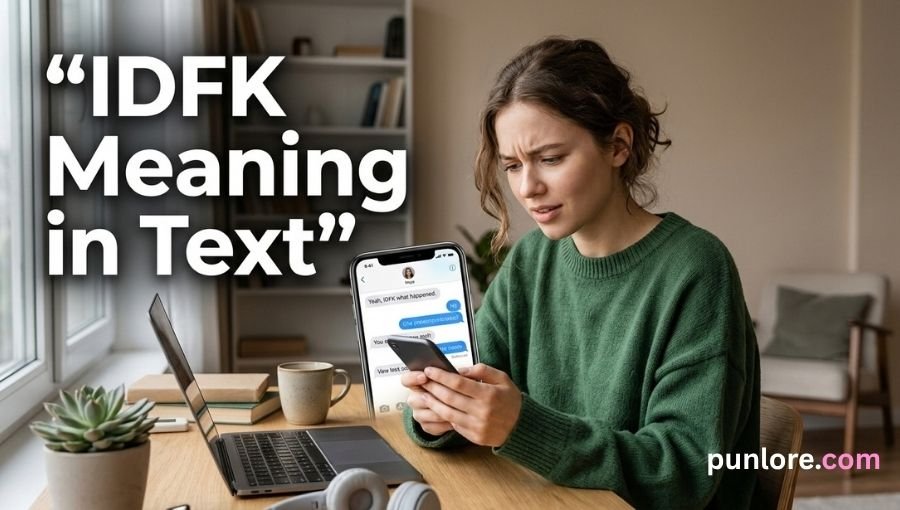
You’re texting a friend about weekend plans when they suddenly reply, “IDFK, you decide.” If you’ve never seen the abbreviation before, it can look confusing—or even a little rude. So what does it mean? The IDFK meaning in text is usually “I don’t fucking know.”
It’s an informal version of “I don’t know” that adds frustration, emphasis, surprise, or emotional intensity. The exact feeling depends heavily on the conversation and the relationship between the people involved.
You may see IDFK in text messages, comments, DMs, captions, group chats, and casual online conversations. People often use it when they genuinely don’t know something, feel annoyed about a situation, or simply want to give a blunt answer.
Because the abbreviation contains profanity, it’s more casual and stronger than IDK. That small difference can change how a message feels.
Here’s a straightforward look at the IDFK meaning in text, including its different contexts, tone, examples, and situations where you may want to avoid using it.
Quick Answer / Quick Definition of “IDFK Meaning in Text”
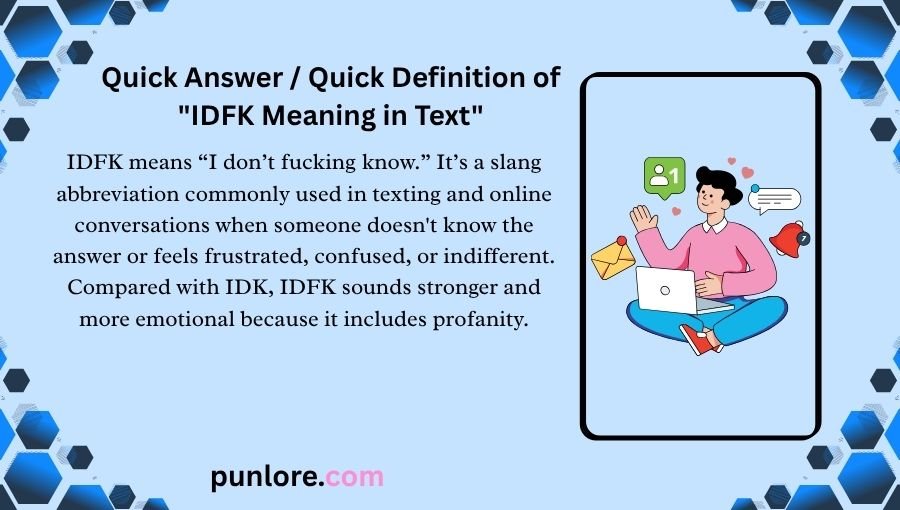
IDFK means “I don’t fucking know.” It’s a slang abbreviation commonly used in texting and online conversations when someone doesn’t know the answer or feels frustrated, confused, or indifferent. Compared with IDK, IDFK sounds stronger and more emotional because it includes profanity.
Detailed Meaning Breakdown
Primary Meaning
The primary meaning of IDFK is “I don’t fucking know.”
It communicates a lack of knowledge, but the added swear word gives the statement extra force. Depending on context, it can sound irritated, shocked, dismissive, or simply casual.
For example:
“What time does the movie start?”
“IDFK, check the website.”
The speaker probably doesn’t know and isn’t treating the question as a serious issue.
I’ve noticed that the abbreviation often looks harsher on screen than it sounds between close friends. That’s because texting removes facial expressions and voice tone.
Secondary Meanings
Sometimes IDFK doesn’t literally mean the person has zero knowledge.
It can communicate:
- Frustration: “IDFK why he keeps doing that.”
- Confusion: “IDFK what happened.”
- Indifference: “IDFK, pick whichever one.”
- Exasperation: “IDFK anymore.”
- Surprise: “IDFK! That came out of nowhere.”
The surrounding words matter. A short “IDFK” can feel dismissive, while “IDFK 😭” may communicate humorous confusion.
Rare or Misinterpreted Meanings
IDFK generally has one established slang meaning. It isn’t normally a secret code or special acronym with a completely different everyday definition.
Still, people sometimes misread it as simply IDK. That misses the emotional strength of the phrase.
The IDFK meaning in text includes profanity, so it can sound more intense than “I don’t know,” even when both answers provide the same basic information.
What “IDFK Meaning in Text” Means in Different Contexts
In Texting and Messaging
In ordinary texting, IDFK is usually a fast way to say that you don’t know something.
For example:
“Are we meeting at 6 or 7?”
“IDFK, ask Mike.”
Here, the sender isn’t necessarily angry. They’re simply using blunt internet slang.
Another example:
“Why is my phone doing this?”
“IDFK 😂”
The laughing emoji can soften the message and make it feel playful rather than hostile.
On Social Media Platforms
On Instagram, Snapchat, TikTok, and Threads, IDFK can appear in comments, captions, stories, and direct messages.
A TikTok comment might say:
“IDFK how she made that look so easy.”
On Instagram, someone might write:
“IDFK what I was thinking with this outfit.”
A Snapchat message can be even more casual:
“IDFK where we’re going tonight.”
Threads conversations may use it when someone wants to express uncertainty or frustration without writing a full sentence.
The IDFK meaning in text stays essentially the same across these platforms, but the tone often follows the platform’s casual conversational style.
In Dating and Relationships
Among romantic partners, IDFK can be playful, frustrated, or genuinely uncertain.
For example:
“Do you think he likes me?”
“IDFK, babe. Ask him.”
Between people who are comfortable swearing around each other, this may feel completely normal.
But during an argument, the same abbreviation can sound cold:
“Why won’t you tell me what’s wrong?”
“IDFK.”
In that situation, the short response may communicate emotional exhaustion or unwillingness to continue the conversation.
In Professional Communication
IDFK is generally not appropriate for formal workplace communication.
Sending it to a manager, customer, client, teacher, or business contact can appear disrespectful or careless because it contains profanity.
Instead of:
“IDFK when the report will be ready.”
Use:
“I’m not sure when the report will be ready, but I’ll check.”
The difference is simple: professional communication benefits from clarity without unnecessary slang or profanity.
Cultural or Regional Differences
IDFK is primarily associated with informal English-language internet and texting culture. Its interpretation can vary according to age, familiarity with online slang, and comfort with profanity.
Younger users or people who regularly use social media may recognize it immediately. Someone less familiar with texting abbreviations may need the phrase explained.
The important point is that IDFK meaning in text doesn’t automatically tell you how someone feels. Their wording and relationship with you provide the missing context.
Tone, Psychology & Why People Use It
Why People Use It & What It Signals Socially
People use IDFK because it’s quick, expressive, and emotionally stronger than “I don’t know.”
Typing four letters is faster than writing the full phrase. More importantly, the abbreviation lets the sender communicate attitude at the same time.
It can signal:
- Casualness
- Frustration
- Humor
- Confusion
- Indifference
- Emotional exhaustion
A person who writes “IDFK 😂” may be joking, while someone who writes “IDFK anymore” may be genuinely overwhelmed.
In my experience, the words immediately before and after an abbreviation often reveal more than the abbreviation itself.
Emotional Layer Behind It
IDFK can have several emotional shades.
A friendly tone might look like:
“IDFK lol, you tell me.”
A neutral-casual tone could be:
“IDFK. Maybe tomorrow.”
A cold or irritated tone might be:
“IDFK. Stop asking me.”
The abbreviation itself isn’t automatically rude. The surrounding language determines much of its emotional impact.
10 Real Conversation Examples (Explained)
- Message: “IDFK what restaurant we should pick.”
Meaning: The person has no preference or answer. Tone: Casual. Likely interpretation: They’re asking someone else to decide. - Message: “IDFK why my laptop keeps restarting.”
Meaning: Genuine confusion. Tone: Frustrated. Likely interpretation: The technical problem is annoying them. - Message: “IDFK 😂 you choose the movie.”
Meaning: They don’t care which movie plays. Tone: Playful. Likely interpretation: They’re leaving the decision to you. - Message: “IDFK what she wants from me.”
Meaning: The sender doesn’t understand someone’s behavior. Tone: Confused. Likely interpretation: They’re seeking emotional advice. - Message: “IDFK anymore.”
Meaning: The person feels unable to figure something out. Tone: Potentially serious. Likely interpretation: Context is needed before assuming they’re joking. - Message: “IDFK where Sam went.”
Meaning: The sender doesn’t know Sam’s location. Tone: Neutral. Likely interpretation: A straightforward lack of information. - Message: “IDFK why you thought that was okay.”
Meaning: The sender strongly disagrees. Tone: Confrontational. Likely interpretation: They’re upset. - Message: “IDFK, surprise me.”
Meaning: They’re allowing the other person to make the choice. Tone: Relaxed. Likely interpretation: They don’t have a preference. - Message: “IDFK if I’ll be able to come tonight.”
Meaning: The person’s plans are uncertain. Tone: Casual but uncertain. Likely interpretation: Don’t count on them yet. - Message: “IDFK 😭 this is too funny.”
Meaning: The speaker is overwhelmed by laughter rather than genuinely confused. Tone: Humorous. Likely interpretation: The abbreviation is being used dramatically.
Where Misunderstandings Happen
Context Confusion
The biggest problem is assuming that IDFK always means anger.
It doesn’t.
A person can use it casually with a friend or sharply during an argument. Look at the entire message before deciding what emotion is present.
Generational Gap
Not everyone knows internet abbreviations. Older readers, new English learners, or people who don’t spend much time online may not recognize IDFK immediately.
If clarity matters, spell out what you mean.
Platform Differences
The abbreviation may feel more natural in a Snapchat DM than in a LinkedIn message. The platform creates an expected level of formality.
That’s why the IDFK meaning in text should always be interpreted alongside the setting.
Similar Words, Symbols, or Abbreviations
| Term | Meaning | How It Differs from IDFK Meaning in Text |
|---|---|---|
| IDK | I don’t know | Less profane and usually softer |
| IDC | I don’t care | Expresses indifference rather than uncertainty |
| IMO | In my opinion | Introduces a personal view |
| TBH | To be honest | Signals frankness or sincerity |
| WTF | What the fuck | Usually expresses shock, confusion, or disbelief |
| IKR | I know, right? | Shows agreement or shared reaction |
| NGL | Not gonna lie | Introduces an honest statement |
| SMH | Shaking my head | Often expresses disappointment or disbelief |
These abbreviations overlap in casual conversations, but they aren’t interchangeable. IDK is the closest alternative because both can answer a question about knowledge.
When Not to Use “IDFK Meaning in Text”
Professional Risks
Avoid IDFK in job applications, formal emails, client conversations, official documents, and serious customer service situations.
Even if your workplace is relaxed, profanity can be interpreted differently by different people.
Cultural Risks
Some people are comfortable with swear words; others aren’t. Don’t assume familiarity means permission to use profanity.
This is especially relevant when communicating with someone from a different background.
Tone Risks
A short abbreviation can sound harsher than intended.
If you’re discussing a sensitive topic, “I’m not sure” is usually safer than IDFK. You can always add emotional detail when appropriate.
Expert Tips for Using “IDFK Meaning in Text” Correctly
- Use it with people who understand your casual style.
- Avoid it in formal or professional communication.
- Read the surrounding conversation before interpreting someone’s tone.
- Remember that IDFK is stronger than IDK.
- Use emojis carefully when they genuinely clarify your mood.
- Don’t use the abbreviation when precise information is required.
- If you’re angry, consider whether the abbreviation will escalate the conversation.
- When talking to someone unfamiliar with slang, write the phrase out instead.
- Don’t assume every short IDFK response is hostile.
- Match the level of informality already established in the conversation.
Frequently Asked Questions
1. What does IDFK mean in texting?
IDFK means “I don’t fucking know.” It’s informal internet slang used when someone doesn’t know an answer or wants to express confusion, frustration, indifference, or surprise. Because it contains profanity, it’s stronger than IDK and is best reserved for casual conversations with people who are comfortable with that language.
2. Is IDFK rude or offensive?
IDFK can be rude in some situations because it contains profanity, but it isn’t automatically intended as an insult. Among close friends, it may be completely casual. In a workplace, with strangers, or during a sensitive conversation, however, the same abbreviation can come across as dismissive or disrespectful.
3. Is IDFK the same as IDK?
They’re similar, but not identical in tone. IDK means “I don’t know” and is generally neutral or casual. IDFK adds profanity, which can communicate stronger frustration, emphasis, or bluntness. If you’re unsure which one to use, IDK is the safer choice because it carries less emotional weight.
4. Can IDFK have a romantic meaning?
IDFK doesn’t have a special romantic definition. Someone might use it while talking about dating, relationships, attraction, or plans, but its basic meaning remains “I don’t fucking know.” Whether the message feels affectionate, annoyed, playful, or distant depends on the surrounding conversation and the relationship.
5. How should I respond when someone texts IDFK?
Your response should match the situation. If they’re simply unsure, you could provide information or suggest an option. If they sound frustrated, give them space or ask what is bothering them. A simple “No worries, I’ll figure it out” can work well when the question doesn’t require an immediate answer.
6. Why do people use IDFK instead of saying “I don’t know”?
Speed is one reason. Texting abbreviations save time, but they also communicate personality and emotion. IDFK can sound more emphatic than the plain phrase. Someone may choose it because they’re annoyed, joking, overwhelmed, or simply accustomed to casual online slang.
7. Is IDFK appropriate for Instagram or TikTok?
Usually, IDFK fits casual social media environments, including comments, DMs, captions, and stories. However, context still matters. A personal post may use it comfortably, while a business account addressing customers may want more polished language. Audience expectations should guide the choice.
8. What is the difference between IDFK and “WTF”?
IDFK means “I don’t fucking know,” while WTF generally means “what the fuck.” IDFK focuses on not knowing something; WTF commonly expresses shock, disbelief, anger, or confusion. They can appear together, but they serve different conversational purposes and shouldn’t be treated as interchangeable abbreviations.
Final Summary & Smart Usage Advice
The IDFK meaning in text is straightforward: it usually means “I don’t fucking know.” What makes it interesting is the tone behind those four letters.
Someone might use IDFK because they genuinely don’t know the answer. Another person might use it to show frustration, confusion, humor, indifference, or emotional exhaustion. The surrounding words, punctuation, emojis, platform, and relationship all help determine the intended feeling.
IDFK works best in casual texting, group chats, social media conversations, and relaxed exchanges with people who are comfortable with profanity. It isn’t a good fit for formal emails, job applications, professional messages, or situations where a respectful tone is especially important.
The most common mistake is treating every IDFK message as angry. That’s too simplistic. A friend saying “IDFK 😂” may be joking, while “IDFK anymore” could carry much more emotional weight.
If you’re deciding whether to use it yourself, ask one simple question: Would I normally swear when speaking casually to this person? If the answer is no, “I don’t know” or “IDK” is probably a better choice.
Remember: IDFK says “I don’t know,” but the context tells you how strongly the person means it.
Also Read This: What Does IGH Mean in Text