Hm Meaning in Text: Definition, Context, Examples, and Modern Usage (2026 Guide)
Imagine you send someone a long message and get one reply: “Hm.” You stare at your phone for a second. Are they interested? Annoyed? Thinking? Or simply unsure what to say? That small two-letter response can feel surprisingly difficult to read. The meaning depends heavily on the conversation, punctuation, relationship, and even the person’s usual texting habits. That’s why people keep searching for Hm Meaning in Text when they receive it in a message, comment, or direct message.
Unlike many internet abbreviations, “hm” isn’t usually a fixed acronym. It commonly represents a thoughtful sound, hesitation, uncertainty, or mild reaction. A stretched version such as “hmm” can add even more nuance.
The term has become especially relevant as short-form communication continues to dominate texting and social media. A single syllable can replace an entire sentence, but it can also create confusion.
So, what does “hm” actually mean? Let’s break down Hm Meaning in Text by context, tone, relationship, and platform so you can interpret it without overthinking every message.
Quick Answer / Quick Definition of “Hm Meaning in Text”
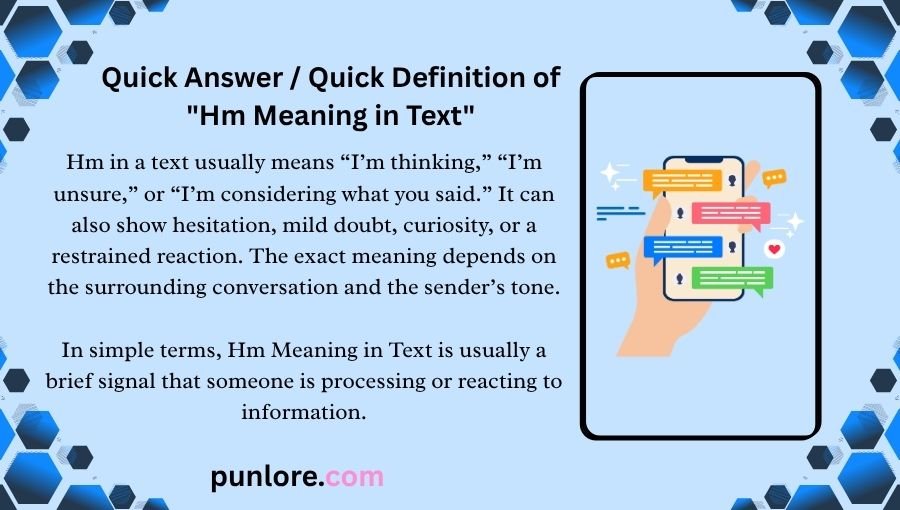
Hm in a text usually means “I’m thinking,” “I’m unsure,” or “I’m considering what you said.” It can also show hesitation, mild doubt, curiosity, or a restrained reaction. The exact meaning depends on the surrounding conversation and the sender’s tone.
In simple terms, Hm Meaning in Text is usually a brief signal that someone is processing or reacting to information.
Detailed Meaning Breakdown
Primary Meaning
The most common meaning of hm is a written version of a thoughtful sound. Someone may type it when they are considering an idea or deciding how to respond.
For example:
“Hm, I never thought about it that way.”
Here, “hm” suggests reflection. The person isn’t necessarily upset. They’re simply taking a moment to process the idea.
You’ll often see hm, hmm, or hmmm used this way. More letters can sometimes make the response feel slower, more hesitant, or more expressive.
Secondary Meanings
Depending on the situation, “hm” can communicate several related ideas:
- Hesitation: “Hm, I’m not sure.”
- Curiosity: “Hm, interesting.”
- Doubt: “Hm, are you certain?”
- Mild disagreement: “Hm. I don’t know about that.”
- Thinking: “Hm, let me check.”
- Uncertainty: “Hm, maybe.”
- Quiet acknowledgment: “Hm, okay.”
One thing I’ve noticed in everyday messaging is that people often use “hm” when they haven’t decided what they genuinely think yet.
Rare or Misinterpreted Meanings
“Hm” isn’t automatically a sign of anger, rejection, boredom, or sarcasm.
For example, if a friend replies:
“Hm, that’s actually a good point.”
The response is probably positive or thoughtful.
But:
“Hm.”
after an argument may feel much colder.
The surrounding words matter more than the letters themselves. Treating every short response as negative can lead to unnecessary misunderstandings.
What “Hm Meaning in Text” Means in Different Contexts
In Texting and Messaging
In ordinary texting, Hm Meaning in Text is usually connected to thinking or hesitation.
Someone might write:
“Hm, should I go tonight?”
This means they are considering the choice.
Another example:
“Hm, I didn’t know that.”
Here, the sender sounds mildly surprised or interested.
Punctuation changes the feeling too. “Hm…” can suggest uncertainty or suspicion, while “Hm!” may sound more energetic or surprised.
A plain “Hm” is harder to interpret because it provides very little emotional information.
On Social Media Platforms
The meaning can shift slightly depending on where it appears.
On Instagram, “hm” in a comment might be playful, curious, or skeptical. In a DM, it usually follows the normal texting meaning.
On Snapchat, short responses are common, so “hm” may simply indicate that someone saw a message and is thinking about it.
On TikTok, a comment such as “hm…” can sound humorous, doubtful, or teasing, especially when reacting to an unusual video.
On Threads, “hm” may appear as a brief reaction to an opinion or discussion. The surrounding post usually provides the missing context.
A useful rule is simple: don’t interpret the same two letters without considering what they’re responding to.
In Dating and Relationships
In romantic conversations, Hm Meaning in Text can become more complicated because people naturally look for emotional clues.
Suppose someone says:
“Hm, so you really like that place?”
That could be genuine curiosity.
But:
“Hm.”
after you ask, “Do you still want to see me?” may feel uncertain or emotionally distant.
It isn’t proof of rejection. The person could be thinking, distracted, or unsure how to answer.
In dating, look at the full conversation and behavior, not one tiny response. A single “hm” rarely tells the whole story.
In Professional Communication
In workplace messages, “hm” can sound too informal or ambiguous.
For example:
“Hm, I’ll have to think about that.”
A coworker may understand it as hesitation. However, a client could interpret the same wording as doubt or dissatisfaction.
Professional communication benefits from clarity. Instead of relying on a vague reaction, say exactly what you mean:
“I’ll review this and get back to you.”
That leaves less room for interpretation.
Cultural or Regional Differences
The basic use of “hm” is fairly recognizable across English-language messaging, but communication styles vary by age, culture, and personal habits.
Some people use “hmm” frequently and don’t intend anything negative. Others use “hm” only when they’re skeptical.
Younger users may also combine it with punctuation, emojis, GIFs, or slang to make the intended tone clearer.
Personal texting style matters greatly. Someone who normally sends one-word replies may use “hm” casually, while a normally expressive person sending only “hm” may be signaling something different.
Tone, Psychology & Why People Use It
Why People Use It & What It Signals Socially
People use “hm” because it is quick and flexible. It can buy time without ending the conversation.
Instead of writing:
“I’m not sure what I think about that yet.”
someone can simply type:
“Hm…”
The short response keeps the conversation open.
It can also signal that the sender is listening. In some conversations, “hm” functions almost like a spoken “I see” or “I’m thinking about that.”
Emotional Layer Behind It
Tone is where Hm Meaning in Text gets tricky.
A friendly “hm” might look like:
“Hm, that sounds fun!”
A neutral version could be:
“Hm, let me think.”
A colder version might be:
“Hm.”
The difference isn’t the word alone. It comes from punctuation, timing, previous messages, and the relationship between the people.
If someone normally writes warmly and suddenly sends only “Hm.” after bad news, the period may make the message feel especially serious.
10 Real Conversation Examples (Explained)
- Message: “Hm, that could work.”
Meaning: They’re considering the idea positively.
Tone: Neutral and open.
Likely interpretation: They haven’t fully committed yet. - Message: “Hm… I don’t know.”
Meaning: The person has doubts.
Tone: Hesitant.
Likely interpretation: Don’t assume they’re agreeing. - Message: “Hm, interesting.”
Meaning: Something caught their attention.
Tone: Curious or neutral.
Likely interpretation: They may want more information. - Message: “Hm. That’s strange.”
Meaning: They’re reacting to something unusual.
Tone: Concerned or suspicious.
Likely interpretation: They aren’t completely comfortable with what happened. - Message: “Hmmm 😂”
Meaning: The sender is probably teasing or joking.
Tone: Playful.
Likely interpretation: The emoji softens the response. - Message: “Hm, what time?”
Meaning: They’re interested in the plan and want details.
Tone: Practical.
Likely interpretation: This isn’t necessarily hesitation about going. - Message: “Hm.” after a compliment
Meaning: The sender may be shy, unsure, or intentionally brief.
Tone: Ambiguous.
Likely interpretation: More context is needed. - Message: “Hm, you might be right.”
Meaning: They’re reconsidering their position.
Tone: Reflective.
Likely interpretation: Their opinion may be changing. - Message: “Hm… why did you ask?”
Meaning: They’re curious about your motive.
Tone: Cautious.
Likely interpretation: Explain your question clearly. - Message: “Hm, okay, I understand.”
Meaning: They’ve acknowledged your explanation.
Tone: Neutral.
Likely interpretation: They may understand without necessarily agreeing.
Where Misunderstandings Happen
Context Confusion
The biggest problem is that text removes many spoken clues. You can’t hear someone’s voice or see their facial expression.
A spoken “hm” might sound warm and thoughtful. Typed on its own, it can look distant.
That’s why Hm Meaning in Text should always be interpreted alongside the messages before and after it.
Generational Gap
Different age groups may use short expressions differently.
One person might see “hm” as a harmless thinking sound. Another may read it as passive-aggressive or dismissive.
Texting habits aren’t universal. Never assume your personal interpretation is automatically the sender’s intention.
Platform Differences
A TikTok comment has a different social setting from a private workplace chat. A playful “hm” under a funny video may carry little emotional weight.
In a private conversation, however, the same response could deserve more attention.
Similar Words, Symbols, or Abbreviations
| Term | Meaning | How It Differs from Hm Meaning in Text |
|---|---|---|
| Hmm | Thinking or hesitation | Usually more expressive or drawn out |
| Hmmm | Extended hesitation or reaction | Can sound more doubtful or playful |
| Okay | Acknowledgment | More direct and less ambiguous |
| Oh | Surprise or realization | Usually signals a clearer reaction |
| Uh | Hesitation | Often suggests uncertainty while speaking |
| IDK | I don’t know | Directly states uncertainty |
| TBH | To be honest | Introduces an opinion or candid statement |
| LOL | Laughing or amusement | Communicates humor rather than thoughtfulness |
| K | Brief acknowledgment | Often much more final or abrupt |
| Ah | Understanding or realization | Usually signals recognition rather than hesitation |
When Not to Use “Hm Meaning in Text”
Professional Risks
Avoid using “hm” when a decision, instruction, or client response needs to be unmistakable.
A vague reaction can create extra back-and-forth. In business communication, clarity usually matters more than conversational shorthand.
Cultural Risks
Don’t assume everyone interprets short expressions identically. Some readers may attach a stronger emotional meaning to “hm” than you intended.
When communicating across cultures or with someone you don’t know well, complete sentences are safer.
Tone Risks
A standalone “Hm.” can accidentally sound annoyed, skeptical, or dismissive.
If you mean something friendly, add context:
“Hm, that’s interesting. Tell me more.”
Those extra words remove much of the uncertainty.
Expert Tips for Using “Hm Meaning in Text” Correctly
- Consider the conversation first. Read the messages around “hm” before deciding what it means.
- Look at punctuation. “Hm?” and “Hm…” can create very different impressions.
- Notice the sender’s habits. Their normal texting style is useful context.
- Don’t assume rejection. A short response isn’t automatically negative.
- Watch for emojis. They can make a brief reaction warmer, funnier, or more sarcastic.
- Use extra words when clarity matters. Explain your actual thought instead of making someone guess.
- Be careful at work. Informal shorthand can appear uncertain in professional conversations.
- Don’t overanalyze one message. Look for patterns rather than isolated words.
- Ask directly if you’re confused. “What do you mean?” can solve the problem quickly.
- Match the relationship. Casual shorthand works better with people who already understand your communication style.
Frequently Asked Questions
1. What does “hm” mean in texting?
“hm” usually means the person is thinking, considering something, hesitating, or reacting mildly to what you said. It doesn’t have one fixed emotional meaning. The words around it, punctuation, and relationship between the speakers help determine whether it sounds curious, neutral, doubtful, or cold.
2. Is “hm” positive or negative?
It can be either, or neither. A message such as “Hm, that’s interesting” may show curiosity, while “Hm.” after an argument can sound distant. Hm Meaning in Text depends heavily on context, so it’s risky to label it positive or negative based on the letters alone.
3. Can “hm” be romantic?
Yes, but the romantic meaning comes from the surrounding conversation rather than “hm” itself. In flirting, someone might use “hmm” playfully when teasing or considering a suggestion. However, the response doesn’t automatically indicate attraction. Look at the broader communication pattern before drawing a romantic conclusion.
4. How should I respond to “hm”?
Respond according to the situation. If you’re unsure what they mean, try something simple such as, “What are you thinking?” If they’re considering a plan, give them time. If the conversation feels tense, a calm question can prevent you from guessing incorrectly.
5. What does “hmm” mean compared with “hm”?
“Hmm” generally gives the reaction a little more expression. It can suggest longer thought, hesitation, curiosity, or playful skepticism. Still, there is no universal rule. One person may use “hmm” casually, while another uses it when they genuinely aren’t convinced.
6. Does “hm” mean someone is angry?
Not necessarily. Anger is only one possible interpretation, and often not the intended one. A sender may type “hm” because they’re distracted, thinking, surprised, or unsure. If the conversation already contains conflict, however, the same short reply may understandably feel more negative.
7. Why do people type “hm” instead of saying what they think?
It’s a quick way to acknowledge a message while buying time to form a response. People also use it because written conversation often mirrors natural speech. Saying “hm” aloud is common when processing information, so typing it can feel natural and effortless.
8. Does punctuation change the meaning of “hm”?
Yes. “Hm?” can sound questioning, while “Hm…” often suggests hesitation or continued thought. “Hm.” may feel more final or serious. Punctuation isn’t a perfect emotional code, though. The sender’s normal writing habits and the conversation itself still matter more than punctuation alone.
Final Summary & Smart Usage Advice
Understanding Hm Meaning in Text is mostly about understanding context.
At its simplest, hm is a written thinking sound. Someone may use it when they’re considering an idea, feeling uncertain, showing curiosity, or reacting without having a full response ready. The longer forms “hmm” and “hmmm” can add extra hesitation or expression.
The same message can feel completely different depending on the situation. “Hm, that’s interesting” sounds quite different from “Hm.” after an argument. A laughing emoji can make it playful, while a period can make it feel more restrained.
For casual conversations, “hm” is usually harmless when the people involved understand each other’s texting style. In professional settings, though, clearer language is often preferable because ambiguity can cause confusion.
If someone sends you “hm,” don’t immediately assume they’re angry, uninterested, or rejecting you. Read the surrounding messages, consider their usual communication style, and ask for clarification when necessary.
You now have a practical way to interpret this tiny but surprisingly flexible expression.
The simplest rule to remember: “hm” rarely tells the whole story—context does.
Also Read This: What Does BBL Mean in Text