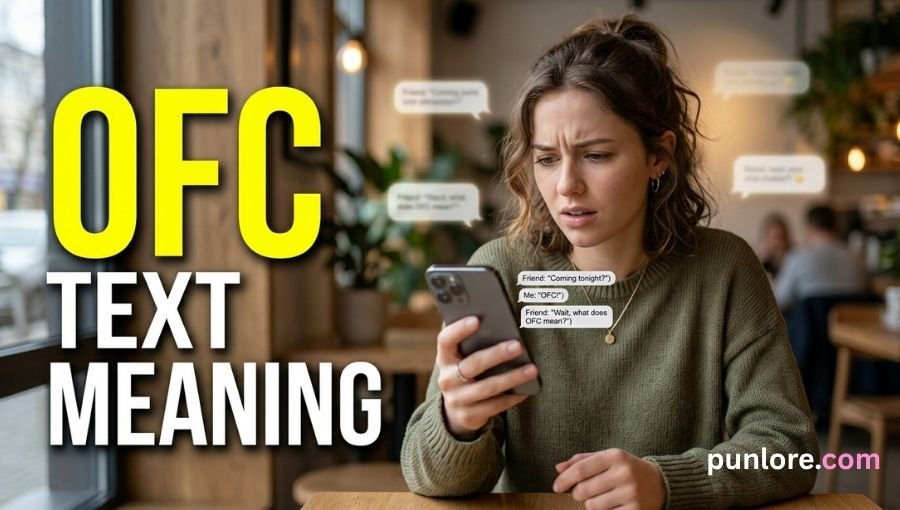
OFC Text Meaning: Definition, Context, Examples, and Modern Usage (2026 Guide)
You get a message from a friend asking, “Are you coming tonight?” You reply, “Yes, ofc.” A few seconds later, you might wonder: What does OFC actually mean, and can it sound rude? The OFC text meaning is usually simple, but tone can change everything.
In most online conversations, OFC means “of course.” People use it to show agreement, confirm something obvious, offer reassurance, or respond quickly without typing the full phrase.
The abbreviation has become common because texting is fast, casual, and full of shortcuts. You’ll see OFC in private messages, group chats, comments, gaming conversations, and social media DMs. Its exact feeling, however, depends on the relationship between the people talking.
A warm “ofc!!” can sound excited and caring. A plain “ofc” may sound neutral. In the wrong situation, it can even feel impatient.
That’s why understanding the OFC text meaning involves more than memorizing two words. Context, punctuation, platform, and tone all matter. Let’s break it down so you’ll know exactly what OFC means and when to use it.
Quick Answer / Quick Definition of “OFC Text Meaning”
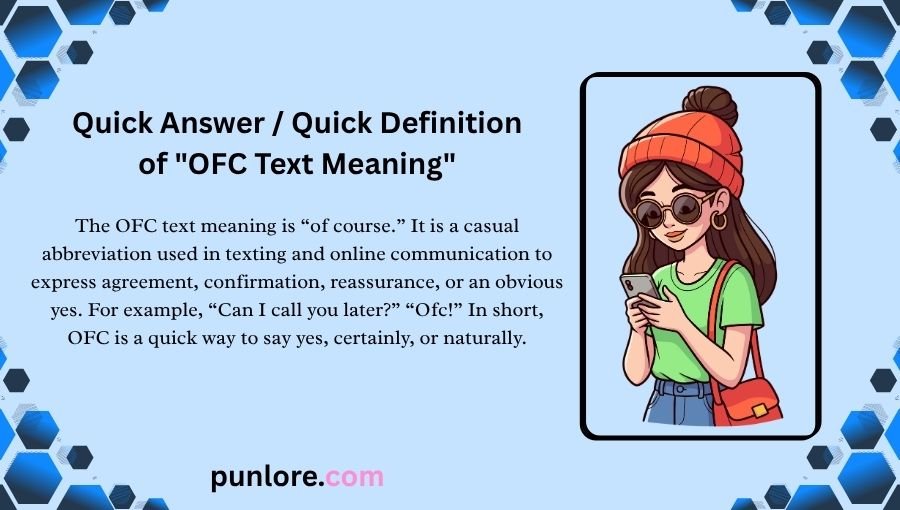
The OFC text meaning is “of course.” It is a casual abbreviation used in texting and online communication to express agreement, confirmation, reassurance, or an obvious yes. For example, “Can I call you later?” “Ofc!” In short, OFC is a quick way to say yes, certainly, or naturally.
Detailed Meaning Breakdown
Primary Meaning
The primary meaning of OFC is “of course.” It usually answers a question or responds to a statement in a quick, informal way.
For example:
“Will you help me with my homework?”
“Ofc.”
Here, OFC means, “Of course I will help you.” The shortened version saves time while keeping the basic message clear. I’ve noticed that people often use it when the answer feels easy or expected.
The OFC text meaning can also communicate strong certainty. Someone who says “ofc I remember” isn’t merely saying “yes.” They’re often suggesting that remembering was natural or obvious.
Secondary Meanings
Depending on context, OFC can carry several related ideas:
- Yes, definitely
- Certainly
- Naturally
- No problem
- Obviously, in some situations
For instance, if a friend says, “Thanks for waiting for me,” and you answer, “Ofc,” the meaning is closer to “You’re welcome, no problem.”
That small shift matters. The letters stay the same, but the social purpose changes.
Rare or Misinterpreted Meanings
OFC can occasionally stand for other phrases or names in specialized settings, organizations, sports, or technical discussions. However, in ordinary texting, messaging, and social media, “of course” is overwhelmingly the intended meaning.
A common mistake is reading OFC as automatically sarcastic or cold. It isn’t inherently either. A short reply can look blunt on a screen, especially when there’s no voice or facial expression to explain it.
What “OFC Text Meaning” Means in Different Contexts
In Texting and Messaging
In everyday messages, the OFC text meaning is usually direct and friendly: “of course.” It’s often used as a quick confirmation.
Example:
“Can you send me the address again?”
“Ofc, one sec.”
This sounds helpful and casual. The second sentence adds warmth and shows action.
Another example might be:
“You’ll be there for my birthday, right?”
“Ofc I will.”
Here, OFC provides reassurance. The speaker wants the other person to feel secure.
In close friendships, people may write “ofc,” “ofcc,” or “ofccc” for a more playful feeling. Extra letters can add enthusiasm, much like saying “yesss” instead of “yes.”
On Social Media Platforms
The meaning remains “of course” across major platforms, but the style can change.
Instagram: OFC often appears in DMs, comments, and story replies. A creator might receive, “Can I share this?” and answer, “Ofc, tag me!” That feels friendly and community-focused.
Snapchat: Because messages are often quick and informal, “ofc” may be used with very little extra wording. “You look good today.” “Ofc 😌” could be playful or jokingly confident.
TikTok: In comments, OFC can show agreement with a video or another user. For example, “Would watch a part two.” “Ofc, it’s coming tomorrow.” The tone is often energetic and conversational.
Threads: OFC may appear in replies during discussions. “Can people disagree without being rude?” “Ofc. That’s the whole point of discussion.” Here, it can sound more emphatic.
Captions and public comments can make OFC feel more expressive because other users are watching. In private DMs, the same abbreviation usually feels more personal.
In Dating and Relationships
The OFC text meaning can become warmer in a romantic conversation because the surrounding message carries emotional weight.
Example:
“Do you really want to see me this weekend?”
“Ofc I do.”
That response can feel reassuring and affectionate.
Another example:
“Can I hold your hand when we go out?”
“Ofc 😊”
The abbreviation itself isn’t romantic, but it can support a romantic message. Think of OFC as the container, while the context supplies the emotion.
Be careful, though. “Ofc” can also sound dismissive if someone asks a serious emotional question.
“Do you even care about me?”
“Ofc.”
A one-word reply may feel too brief for the situation. A fuller response would usually work better.
In Professional Communication
In most workplaces, OFC is too informal for formal communication. It may be acceptable in a relaxed team chat between coworkers who already use casual language.
For example:
“Can you join the 2 p.m. call?”
“Ofc, I’ll be there.”
Among close teammates, that may be fine.
But in an email to a client, manager, recruiter, or senior executive, writing “OFC” can appear careless or overly casual. “Of course, I’ll send that today” is safer.
The OFC text meaning doesn’t change at work, but professional expectations do. That’s something I’ve seen cause avoidable misunderstandings: people assume a familiar abbreviation always sounds friendly.
Cultural or Regional Differences
OFC is widely understood among English-speaking internet users, especially younger people and frequent texters. It isn’t strongly tied to one country.
Still, familiarity varies by age, online habits, and language background. A teenager who spends hours messaging may instantly understand OFC. Someone who rarely uses abbreviations might pause or ask what it means.
In multicultural workplaces or international groups, plain language is often better. “Of course” is clearer to someone learning English than “ofc.”
There can also be generational differences in tone. Younger users may see it as completely normal, while older users may interpret a very short reply as abrupt.
Tone, Psychology & Why People Use It
Why People Use It & What It Signals Socially
People use OFC because it is fast. But speed isn’t the only reason.
The abbreviation can signal familiarity and comfort. When two friends use shorthand, they often don’t need formal sentences. Their shared communication style does some of the work.
OFC can also make a response feel effortless:
“Can I sit with you?”
“Ofc.”
The speaker is saying yes without making the answer sound overly formal.
Sometimes, OFC signals that the answer should have been expected. “Ofc I remember your favorite movie” can suggest closeness. In another context, though, that same sense of obviousness may sound slightly annoyed.
The psychology is simple: short messages leave more room for interpretation. The reader fills in the missing tone.
Emotional Layer Behind It
The same abbreviation can sound friendly, neutral, cold, excited, or sarcastic.
Friendly: “Ofc! I saved you a seat.” The extra information makes the answer welcoming.
Neutral: “Ofc, that’s fine.” This simply confirms agreement.
Excited: “OFCCC!!! I can’t wait!” Capital letters and punctuation add energy.
Cold: “ofc.” On its own, after an emotional message, this may feel distant.
Sarcastic: “OFC, because that always works 🙄.” Here, the surrounding words clearly reverse the positive feeling.
When reading the OFC text meaning, don’t focus only on the abbreviation. Look at punctuation, timing, previous messages, and the relationship between the people involved.
10 Real Conversation Examples (Explained)
- Message: “Can you pick me up after work?” — “Ofc.”
Intended meaning: Yes, certainly. Tone: Helpful and casual. Likely interpretation: The person is happy or willing to help. - Message: “Are we still friends?” — “Ofc we are.”
Intended meaning: Absolutely; there’s no doubt. Tone: Reassuring. Likely interpretation: The speaker wants to calm the other person’s worry. - Message: “You liked the movie too?” — “ofc 😂”
Intended meaning: Obviously, yes. Tone: Playful. Likely interpretation: The shared opinion feels amusing or predictable. - Message: “Can I tell you something private?” — “Ofc, what’s up?”
Intended meaning: Yes, you can trust me. Tone: Open and supportive. Likely interpretation: The listener is inviting the conversation. - Message: “Will you come to my graduation?” — “OFCCC!!!”
Intended meaning: Definitely, with excitement. Tone: Enthusiastic. Likely interpretation: The event matters to the speaker. - Message: “Should I bring snacks?” — “Ofc. Always bring snacks.”
Intended meaning: Yes, that’s a good idea. Tone: Lighthearted. Likely interpretation: The speaker is joking while agreeing. - Message: “Do you miss me?” — “Ofc I do.”
Intended meaning: Yes, sincerely. Tone: Potentially affectionate. Likely interpretation: The reply may carry romantic or emotional warmth. - Message: “Can you review this report?” — “Of course. Send it over.”
Intended meaning: Willingly, in a professional setting. Tone: Polished. Likely interpretation: The person chose the full phrase because the context is formal. - Message: “Did you forget my birthday?” — “OFC not!”
Intended meaning: Definitely not. Tone: Strong reassurance, possibly defensive. Likely interpretation: The speaker may be surprised by the question. - Message: “Another meeting at 7 a.m.?” — “Ofc there is 🙃”
Intended meaning: Yes, unfortunately, and I’m not happy about it. Tone: Sarcastic or resigned. Likely interpretation: The speaker is complaining, not celebrating.
Where Misunderstandings Happen
Context Confusion
The biggest problem with the OFC text meaning is assuming the abbreviation always carries the same emotional message.
Imagine someone says, “I’m scared you don’t want me around.”
Replying only “ofc” may technically answer the concern, but it doesn’t address the emotion behind it. The reader might think, “Are they annoyed? Do they mean it?”
Shortcuts work best when the conversation itself is simple.
Generational Gap
Not everyone grew up using internet shorthand. Terms such as OFC, LOL, IDK, IMO, and TBH may feel natural to one person and confusing to another.
A parent, teacher, client, or older relative may ask what OFC means. That doesn’t mean they’re out of touch. They may simply communicate differently.
When clarity matters, spelling out “of course” takes almost no extra effort.
Platform Differences
A quick Snapchat reply and a public Threads comment don’t carry the same expectations.
On Snapchat, short responses are normal. In a public comment, “ofc” can look confident, dismissive, or sarcastic depending on the discussion.
Platform culture shapes interpretation. That’s why the OFC text meaning should always be read alongside the place where it appears.
Similar Words, Symbols, or Abbreviations
| Term | Meaning | How It Differs from OFC Text Meaning |
|---|---|---|
| Of course | Certainly; naturally | The full, standard version of OFC |
| Sure | Yes; agreement | Often more neutral and less emphatic |
| Definitely | Absolutely; without doubt | Usually stronger than OFC |
| Absolutely | Complete agreement | More forceful and formal in some contexts |
| Yep | Casual yes | Confirms without the “naturally” feeling |
| Yup | Informal yes | Very casual and often softer |
| For sure | Definitely | More conversational and enthusiastic |
| Bet | Okay; agreed; definitely | Modern slang with a different style |
| NP | No problem | Often used after thanks, unlike OFC’s broader uses |
| IDK | I don’t know | Expresses uncertainty, the opposite of OFC’s confidence |
When Not to Use “OFC Text Meaning”
Professional Risks
Avoid OFC in formal emails, job applications, customer complaints, legal communication, and messages to people who expect professional language.
“Ofc, I can do that” isn’t wrong grammatically as internet shorthand, but it may weaken the tone of a serious message.
Use “Of course” or “Certainly” instead.
Cultural Risks
Don’t assume everyone knows English internet abbreviations. In international groups, OFC may create confusion instead of saving time.
This is especially relevant when communicating with customers, students, older relatives, or people who use English as a second language.
Clear communication beats trendy shorthand.
Tone Risks
Don’t use a bare “ofc” when someone shares grief, fear, insecurity, or another serious emotion.
For example, if someone says, “I’m worried I disappointed you,” a fuller answer is kinder: “Of course you didn’t disappoint me. I’m proud of you.”
The extra words show care.
Expert Tips for Using “OFC Text Meaning” Correctly
- Use OFC in casual conversations with people who understand texting shorthand.
- Match the other person’s communication style instead of forcing slang into every chat.
- Add context when the topic is emotional so your reply doesn’t seem cold.
- Use punctuation to guide tone. “Ofc!” feels different from “ofc.”
- Don’t overuse all caps, because “OFC” can look louder or more intense.
- Spell out “of course” in formal settings where professionalism matters.
- Consider your audience’s age and language background before using abbreviations.
- Read the previous message first. OFC may mean agreement, reassurance, or obvious confirmation.
- Avoid using it sarcastically unless your intent is clear. Sarcasm is easy to miss in text.
- When unsure, choose clarity over speed. Two extra words can prevent a misunderstanding.
Frequently Asked Questions
What does OFC mean in a text?
In a text message, OFC almost always means “of course.” It can mean “yes,” “definitely,” “certainly,” or “naturally,” depending on the conversation. For example, “Can I borrow your charger?” “Ofc.” The response means the person is agreeing and giving permission.
Is OFC positive or negative?
OFC is generally neutral to positive. Its emotional effect depends on context. “Ofc! I’d love to help” sounds warm, while a lone “ofc” after a serious question can seem flat. The abbreviation itself isn’t rude or negative; the surrounding conversation determines how it feels.
Can OFC be romantic?
Yes, OFC can appear in romantic conversations, but the abbreviation doesn’t have a romantic meaning by itself. “Ofc I want to see you” can sound affectionate because of the message around it. The same OFC used with a coworker would simply mean “of course.”
How should I respond when someone says OFC?
Usually, continue the conversation normally. If someone says “OFC,” they’re typically confirming or agreeing with you. You might reply with “Thanks!” after a favor, or move to the next topic. There’s no special response required because OFC functions like the full phrase “of course.”
What does OFC mean from a girl or a guy?
The basic meaning doesn’t change based on gender. OFC still means “of course.” If the message is romantic, playful, distant, or excited, that feeling comes from context, punctuation, timing, and the relationship—not from whether the sender is a girl or a guy.
Why do people write OFC instead of “of course”?
The main reason is speed and convenience. Texting encourages short forms, especially in quick conversations. OFC also creates a casual, familiar tone among people who regularly communicate online. It’s similar to using “IDK” instead of “I don’t know” or “TBH” instead of “to be honest.”
Does OFC mean the same thing as “obviously”?
Not exactly. Both can suggest certainty, but “obviously” may sound more judgmental or dismissive. OFC is usually softer. “Ofc I remember” can imply that remembering was expected, while “Obviously I remember” may sound defensive or annoyed.
Is OFC rude in a text message?
OFC isn’t automatically rude. However, it can feel abrupt when used alone, particularly during a serious or emotional conversation. Adding a few words often helps. Compare “ofc” with “Ofc, I’m here for you.” The second reply gives the reader much more reassurance.
Final Summary & Smart Usage Advice
The OFC text meaning is simple: OFC usually means “of course.” It’s a common online abbreviation used to agree, confirm, reassure someone, or say that something feels natural and expected.
Its best place is in casual communication. Use it with friends, family members, classmates, gaming partners, and people who are comfortable with internet shorthand. In relaxed social media conversations, it can make your response quick and natural.
The main mistake is ignoring tone. A cheerful “Ofc!” can sound completely different from a plain “ofc” after an emotional question. Punctuation, extra words, timing, and your relationship with the other person all shape the message.
For professional or sensitive conversations, spelling out “of course” is usually the smarter choice. It looks clearer, warmer, and more polished.
You now know that OFC isn’t a mysterious code or hidden slang term in most chats. It’s simply a shortened way to say “of course,” with context doing the rest of the work.
The easiest rule to remember: use “ofc” for speed, but use “of course” when clarity and warmth matter more.
Also Read This: LWK Slang Meaning



Pingback: What Does HN Mean in Text? 2026 Meaning Guide